.svg&w=384&q=75 "Naijagoal logo")

Udinese and Como Battle to a Draw in Serie A Opener
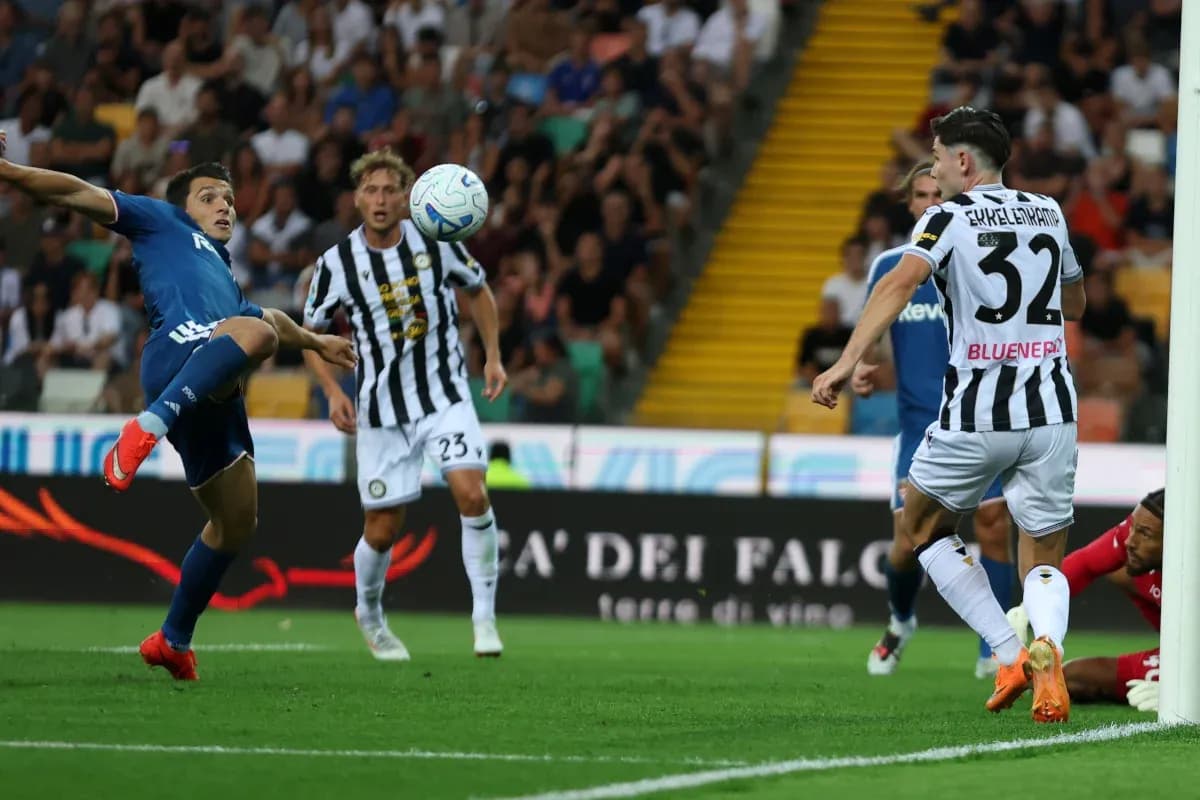
Under the Friulian sky at Bluenergy Stadium – Stadio Friuli, Udinese and Como opened their 2026 Serie A campaigns with a 1–1 draw that felt less like a conclusion and more like the prologue to two distinct tactical stories. Following this result, Udinese sit 9th and Como 8th, both on 1 point with a goal difference of 0, but the routes they took to that shared outcome reveal contrasting identities that will shape the season ahead.
I. The Big Picture – Structures and Seasonal DNA
Udinese under Kosta Runjaic set their stall out in a 3-4-2-1, a shape that immediately framed the evening as a test of structure versus fluidity. With M. Okoye behind a back three of J. Abankwah, M. Palma and O. Solet, the hosts built a solid, if still gelling, defensive platform. Ahead of them, the wing-backs M. Vojvoda and H. Kamara flanked the double pivot of J. Karlstrom and J. Piotrowski, while N. Zaniolo and J. Ekkelenkamp floated behind lone forward I. Gueye.
Runjaic’s choice was not just about numbers. It spoke to Udinese’s early-season profile: heading into this game they had played 1 match, all of it at home, scoring 1.0 goals at home on average and conceding 1.0 at home. The 3-4-2-1 is an attempt to raise that attacking ceiling without sacrificing the defensive balance that kept them unbeaten.
Como, guided by Cesc Fabregas, answered with a 4-2-3-1 that bore the fingerprints of a possession-minded midfielder turned coach. J. Butez started in goal, shielded by a back four of Y. Couto, J. Ramon, T. Chalobah and A. Valle. In front of them, the double pivot of M. Perrone and L. Milla supported an attacking trio of N. Paz, M. Baturina and J. Rodriguez behind centre-forward T. Douvikas.
For a side whose only league action so far has come on their travels, Como’s numbers are symmetrical: on their travels they average 1.0 goal scored and 1.0 conceded, with 1 away draw from 1 away match. The 4-2-3-1 is their vehicle for controlled risk, aiming to survive defensively while giving their front four the freedom to improvise.
II. Tactical Voids – Absences and Discipline
Both coaches had to navigate key absences that subtly reshaped their plans.
Udinese were without A. Buksa (inactive), G. Chakvetadze (foot injury), C. Kabasele (suspended after a red card) and A. Zanoli (knee injury). The loss of Kabasele in particular forced Runjaic to lean on the youth and mobility of Abankwah and Palma in the back three, prioritising recovery pace and front-foot defending over pure experience. Without Chakvetadze’s creativity, there was more onus on Zaniolo and Ekkelenkamp to stitch play between the lines.
Como’s list was shorter but no less significant: J. Addai missed out with an Achilles tendon injury, trimming Fabregas’s attacking rotation and making Douvikas’s durability and efficiency even more crucial.
Disciplinary trends offer an early-season warning light for Udinese. Across their opening match, all of their cards have been yellow, but the timing is revealing: 33.33% of their yellows came between 16–30 minutes, another 33.33% between 31–45, and 33.33% between 91–105. That spread suggests a side that starts aggressively, then strains again in the closing phases as legs tire and structure loosens.
Individually, Unai Gómez, Piotrowski and Abankwah have each taken a yellow. Gómez’s caution came despite only 11 minutes on the pitch, underlining his combative edge. Piotrowski, who completed 30 passes at a 96% accuracy, mixes calm distribution with a willingness to step into duels. Abankwah, who blocked 2 shots and engaged in 6 duels, embodies the risk-reward profile of Udinese’s back line: proactive, but occasionally overzealous.
Como, by contrast, have yet to pick up a yellow or red in the league. It is a small sample, but it fits the image of a Fabregas side that wants control through the ball rather than chaos without it.
III. Key Matchups – Hunter vs Shield, Engine Room Battles
Hunter vs Shield
In the Como shirt, T. Douvikas has already marked himself as one of Serie A’s early hunters. With 1 goal in 1 appearance, he has been ruthlessly direct: 3 shots, all 3 on target, and a rating of 6.6 while leading the line for the full 90 minutes. His profile is that of a penalty-box forward who needs only a handful of touches to tilt a game.
Across from him, Udinese’s “shield” is not one man but the collective of Okoye, Abankwah, Palma and Solet. Following this result, Udinese’s overall defensive record stands at 1 goal conceded in 1 match, with an average of 1.0 goal conceded at home. The early evidence suggests a defence that can limit volume but is still vulnerable to single, high-quality chances – precisely the kind Douvikas thrives on.
Abankwah, in particular, is central to this duel. He won 3 of his 6 duels and blocked 2 shots, showing a willingness to step in front of danger. But every step is a gamble against a striker like Douvikas, whose 9 total duels and 1 drawn foul show he is comfortable wrestling with centre-backs as much as he is finishing moves.
Engine Room – Playmaker vs Enforcer
For Udinese, the creative heartbeat is J. Ekkelenkamp. From his advanced role, he has already delivered 1 assist and 1 key pass, completing 30 passes at 70% accuracy and attempting 4 dribbles. He is less a classic No. 10 and more a hybrid: pressing from the front, dropping into half-spaces, and linking with Kamara and Zaniolo.
On Como’s side, the stabilisers are Perrone and Milla. They are tasked with a double mission: screening the back four and ensuring clean progression into the feet of Paz, Baturina and Rodriguez. Their success is not yet fully captured in raw numbers, but their positioning in the 4-2-3-1 is the hinge on which Como’s balance rests.
Against Udinese’s double pivot of Karlstrom and Piotrowski, this becomes a chess match. Karlstrom’s metronomic passing and Piotrowski’s vertical bursts ask constant questions of Perrone and Milla: step up and risk leaving space behind, or sit off and allow Ekkelenkamp to receive between the lines?
Meanwhile, on the flanks, Kamara has already emerged as a two-way force. With 1 goal, 3 tackles and 2 interceptions, he has shown he can both finish attacks and break them up. His duel with Y. Couto on Como’s right side is a stylistic clash: Kamara driving aggressively into space, Couto looking to overlap and stretch Udinese’s back three.
IV. Statistical Prognosis – Margins, xG Logic and Defensive Solidity
Even without explicit xG values, the early-season shot and goal profiles sketch the outline of how these sides might evolve.
Udinese’s overall scoring average of 1.0 goal per match, combined with 0 clean sheets in total and 0 matches failed to score, paints them as a team that will rarely be dull. They find a way to create – through Kamara’s late surges, Ekkelenkamp’s combinations, or Zaniolo’s individual quality – but they have not yet found a way to close the door completely at the other end.
Como mirror that profile on their travels: 1.0 goal scored and 1.0 conceded away, 0 clean sheets and 0 matches where they have failed to score. Fabregas’s side appears destined for tight margins, where Douvikas’s efficiency and the discipline of the back four decide whether a 1–1 becomes a 2–1 or a 0–1.
Penalties are not yet a factor for either team. Udinese have taken 0 penalties in total, scoring 0 and missing 0; Como are identical, with 0 penalties taken, 0 scored and 0 missed. Any future spot-kick will therefore carry a psychological weight that numbers cannot yet predict.
Following this result, both Udinese and Como walk away with the same tangible reward – 1 point, a neutral goal difference of 0 (1 goal for, 1 against) – but very different questions. Can Runjaic tighten a defence that occasionally lives on the edge without blunting the thrust of Kamara and Ekkelenkamp? Can Fabregas maintain Como’s composure on their travels while giving Douvikas and his supporting cast enough volume of chances?
The answers will not come from a single evening in Udine. But the shapes, the duels and the numbers we have already seen suggest that when these two teams cross paths again, the story will once more be written in the narrow space between risk and control.