.svg&w=384&q=75 "Naijagoal logo")
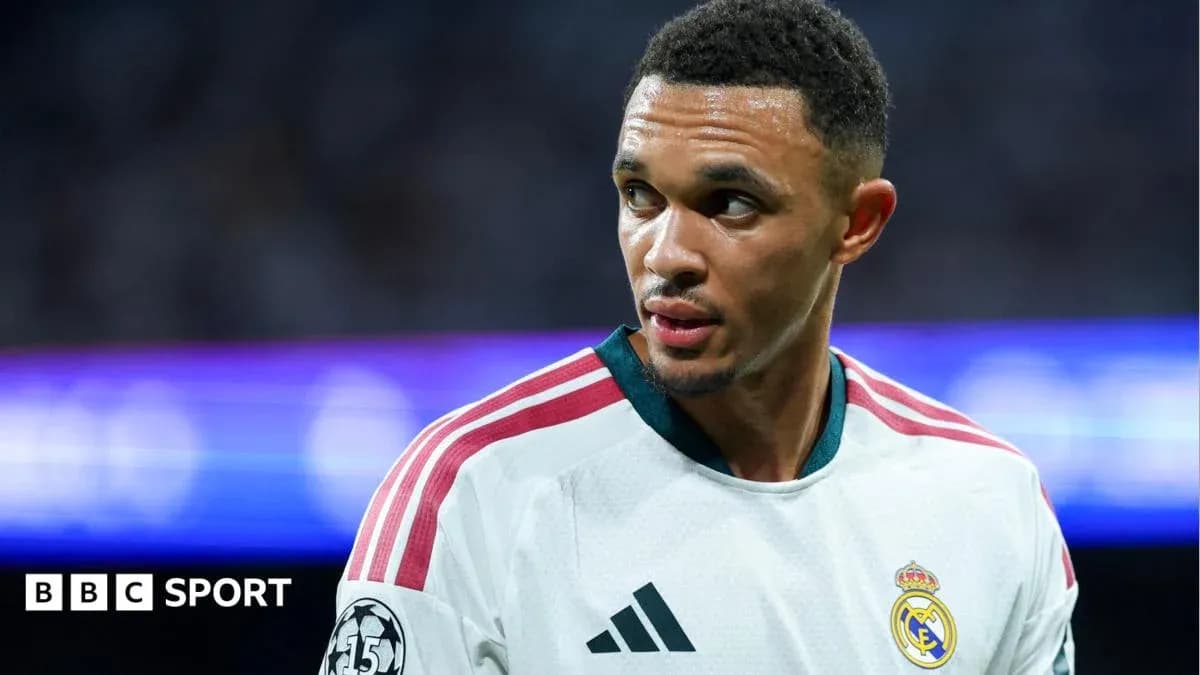

Trent Alexander-Arnold's Midfield Experiment with Mourinho
The Trent question just will not die.
Can Trent Alexander-Arnold really work in midfield?
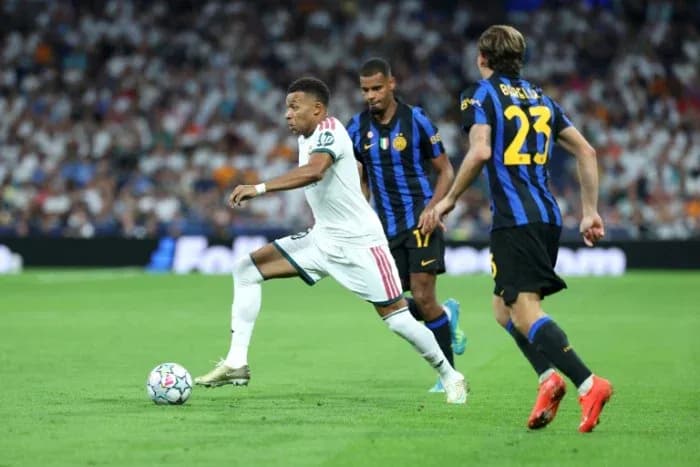
Gareth Southgate tried it at Euro 2024, then quietly shelved the idea after two group games. Jurgen Klopp built an entire Liverpool structure around him drifting inside, dictating from those hybrid zones while still nominally a right-back. Now it is Jose Mourinho’s turn to experiment, dropping him into the centre of Real Madrid’s midfield for a tight Champions League win over Inter Milan on Tuesday night.
Different country, different shirt, same debate.
Mourinho’s midfield gamble
Alexander-Arnold, 27, has not yet nailed down the right-back spot at the Bernabeu since arriving last summer. Dani Carvajal last season, Denzel Dumfries this – the competition has never really gone away. So when Mourinho named him in midfield against Inter, it felt less like a grand reinvention and more like a necessity.
Real were stripped bare in the middle of the pitch. Eduardo Camavinga, Arda Guler and Bernardo Silva were all suspended, leaving Mourinho short of options and short on time. The solution was pragmatic: Alexander-Arnold alongside Federico Valverde, with the Englishman asked to stitch the game together from deeper areas.
He did some of it well. He created two chances, slung in more crosses than any other Real player and tried to inject tempo into a laboured performance. His passing accuracy, though, dipped to 83.3%, and he failed to win a single tackle. The numbers told the story of a player still feeling his way into a role that looks familiar on paper but very different in practice.
When Inter pulled a goal back on 77 minutes, Mourinho turned to his bench. Alexander-Arnold’s number went up. As he left the pitch, whistles crackled around the stadium – an outpouring of irritation that seemed aimed more at Madrid’s overall display than at one player, but a reminder all the same of the scrutiny he lives under.
Mourinho’s verdict was blunt.
“He has played midfield with England and Liverpool... but he is not a midfielder,” he said after the 2-1 win. The Portuguese coach praised his tactical discipline and work with Valverde, calling himself “very grateful” for the effort, but he also drew a clear line. This was a solution for a specific night, not the blueprint for a new era.
A full-back who refuses to stay in his lane
That does not mean Mourinho is unconvinced by Alexander-Arnold. Far from it. Those inside the club say he has been impressed by the England international’s performances, his attitude and, crucially, his flexibility.
Mourinho sees him as a different breed of full-back – one who naturally drifts into central zones, who can hurt teams with passes usually reserved for playmakers. His delivery from set pieces, his crossing, his eye for a through ball: these are still the sharpest tools in his box.
That hybrid quality has defined his career. At Liverpool, he often appeared in midfield positions without ever being officially listed there. Under Mourinho, the pattern is similar. Real’s coach still has no fixed first-choice right-back, rotating and reshaping that flank. Last season it was a battle with Carvajal; this season, Dumfries has entered the frame.
On Tuesday, it was the first time Alexander-Arnold and Dumfries had started a competitive game together. Mourinho had already tested the pairing in pre-season against Fiorentina, with Alexander-Arnold at right-back and Dumfries pushed higher on the same side. Against Inter, he pushed the Englishman inside instead.
It underlined a simple truth: Mourinho values what Alexander-Arnold can give him in different zones. But he remains, in his manager’s eyes, a defender first.
England’s midfield experiment that fizzled out
The Real Madrid trial carried echoes of Southgate’s own midfield project with England.
In June 2023, Alexander-Arnold wore the number 10 shirt for a Euro 2024 qualifier in Malta. England won 4-0, he scored from midfield and looked at ease operating centrally. Speaking to Channel 4 afterwards, he admitted he had not played there much but said the role felt “comfortable” and “natural”, a position where he could imagine his future.
Southgate liked the idea enough to keep revisiting it over the following year. He nudged Alexander-Arnold into central areas, searching for a way to harness that passing range in the tightest games. Then came Euro 2024. The grand test.
It did not last long. After an underwhelming 1-1 draw with Denmark in the group stage, Southgate hooked him before the hour. The experiment quietly ended, and with it the notion – for now – of Alexander-Arnold as England’s long-term central midfielder.
Mourinho, watching his own version of that experiment unfold against Inter, sounded many of the same notes.
“He has lost some balls because it is not the same to play in this position compared to at right-back,” he said. “The intensity of physical work is quite difficult. He has a different engine. He has given 100%. He left the pitch with nothing left to give.”
The effort was never in doubt. The fit still is.
A role that keeps chasing him
Alexander-Arnold cannot escape midfield. Managers keep dragging him towards it, seduced by his vision, his range, the way he can slice a defence open from 40 yards. Yet when the stakes rise, when tournaments or Champions League nights tighten, they almost always pull him back to the flank.
At the Bernabeu, the pattern looks set to continue. Mourinho appreciates his versatility, trusts his quality and, on nights like this one, will not hesitate to use him in the middle. But his own words were clear: this is a useful option, not a permanent conversion.
So the question lingers, as it has for years now. Is Trent Alexander-Arnold a full-back who steps into midfield, or a midfielder trapped in a full-back’s shirt?
For the moment, under Mourinho and under these lights, the answer still leans towards the touchline.