.svg&w=384&q=75 "Naijagoal logo")
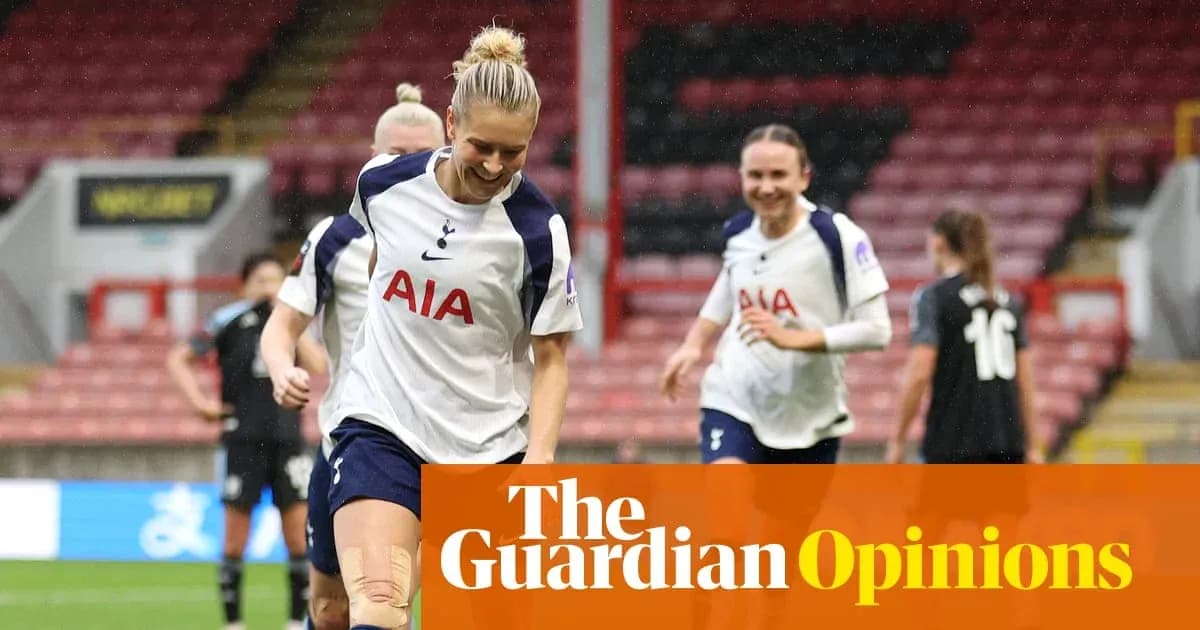

Tottenham Women Rewrite the Script: A New Standard in N17
For much of last season, Tottenham’s women offered something precious to a fanbase drowning in angst: joy. While the men’s side didn’t just flirt with relegation but seemed ready to settle down with it, the women played with freedom and purpose, quietly putting together the best Women’s Super League campaign in the club’s history.
The contrast could hardly have been sharper. As the men spiralled, WhatsApp groups of long‑suffering season-ticket holders filled with tactical despair and transfer rage. Questions flew: why the endless sideways passing around the box? Where were the signings to patch the injury crisis? The mood was funereal.
Across town, though, another Spurs team were rewriting the script.
A new standard in N17
Tottenham Women’s season crackled with incident. A 7-2 demolition of Aston Villa, the kind of scoreline that belongs to another era. An FA Cup epic against London City Lionesses that descended into a penalty shootout of almost surreal precision: 17 consecutive spot-kicks converted before anyone blinked. A 40-yard thunderbolt from Cathinka Tandberg that felt less like a goal and more like a statement.
This wasn’t a fluke run from a plucky mid-table side. It was a team growing into itself.
The transformation has roots. Three years ago, one family decision mirrored a wider shift in English football. Inspired by the Lionesses’ run to the 2023 World Cup final, a household of Spurs supporters took out season tickets for the women’s side. In Brisbane, after England edged Colombia 2-1 in the quarter-finals, Colombia fans detoured through the fan zone to shake hands with the tiny England contingent. Around 2,000 Colombia supporters. Roughly 20 England fans. Respect, not rancour. That felt like the kind of football environment you’d want a child to grow up in.
That same spirit now runs through Tottenham Women’s matchdays.
Martin Ho’s imprint
The most obvious catalyst for Spurs’ rise arrived in the dugout. Martin Ho, previously an assistant at Manchester United and head coach of Norwegian side Brann, took charge last year and immediately imposed structure without strangling creativity.
Players, by all accounts, like him. They respect him. That matters, but what really shows is the football. Spurs now attack with intent and defend with clarity. Each player seems to know her lane, her angles, where the support will come from. The chaos of previous seasons has given way to something sharper.
Ho hasn’t hidden in an office either. At Leyton Orient, where Spurs Women play most of their home fixtures, he has been known to wander through the “Legends Lounge” before games, chatting with supporters. It’s a small gesture, but it bridges the gap between touchline and terrace in a way that fits this team’s identity.
The impact on the pitch has been stark. Two seasons ago, Tottenham laboured through a grim campaign, finishing just one place above the drop and prompting the departure of Robert Vilahamn. Last season they burst out of the blocks, winning five of their first six league matches. No one outside the dressing room knows exactly what Ho said to reboot a squad that had underperformed so badly, but whatever the message, it clearly wasn’t an Igor Tudor-style demolition of his own players.
Tottenham attacked, defended and ran with conviction. All year.
Eveliina Summanen knitted play together. Amanda Nildén and Clare Hunt brought steel and composure. Lize Kop offered assurance in goal. Drew Spence added experience and edge. This was not a one-woman show but a functioning, balanced side.
Smart recruitment, sharper edge
Recruitment has underpinned the shift. Olivia Holdt arrived and promptly became Spurs’ top scorer from midfield, adding a cutting edge in the final third. Toko Koga anchored central defence, a calm presence in the most unforgiving part of the pitch. In January, Signe Gaupset joined and started charging through midfield with the ball, turning defence into attack in a few purposeful strides.
Even the setbacks carried context. Spurs were comfortably beaten a couple of times by Manchester City, but City possess Khadija “Bunny” Shaw, whose goals-per-game numbers outstrip even Erling Haaland’s. City went on to win the league ahead of Arsenal, Chelsea and Manchester United – the established WSL superpowers.
Tottenham finished fifth, just behind that elite quartet. For a club still relatively new to the top tier, that position felt less like a ceiling and more like a platform. Cracking the top four no longer sounds fanciful. It feels like a timeline question.
The response at board level has matched that ambition. Within days of the season ending, Spurs moved decisively in the market. Netherlands international Caitlin Dijkstra arrived from Wolfsburg to strengthen the back line. Germany’s Shekiera Martinez, who had shown a ruthless streak in front of goal at a struggling West Ham, came in to sharpen the attack. Kirsty Hanson joined from Aston Villa, Alice Sombath from OL Lyonnais – proven operators to deepen a squad now expected to compete, not just survive.
Farewells and foundations
Progress always comes with a price. Saying goodbye to Bethany England and Ashleigh Neville has hurt. Neville’s decision to move to Leicester to be closer to home makes sense on a human level, but England’s exit is harder to process. She is the club’s record goalscorer, a player who helped drag Spurs forward, and the lack of even a one-year extension jars with many supporters.
Still, the squad that starts the new campaign will look dramatically different from the one some fans first fell in love with three years ago. The constant is not the names on the teamsheet. It’s the people in the stands.
The core of Tottenham Women’s support is fiercely knowledgeable. Many have followed both the men and women for years, writing blogs, recording podcasts, travelling to West Ham away to stand in the rain and question their life choices. Some were there when the club was known as Broxbourne Ladies, a small outfit grinding through the lower leagues with barely more than a smattering of followers. They have watched this story from the opening chapter.
The payoff is not just the football. It’s the atmosphere.
A different kind of matchday
At Spurs Women games, frustration still bubbles up. Referees are still asked, with mock politeness, whether they have recently visited a famous high-street optician. But the seething anger, the industrial language that often engulfs men’s fixtures, is largely absent. Families sit together without bracing for a barrage of abuse. The noise feels intense without turning toxic.
Before kick-off, banners of Spurs players draped with the Progress Pride flag are unfurled in the stands. It’s not tokenism; it’s a visual statement that LGBTQIA+ identities are part of the fabric of this club, not an add-on. For some fans, that has been an awakening – a reminder that football can be a force for inclusion rather than a refuge for the worst instincts in the game.
On the pitch, the product holds up. Women’s football may be fractionally slower than the men’s, but the matches are brisk, open and – crucially – free of VAR. That means the odd glaring refereeing mistake, yes, but it also means no five‑minute waits in the cold while a disembodied official draws lines on a screen. Decisions stand. Emotions stay raw.
As Tottenham Women step into another season, the momentum is real. The football is bold, the recruitment ambitious, the connection between team and supporters unusually strong. Crowds are growing, and there is room for many more.
The men may yet sort themselves out. They usually threaten to, eventually. But right now, for anyone wanting to feel what football can be at its best – competitive, inclusive, human – it’s hard to look past the side in lilywhite who play their home games at Leyton and dream of breaking the WSL’s glass ceiling.