.svg&w=384&q=75 "Naijagoal logo")

Tottenham vs Everton: A Premier League Identity Check
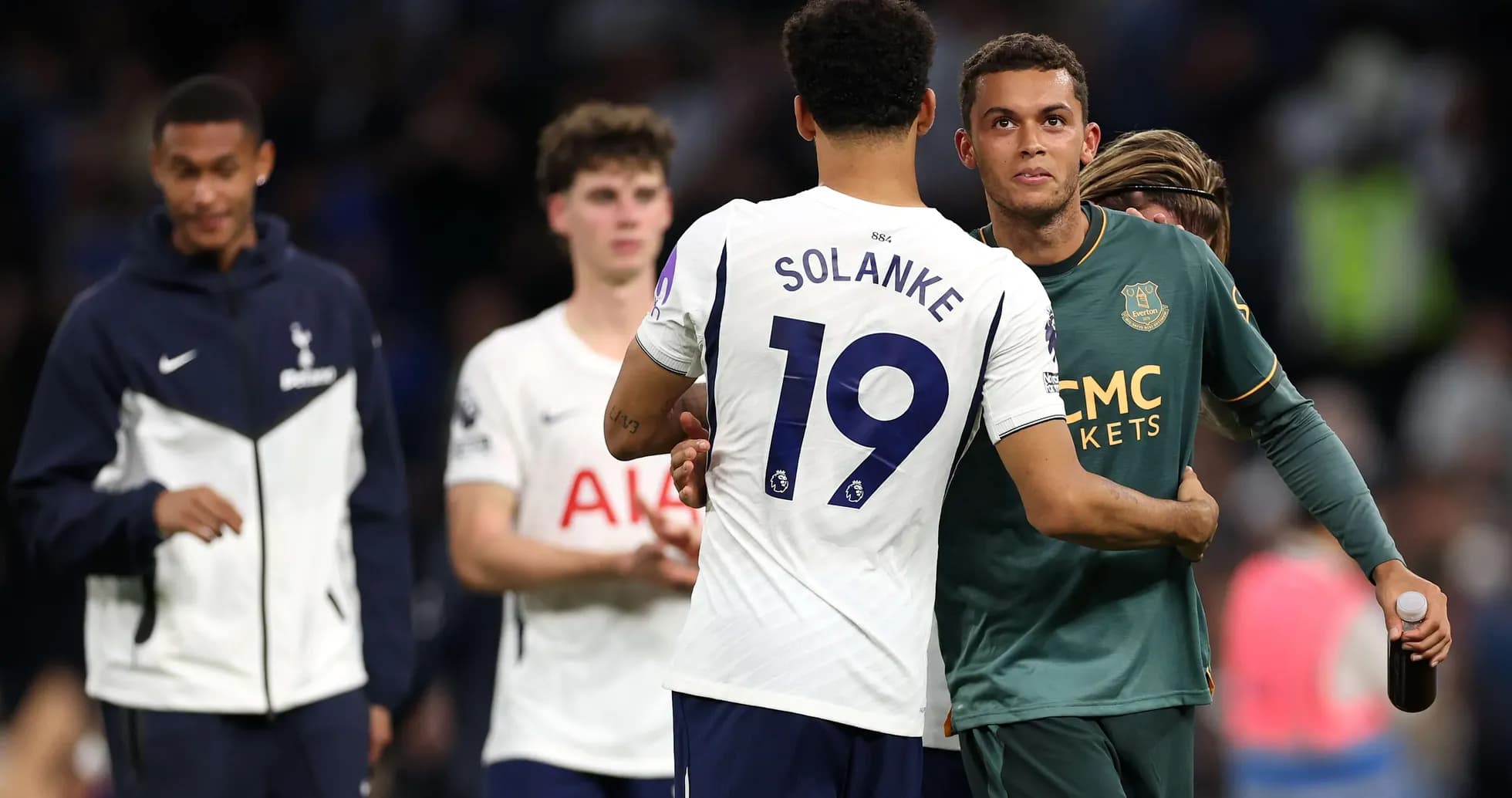
Under the grey September sky at Tottenham Hotspur Stadium, this felt less like Round 4 of a long Premier League season and more like an early identity check. Tottenham, 17th in the table with 2 points and a goal difference of -5, came into this fixture scoreless overall and searching for conviction. Everton arrived in London in a very different mood: unbeaten, 8th in the standings with 6 points, and quietly confident behind a balanced return of 5 goals scored and 3 conceded overall.
Both managers doubled down on a shared language: 4-2-3-1 on each side of the halfway line. But the similarities ended there. For Roberto De Zerbi, the shape was a canvas for control and rehabilitation; for David Moyes, it was a framework of compactness and counter-punching.
Tottenham: Structure without a cutting edge
Tottenham’s season-long numbers framed the narrative before a ball was kicked. Heading into this game, they had played 4 league matches overall, failed to score in all 4, and yet kept 2 clean sheets. At home they had played 2, drawn 1, lost 1, scored 0 and conceded 2. On their travels, it was the same attacking blank: 2 played, 1 draw, 1 defeat, 0 scored, 3 conceded. The clean sheets and the 0.0 goals-for average overall painted a team that could organise but not yet hurt.
De Zerbi’s lineup underlined that tension. A. Kinský in goal was shielded by a back four of A. Robertson, M. van de Ven, J. van Hecke and A. Gray – a blend of progressive full-back play and aerial assurance. In front, the double pivot of R. Bentancur and S. Tonali suggested a desire to dictate tempo rather than simply destroy. Ahead of them, Sávio, Mateus Fernandes and Omar Marmoush floated behind lone striker D. Solanke.
On paper, it is a side built to circulate and probe. In practice, Tottenham’s season data shows a team that has repeatedly moved the ball into sterile areas. The biggest defeats – 0-2 at home and 3-0 away – confirm that when they overcommit, they are punished without the compensation of goals at the other end.
The absentees only sharpened the problem. Dejan Kulusevski (knee injury), Mykhailo Mudryk (ankle injury), W. Odobert (knee injury) and X. Simons (knee injury) all missed out, stripping De Zerbi of directness, 1v1 threat and final-third invention. Richarlison’s absence due to transfer negotiations removed a natural penalty-box focal point and a different profile to Solanke. The result is a squad heavy on technical midfielders but light on established end-product.
Even Tottenham’s disciplinary profile hints at a team chasing games late. Overall, 40.00% of their yellow cards have arrived between 76-90 minutes, with further bookings spread evenly across the first hour. It suggests a side that grows increasingly stretched and desperate as matches drift away from them.
Everton: Compact, disciplined, quietly confident
Everton travelled with a far more solid foundation. Overall they had played 4, won 1, drawn 3, lost none, scoring 5 and conceding 3. At home they had played 2, with 1 win, 1 draw, 4 scored and 2 conceded. On their travels they had played 2, drawn both, scoring 1 and conceding 1 – a stubborn away profile built on control of risk.
Moyes mirrored the 4-2-3-1 but with a different emphasis. J. Pickford anchored a back four of A. Maitland-Niles, J. Tarkowski, J. Branthwaite and V. Mykolenko – a unit designed to defend the box first, pass second. In midfield, H. Armstrong and J. Garner formed a double pivot that could both screen and step out.
Ahead of them, B. Johnson and K. Dewsbury-Hall provided the connective tissue between lines, with Tyrique George supporting T. Barry up front. It is not a forward line stacked with proven Premier League finishers, but the collective has already produced 5 goals overall, with a striking split: 4 at home, just 1 away. On their travels, Everton’s 0.5 goals-for average overall is modest, but paired with 0.5 goals-against overall it underpins their unbeaten start.
Garner, in particular, emerges as the heartbeat of this Everton side. With 4 appearances and 240 minutes, he has completed 128 passes with 3 key passes and an accuracy of 90, while contributing 11 tackles and 2 interceptions. He has committed 4 fouls and drawn 5, picking up 2 yellow cards but no reds. The disciplinary data across the team shows a spread of cautions, with 28.57% of yellows arriving between 61-75 minutes and 14.29% in each of the 0-15, 31-45, 46-60, 76-90 and 91-105 ranges. This is a side that rarely loses its head, even as fatigue sets in.
The main absentee, C. Norgaard (injury), deprived Moyes of another defensive-minded midfielder, but the structure remained intact. With Pickford’s authority behind a settled back line and Garner’s metronomic presence, Everton arrived as a team that knows exactly what it is.
Tactical voids and key duels
The most glaring tactical void was Tottenham’s missing verticality. Without Kulusevski, Mudryk, Odobert or Simons, De Zerbi was forced to lean on Sávio and Marmoush to stretch the pitch. Both can drift into pockets, but neither replaces the sheer volume of direct carries and shots those absentees would normally generate. Solanke, isolated at times, needed precise service from wide and late runs from Mateus Fernandes to avoid being swallowed by Tarkowski and Branthwaite.
For Everton, the absence of Norgaard slightly reduced their capacity to form a low block of three in front of the centre-backs. That placed more responsibility on Armstrong to hold his position and on Dewsbury-Hall to choose his moments to press. But the numbers – just 3 goals conceded overall and 1 away – suggest a collective understanding of when to drop and when to spring.
Two duels defined the tactical chessboard.
First, the “Hunter vs Shield”: Solanke against Everton’s central defence. Tottenham had yet to score overall, while Everton’s away record showed just 1 goal conceded in 2 matches. Tarkowski’s command of the box and Branthwaite’s timing in duels created a barrier Tottenham had to break through with combinations, not hopeful crosses. Without a history of goals this season, Solanke needed support runs from Bentancur and Marmoush to generate second balls and cut-backs rather than aerial battles.
Second, the “Engine Room”: Tonali and Bentancur against Garner and Armstrong. Tottenham’s inability to score is not just a finishing problem; it is a progression issue. If Tonali and Bentancur could not consistently play through or around Everton’s double pivot, Spurs would be condemned to sterile possession in front of the block. Garner’s data – high passing volume, strong duel numbers, disciplined fouling – pointed to a midfielder capable of both disrupting and launching counters. Every time Tottenham’s midfield lost the ball in the inside channels, Johnson and Dewsbury-Hall were positioned to turn those moments into transitions aimed at Barry and George.
Statistical prognosis and narrative arc
With no penalty goals and no penalties missed for either side this season, there was little expectation of the game being decided from the spot. Instead, the numbers suggested a low-scoring contest defined by Tottenham’s attacking paralysis and Everton’s compact resilience.
Tottenham’s overall average of 0.0 goals scored and 1.3 conceded, combined with Everton’s 1.3 scored and 0.8 conceded overall, pointed towards a marginal advantage for the visitors in terms of underlying balance. Yet Everton’s drastic drop in attacking output away from home – from 2.0 goals per game at home to 0.5 on their travels – hinted that they would prioritise not losing over overcommitting.
In that light, the 0-0 full-time scoreline at Tottenham Hotspur Stadium felt like the logical extension of both teams’ seasonal DNA. Tottenham once again found structure without incision; Everton once again found a way not to lose. Following this result, Spurs’ clean-sheet tally grows, but so too does the anxiety around their blunt edge. Everton extend their unbeaten run, their away record now built on three pillars: organisation, discipline, and a willingness to accept that sometimes, in a long campaign, a point on the road is the most rational outcome.