.svg&w=384&q=75 "Naijagoal logo")

Bournemouth vs Liverpool Match Analysis: Tactics and Trends
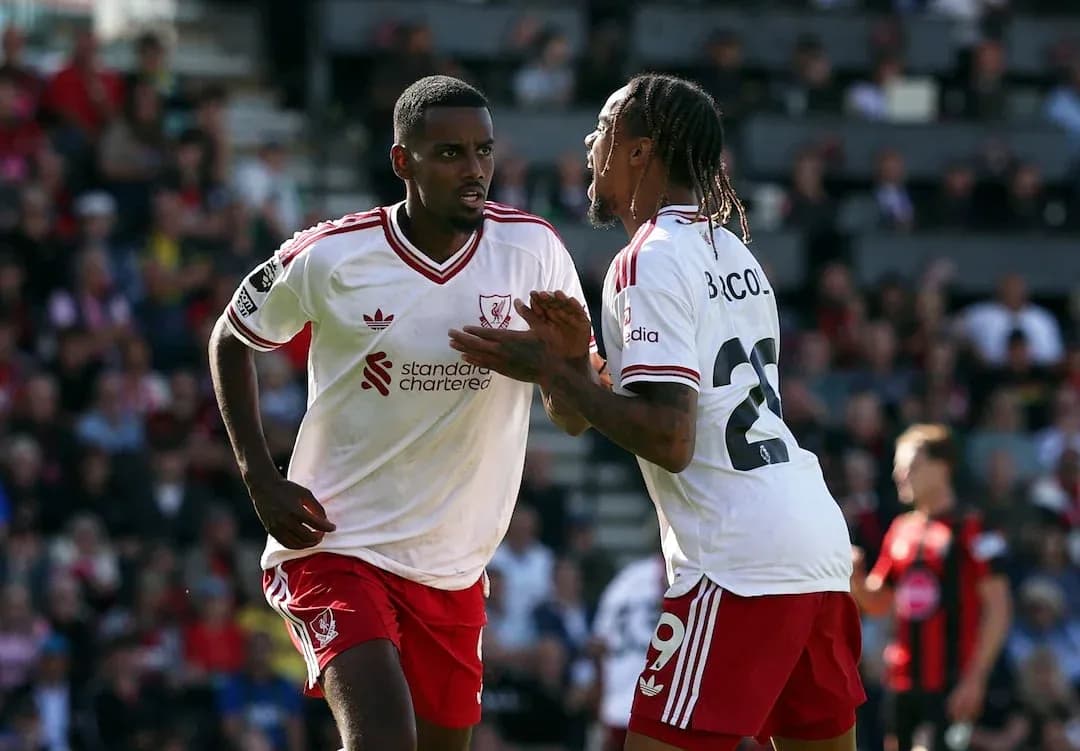
The Vitality Stadium felt tight and tense as Bournemouth and Liverpool emerged in matching 4-2-3-1 shapes, but with very different agendas. For Bournemouth, 17th in the Premier League with 3 points from 5 matches, this was about survival and belief. For Liverpool, 6th with 9 points and still unbeaten, it was about turning control into a sustained top‑end push. The 1–0 away win reflected those trajectories: narrow on the scoreboard, but underpinned by structural differences that have defined their seasons so far.
Bournemouth’s Season Profile
Heading into this game, Bournemouth’s season-long profile was clear. Overall, they had played 5, without a single win: 3 draws and 2 defeats. Their overall goal difference of -2 came from 6 goals scored and 8 conceded. At home, they had drawn 2 and lost 1, scoring 3 and conceding 4; on their travels, they had the same 3 goals for but 4 against. The numbers painted a side that can trade punches – 1.2 goals for per game overall, with 1.0 at home and 1.5 away – but cannot yet control the damage, conceding 1.6 per game overall, 1.3 at home and 2.0 away, with no clean sheets anywhere.
Liverpool’s Season Profile
Liverpool arrived as the mirror opposite. Overall they had also played 5, but with 2 wins and 3 draws, still unbeaten. Their overall goal difference of +3 came from 7 scored and 4 conceded. At home they had drawn both games, scoring and conceding 2; on their travels they were far more ruthless, with 2 wins and a draw, 5 goals scored and only 2 conceded. Their attacking average away – 1.7 goals per game – combined with just 0.7 conceded away and 2 clean sheets on the road underlined why this fixture always tilted their way, even if the final scoreline stayed tight.
Managerial Continuity
Both managers leaned into continuity. Bournemouth’s five league games had all come in a 4-2-3-1, and again they lined up that way under M. Rose. Đ. Petrović started in goal behind a back four of A. Smith, J. Hill, António Silva and A. Truffert. In front of them, T. Adams and A. Scott formed the double pivot, with a fluid three of Rayan, R. Christie and M. Tavernier supporting lone striker Evanilson.
The absences only deepened the load on that group. Bournemouth were without A. Adli (calf injury), J. Araujo (thigh injury), J. Kluivert (injury), E. J. Kroupi (foot injury) and V. Milosavljevic (injury). That stripped Rose of rotation options in wide and attacking areas, and it showed in how much creative burden fell on Tavernier and Evanilson.
Liverpool, also locked into a 4-2-3-1 all season, mirrored the shape but with a different personality. Alisson Becker was shielded by R. Araújo, J. Jacquet, V. van Dijk and M. Kerkez. D. Szoboszlai and A. Mac Allister formed a high‑class double pivot, with C. Gakpo, F. Wirtz and B. Barcola behind A. Isak. Andoni Iraola had to do without C. Bradley (knee), F. Chiesa (back), H. Ekitike (Achilles tendon) and G. Leoni (knee), but the starting XI still crackled with technical quality.
Key Matchups
The “Hunter vs Shield” duel was always going to be central. A. Isak arrived as one of the league’s sharpest forwards: 4 goals in 5 appearances, from 13 shots and 7 on target, with a rating of 7.47 and a willingness to work – 27 duels contested, 13 won, plus 2 shots blocked defensively. Against a Bournemouth side that, overall, conceded 1.6 goals per game and had yet to keep a clean sheet, the matchup tilted towards the Swede. Bournemouth’s defensive line, with J. Hill and António Silva at its heart, had to live on the edge of their box, compressing space, trusting Petrović and hoping their own attacking threat could keep Liverpool honest.
On the other side, Bournemouth’s own “Hunter” was M. Tavernier. With 3 goals in 5 matches and a rating of 7.52, he had been their standout, adding 12 shots (8 on target), 9 key passes and 11 tackles. He is also one of their most combative players, with 2 yellow cards already this season. His duel was less with a single defender and more with Liverpool’s structure: the screening of Mac Allister, the aggressive pressing of Szoboszlai, and the covering intelligence of Van Dijk. Tavernier’s tendency to drift inside from the left lane aimed to overload Liverpool’s right‑half space, where Gakpo’s forward instincts can occasionally leave gaps.
Midfield Dynamics
The “Engine Room” clash in midfield framed the game’s rhythm. Bournemouth’s T. Adams and A. Scott are industrious, but they were up against a Liverpool axis that combines control and incision. Mac Allister’s passing range (and calm under pressure) gives Liverpool a platform to recycle attacks, while Szoboszlai’s vertical running and shooting threat pins midfield lines back. Behind them, Liverpool’s back four is not just defensive cover: Kerkez, in particular, is a dynamic outlet on the left, with 3 shots, 8 tackles and 4 successful blocks this season, though his 2 yellow cards and 9 fouls committed show how aggressively he defends the wide channel.
Discipline and Late-Game Behaviour
Discipline and late‑game behaviour were another quiet fault line. Bournemouth’s yellow-card pattern shows a pronounced late‑game spike: 42.86% of their cautions come between 76–90 minutes, a classic marker of fatigue and chasing games. Liverpool, by contrast, are at their most combustible just after the break, with 50.00% of their yellows arriving between 46–60 minutes. That temporal contrast mattered: a Bournemouth side likely to tire and lunge late against a Liverpool team that tends to front‑load their intensity.
Statistical Prognosis
From a statistical prognosis point of view, the contours were clear before a ball was kicked. Bournemouth, overall, score 1.2 per game but concede 1.6, with no clean sheets and only one match in which they failed to score. They are competitive but porous. Liverpool, overall, score 1.4 per game and concede just 0.8, with 3 clean sheets and only one game in which they have failed to score. On their travels, those numbers harden further in their favour: 1.7 goals for and 0.7 against, with 2 clean sheets in 3 away matches.
Layer in the individual quality – Isak’s finishing, Gakpo’s creativity (3 assists already, 11 key passes and 123 completed passes at 82% accuracy), Wirtz’s link play, versus a Bournemouth side leaning heavily on Tavernier and Evanilson (3 assists, 6 key passes, 56 duels contested) – and the probability curve always leaned Liverpool’s way.
Final Thoughts
The 1–0 final scoreline at the Vitality Stadium ultimately felt like the distilled version of both teams’ seasonal identities. Bournemouth were organised, committed and sporadically dangerous, but their structural fragility and late‑game disciplinary risk left them walking a tightrope. Liverpool, still unbeaten, carried the calm of a side whose numbers and talent base give them margin for error: they did not need to overwhelm Bournemouth, only to be themselves for long enough.