.svg&w=384&q=75 "Naijagoal logo")

Tottenham's Struggles: De Zerbi's Blueprint in Transition
Four games into the Premier League season and the numbers are brutal. Tottenham Hotspur, who have spent around £320million on new talent, much of it in attack, are yet to score. Coventry City are the only other side in the same boat.
So how can a team this expensively rebuilt look so blunt?
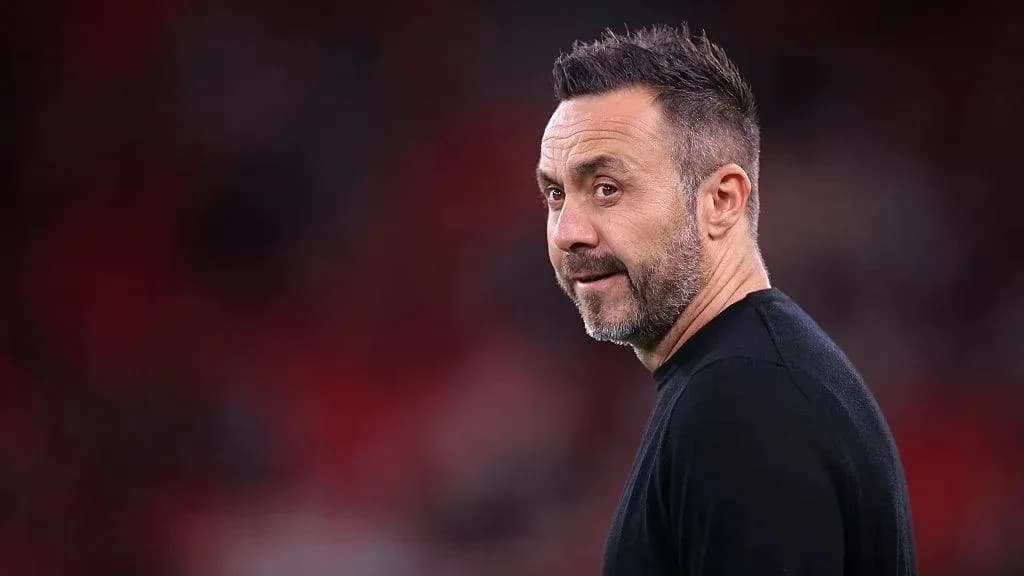
The answer lies less in a lack of ideas and more in a team still learning a demanding new way to play under Roberto De Zerbi.
De Zerbi’s blueprint, unchanged but adapted
The Premier League De Zerbi has returned to is not the one he left when he departed Brighton in 2024. But his core beliefs have travelled with him.
His teams invite pressure. They slow the game, roll the ball backwards, almost daring opponents to step up. Once the press comes, they spring forward, driving passes or carries into the spaces that open behind the first wave.
As De Zerbi put it in a 2020 coaching seminar: “The stronger the pressure of the opponent, the more vertical [our] action becomes. [The fewer opponents behind], the easier it becomes to go and score.”
The pattern is already visible at Spurs. Their forwards are finding themselves in bigger spaces, often facing fewer defenders. The problem is not reaching those zones. It is turning those promising situations into goals.
At Marseille, between 2024 and 2026, the same ideas produced an average of 2.3 goals per game. The structure works. Tottenham just haven’t joined the dots yet.
A complex shape, still being learned
On the ball, Spurs often resemble a 2-3-2-3. It is not always obvious at first glance, but the principles are clear.
Rodrigo Bentancur usually sits as the holding midfielder, stationed just ahead of the two centre-backs. Those three form a relatively fixed base. Ahead of them, the wingers, full-backs and central midfielders rotate, but the overall 2-3-2-3 framework remains.
When one player vacates a zone, another is expected to fill it. The shape matters as much as the name on the back of the shirt.
On top of that positional structure, De Zerbi layers his principles. He wants his teams to use the centre of the pitch, not skirt around it.
That is a major shift from the approach under Thomas Frank at the start of last season, when Spurs built almost exclusively down the flanks, effectively bypassing the middle to avoid dangerous turnovers. Now, those same players are being asked to take the ball in crowded central areas, under pressure, and play through that congestion.
It is not a minor adjustment. It is a complete rewiring of habits.
Playing through the middle – and the players who can do it
De Zerbi’s insistence on central play has a double effect.
When Spurs’ centre-backs have the ball and look to pass inside, opposition forwards and midfielders are drawn up the pitch. That opens pockets between the lines for Spurs’ attacking midfielders to receive. As the defending team narrows to deal with those threats, spaces appear out wide for direct wingers to attack.
But the whole mechanism relies on players who can receive under pressure, with bodies around them, and still make good decisions.
Some are better suited than others. Sandro Tonali, for instance, is more effective when he can face forward in larger spaces. So De Zerbi has often rotated him with Archie Gray, who starts at right-back but moves inside. It is a pragmatic tweak that reflects their skill sets.
Gray, just 20 and playing away from his natural role, has coped admirably in tight areas and seems to grasp what his manager wants.
The return of James Maddison, back from a shoulder injury for the Carabao Cup tie at Liverpool, should sharpen this further. Maddison is built for those pockets between the lines. His presence should help Spurs reach dangerous attacking zones more consistently.
But even with the right profiles, the system only clicks when everyone fully internalises the instructions. That takes time, especially for a squad conditioned under previous coaches to avoid risk in central areas. De Zerbi is asking them to embrace it.
The missing pass
Spurs are not struggling to break pressure. They are struggling with what comes next.
Time and again, their build-up has taken them into promising positions behind opposition midfields. The problem is converting those situations into clear chances.
There are three steps: spotting the best pass, having the movement ahead to make that pass worthwhile, and then executing it.
Right now, the main blockage is at the first stage. Too often, Spurs players are either not seeing the through ball or choosing not to play it. The runs are there, especially from Omar Marmoush, whose movement in behind has generally been sharp. The ball just does not always follow.
Gray has tried to slide passes down the line, but those central, defence-splitting balls have been rarer.
Pedro Porro could change that. For Spain, on their way to winning the World Cup this summer, he often took up central positions in possession and showed his natural instinct to create. As he settles back into the Tottenham side, those same tendencies should dovetail neatly with De Zerbi’s demands.
If that happens, Spurs might start to see the kind of joy De Zerbi’s forwards enjoyed at Marseille.
Runs, timing and the Marseille template
Movement off the ball is the other half of the equation.
At Marseille, De Zerbi’s teams regularly used diagonal runs from wide attackers on the last defensive line, found by vertical passes from deep. It was a simple idea, executed with precision.
Igor Paixao’s goal in a 2-2 draw with Toulouse last season summed it up: direct passing, well-timed movement, and a team fully in tune with the manager’s patterns.
Spurs are not there yet, but flashes are emerging. Against Liverpool in the Carabao Cup, Destiny Udogie repeatedly surged into threatening positions down the left as the game opened up.
Andy Robertson has been impressive for Tottenham this season, but Udogie’s power and timing gave Liverpool problems once the match became stretched, dragging Spurs into good crossing areas against a disorganised defence.
Those are the kinds of situations De Zerbi wants regularly, not sporadically.
Final ball, final detail
Even when Spurs do accelerate play and reach the final third, the moves are not always finished cleanly.
When an attacking team speeds up, defenders often retreat in a hurry, collapsing towards their own box. That retreat opens space just in front of the back line for late-arriving midfielders or strikers who cleverly drop off.
Marmoush has tried to exploit those zones, peeling away to receive cut-backs or low crosses. He has not consistently been picked out.
Some of this is chemistry. New players, new patterns, new preferences. That understanding does not appear overnight.
There are technical quirks too. Savio, a left-footed right-winger, is better at driving to the byline than cutting the ball back across goal on his weaker foot. On the opposite flank, left-footed Udogie and Robertson have produced clearer chances from crosses, more naturally swinging the ball into the box.
At Marseille, both the right winger and right full-back were comfortable cutting back on their stronger right foot. Those deliveries were then maximised by the penalty-box craft of Pierre-Emerick Aubameyang, whose movement at 37 remained razor sharp.
Spurs do not yet have that same level of harmony between crosser and finisher. But many of their attacks are one detail away from becoming high-quality chances.
Close, but not enough – yet
This is not a story of a broken attack. It is a story of an attack in transition.
The framework is there. The patterns are visible. The ball reaches promising zones often enough to suggest the ideas are sound. What is missing are the small details: the braver through ball, the sharper diagonal run, the cleaner cut-back, the instinctive finish.
Marseille’s forwards were ruthless and thrived in the spaces De Zerbi created for them. Tottenham’s new-look front line is still learning how to do the same.
Right now, the table says Spurs cannot score. The question is how long that statistic can survive once this group fully connects with a manager whose attacking football, when it lands, usually explodes.