.svg&w=384&q=75 "Naijagoal logo")
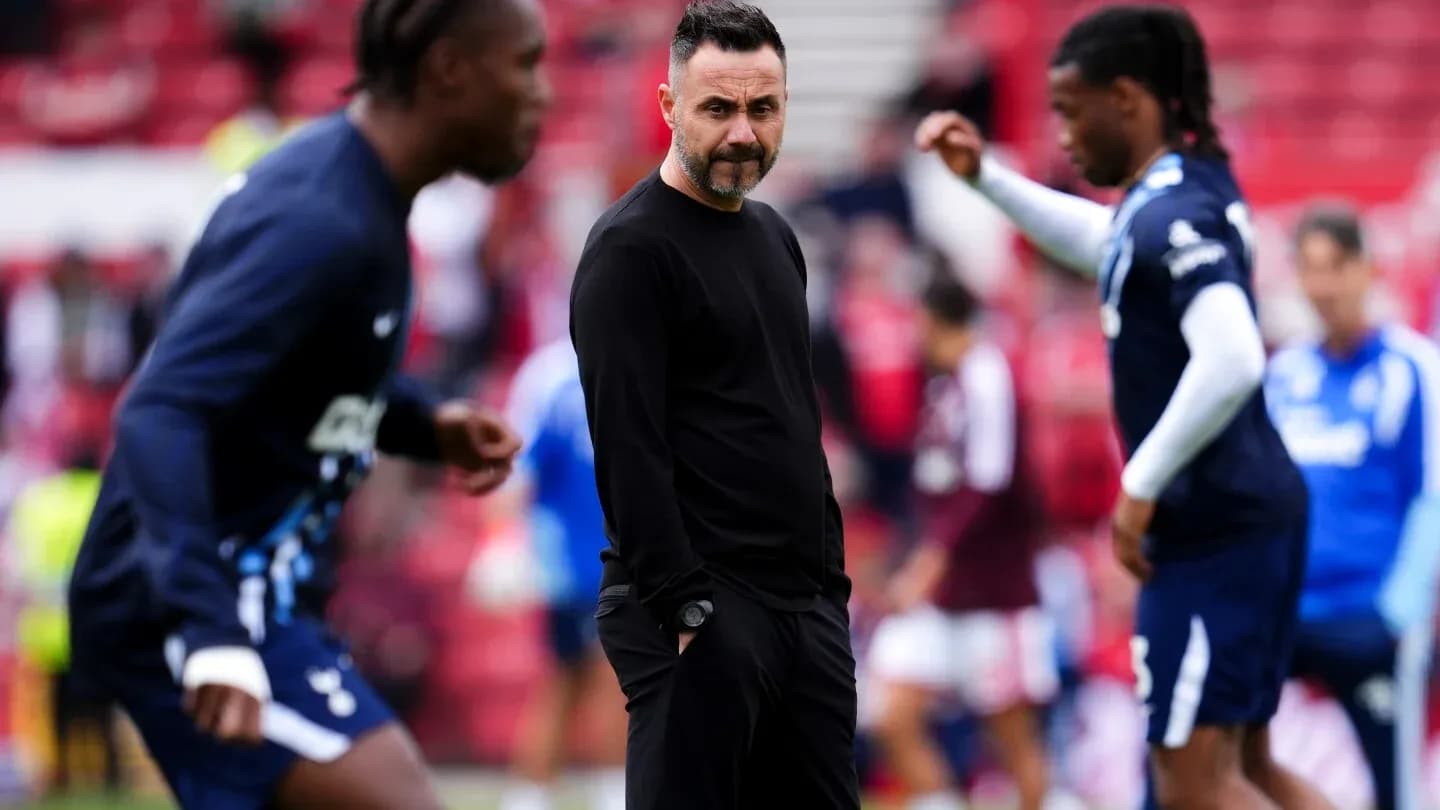

Tottenham's Goalless Draw: A Step Forward for De Zerbi
Tottenham finally stopped the bleeding on Saturday. No win, no goal, but at least no defeat.
A goalless draw at Nottingham Forest is hardly the stuff of title challenges, yet for Roberto De Zerbi it marked a first point of the Premier League season and the faint outline of a team beginning to understand him. Physical, scrappy, bitty – and Spurs were right in the thick of it at the City Ground. If you’re looking for a sliver of optimism, that’s where it lives.
De Zerbi: Happy with the performance, not the result
“Disappointing for the result, but for the performance, very happy,” De Zerbi said afterwards. It was a revealing line. Tottenham have taken just one point from three games, haven’t scored a single league goal, and still he sounded convinced the foundations are there.
“Considering we started working together on Thursday for the first time, we played well,” he explained. “I think we can improve in the last pass. If we improve in the last third, I think we can score many, many goals because we have the players with big qualities. Now it’s a tough moment to accept this result, because I think we played well.”
That final third is the knot Spurs can’t untie. De Zerbi bristled at the idea that it’s some mystical problem.
“It’s not to unlock [the final third]. It’s the mistakes. We have to work in this part,” he said. “I think we played very well with the ball, we found the solutions because they press [our defenders] with three, but one of our full backs was always alone and we found him always in 90 minutes. So in build-up, we played very well. In the last third, I think we can be… better. Much better.”
The structure is doing what he wants in the first two phases. Spurs played through Forest’s press, used the spare full back, and advanced the ball. Then, just when the pitch opened up, the ideas ran out.
Key changes and lost balance
The second half swung on two decisions De Zerbi felt were forced upon him.
“I’m sorry because the medical stuff pushed to change Savio and Udogie after 60 minutes,” he admitted. “Kudus and Robertson played very well, but maybe two substitutions in that moment was not so good. But now we can’t take risk with injuries again. Savio is too important for us, the same Destiny. Maybe we lost some balance, some connection [when they came off].”
That word – connection – keeps circling this Tottenham side. They have talent, they have running, they have individualists who can beat a man. What they don’t yet have is a collective rhythm in the areas where it matters most.
Defensively, though, De Zerbi saw progress.
“I think today we defended very, very well,” he said. “We have to improve the physical condition [of some players], the connection between the players. We changed, I don’t know how many players in this transfer window. We brought very, very good players, but the team doesn’t adjust like the names on paper or Football Manager.”
The message was blunt: this is not a plug-and-play squad. Names don’t equal chemistry.
A system built on risk – and one man holding the floor
The way De Zerbi sets up his teams, the back line lives on a knife edge. The build-up invites pressure, dares opponents to come higher, stretches the game so that, when it works, the attacking payoff justifies the danger.
Right now, Tottenham aren’t cashing in on that risk.
The good news for them is that Micky van de Ven looks born for this style. The Dutch defender has started the season impressively alongside compatriot Jan Paul van Hecke, coping with the exposure that comes with such an aggressive structure. Even in last week’s defeat to Newcastle, it was set pieces that did the damage rather than open-play chaos. Van de Ven, more than anyone, is raising Spurs’ defensive floor.
The problem sits at the other end of the pitch. The ceiling is so low in the final third that Van de Ven “can’t even stand up inside Spurs’ house at the moment,” as the performance hinted again at Forest.
De Zerbi knows he has an “impressive attacking group on paper,” but he also knows matches are not played on paper. The squad has been heavily reshaped from last season, yet the same old issue keeps creeping back into view.
The missing creator and the crowded wings
Spurs lack a true creator in midfield. That single absence shapes everything.
Without a natural no. 10, they struggle to thread passes through the centre and are forced to funnel attacks wide. Once the ball goes there, opponents can shuffle across, get bodies back, and set themselves. Forest’s plan was simple and effective: press high early, then retreat into a compact block with nine or 10 players around the box.
Tottenham had no answer. For all the mercurial dribblers in the side, nobody consistently stitched the play together between the lines. Spurs moved the ball, reached promising positions, and then hit a wall of red shirts.
James Maddison’s eventual return from injury hangs over this picture. Perhaps he comes back quickly, shakes off the rust of effectively missing a year, and gives De Zerbi the central spark he currently lacks. Perhaps.
The more realistic view, for now, is harsher. Until Tottenham prove they can score, until they show they can drag opponents out of that deep shell and punish them, afternoons like this one at the City Ground will keep repeating.
The first point has arrived. The first goal – and a real sense of lift-off – still feels a long way off.