.svg&w=384&q=75 "Naijagoal logo")

Tottenham's Financial Transformation Through Stadium Innovation
Tottenham’s season was one long wince.
Another manager gone. Key players patched up or missing. A final day spent glancing over shoulders, calculators out, as the ninth-richest club in world football flirted with the drop before scrambling to safety. Seventeenth, again. For a club of that wealth, it is not a position. It is a warning.
Yet while the football stuttered, the balance sheet roared.
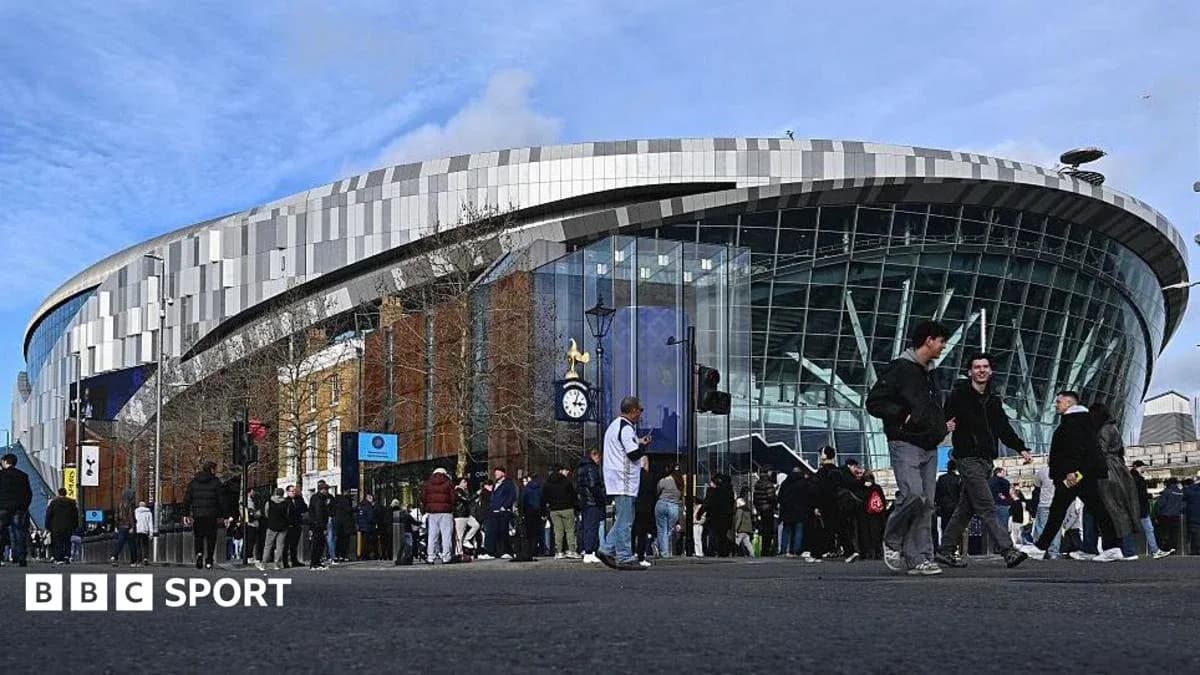
Behind the scenes, Tottenham have built a money machine on the footprint of their old home. The new stadium, mocked by some for its cheese room and microbreweries when it opened, has quietly turned into one of the most powerful financial weapons in the Premier League.
How a stadium changed the game
The numbers are stark.
“Spurs' matchday income has increased from £45m in 2016-17, the season they left White Hart Lane, to £126m in 2024-25,” says football finance expert Kieran Maguire.
Less than double the capacity. Two and a half times the revenue.
That gap is where modern football lives. Tottenham have not simply built more seats; they have built time and temptation into the matchday. Fans arrive earlier. They stay later. And while they linger, they spend.
“What Spurs have done is they've created a welcoming environment,” Maguire explains. “So if people are spending an extra 40 to 50 minutes in the stadium itself they're not just spending time - more importantly they're spending money.”
Bars, food courts, premium lounges, giant screens – the place is designed to keep people inside the turnstiles for as long as possible. Every extra pint, every extra burger, every extra shirt sale is a marginal gain. Add those gains across 25 or more home games and the picture changes dramatically.
Then come the nights when there is no football at all.
The stadium that never sleeps
Tottenham’s ground is not just a football stadium. It is a year-round events venue, a Swiss army knife of modern sport and entertainment.
Spurs can stage up to 30 non-football events a year at full capacity. That calendar has already included NFL fixtures, major concerts and boxing world title fights – among them Anthony Joshua’s heavyweight showdown with Oleksandr Usyk in 2021. Rugby union has moved in as well, with Saracens using the stadium to host Harlequins in the London derby since 2023.
Every event means more commercial revenue. The jump is eye-watering: commercial income has surged from £73m in 2016-17 to £277m in 2024-25.
That kind of uplift changes the way a club behaves in the transfer market. This summer, Tottenham pushed their model into a new bracket by signing Sandro Tonali for a club-record fee that could hit £100m. That sort of deal is easier to justify when the stadium is effectively underwriting your ambition.
The timing is significant too. The Premier League’s financial landscape is shifting.
New rules, old loophole
This summer, the league scraps its long-debated profitability and sustainability rules and brings in a fresh framework built around two ideas: squad-cost ratio (SCR) and sustainability and systemic resilience (SSR).
Strip away the jargon and SCR is simple enough. It caps what a club can spend on its playing squad – wages, transfer amortisation, agent fees – as a percentage of overall revenue. Earn more, you can spend more.
The crucial detail lies in what does not count.
Stadium infrastructure costs sit outside the SCR calculation. They do not drag the ratio down. They do not squeeze the transfer budget.
“In the case of Spurs, their infrastructure costs are around £70m a year - but those are excluded,” Maguire says. “Any money that you invest in stadiums is completely ring-fenced and excluded from your ability to invest in players.
“There's a separate issue in that stadiums do cost a lot of money. But Spurs borrowed from banks at spectacularly cheap interest rates.”
So Tottenham carry the burden of a huge build, but in accounting terms the stadium is a shield, not a shackle. It boosts revenue, fuels spending power on the squad and does not count against the league’s spending controls.
For clubs trying to stay competitive under the new rules, the message is blunt.
“In order to be competitive, you need to have a significant increase in matchday income,” Maguire says. “You could only do that from either increasing prices, which isn't going to go down well, or increasing the size of the stadium with a greater proportion of the tickets going to the non-season ticket fanbase.”
Raise prices and you risk revolt. Expand, modernise or move, and you might just keep pace.
The cost of leaving home
Everton and West Ham have already made that leap. Both have swapped traditional homes for modern arenas, chasing long-term financial strength. Not every supporter has embraced it.
Other Premier League clubs now stand at the same crossroads. Stay and renovate? Or rip up the roots and go?
Renovation looks cheaper on paper. The problem is practical: where do you play if your ground becomes a building site? Renting another stadium brings its own costs and complications, especially when policing, capacity and local politics get involved.
Then comes the emotional bill. History lives in old stands. Fans worry that moving out means leaving part of themselves behind.
Manchester United sit in the middle of that storm.
It is clear Sir Jim Ratcliffe sees a new stadium as the physical symbol of his era at Old Trafford. The concept is bold: a 100,000-capacity arena with vast corporate areas, designed to dwarf United’s current matchday income and pump new money into the senior squad.
The plans unveiled in March 2025 included a huge canopy. Architecturally striking, commercially useful – but expensive. The overhang and everything beneath it would fall inside United’s footprint, meaning the club picks up the tab for its construction and its upkeep. That is a lot of money for a “look”.
Club officials argue that building much of the structure off-site and shipping it in will cut costs compared to a full rebuild on the current Old Trafford bowl. They also believe that placing the new stadium just down the road solves another thorny issue: where United play while the work goes on.
Sharing with Manchester City, Liverpool or Everton? None of those grounds offers the right mix of capacity, security and cost. None is an easy political sell either. A new build on adjacent land allows United to step from one stadium into another without a nomadic season.
If it works, the club gets a modern cash generator without a prolonged exile. If it goes wrong, the price of the misstep will be enormous.
Newcastle’s dilemma
Further north, the debate feels even sharper.
Newcastle United have discovered the hard way what happens when revenues lag behind ambition. This summer, they effectively had to sell some of their best players just to stay within the financial rules.
The numbers tell their own story.
“For the 2024-25 season Newcastle's matchday income was £52m. Manchester United's was £160m, Arsenal's £154m, Spurs' was £126m.
If you're £100m behind your competitors, the only way to address that is either to be super smart or to charge more money for the product.
Newcastle can be smarter. They can trade well, recruit cleverly, coach superbly. But at some point, the gap in raw income bites.
“How can Newcastle increase the yield per fan and still be loyal to the Gallowgate hardcore?” Maguire asks. “You need to be able to offer a different product and St James' Park wasn't built for a corporate audience.”
St James’ Park is a fortress of identity, looming over the city centre. It is also a relic of a different era in stadium design, where hospitality and corporate boxes were an afterthought. For a club trying to keep up with Spurs, Arsenal and United, that matters.
Newcastle fan Charlotte Robson captures the tension.
“I think we can host gigs at St James' Park but probably not on the scale of Spurs or West Ham's London Stadium,” she says.
“I don't think it would be stupid to move from the ground but I think there is so much identity for Newcastle fans who are attached to St James' Park that it would break a lot of hearts to move the ground in any significant way.”
That is the trade-off in its rawest form. More money. Or the soul of the place.
Can everyone copy Spurs?
Clubs eyeing Tottenham’s model see the extra matchday income and the booming commercial deals and wonder if they can simply replicate it. The answer is complicated.
“Spurs have got the advantage that they're in London - a huge tourist trap,” Maguire points out. “They are also a club with a global fanbase, so it works there.
“Is that going to work elsewhere in the country where you've got a more localised fanbase and where there is resistance to putting up prices for tickets? Then it becomes more challenging.
We have seen a substantial increase in the costs of putting stadiums together, but there still seems to be an appetite for it.
London helps Spurs. The NFL helps. Global sponsors help. Not every club can lean on those advantages. For some, the risk of sinking hundreds of millions into concrete and steel without a guaranteed pay-off is enormous.
Yet as the Premier League’s financial rules harden and the gap between the haves and have-nots widens, the direction of travel feels set. Bigger, smarter stadiums are no longer vanity projects. They are survival strategies.
Tottenham have already made their bet. Others now have to decide whether they dare follow – and what they are willing to sacrifice to do it.