.svg&w=384&q=75 "Naijagoal logo")

Tottenham’s £320m Struggle: Why De Zerbi’s Attack Is Not Clicking Yet
Four games in and the Premier League table carries an awkward truth for Tottenham Hotspur. They are one of only two sides, along with Coventry City, still waiting for their first goal.
That would be alarming enough in any season. It feels even starker when you’ve poured around £320m into the squad, much of it on forwards and attacking upgrades, and hired one of Europe’s most adventurous coaches to knit it all together.
So why isn’t it clicking?
The De Zerbi blueprint, Spurs edition
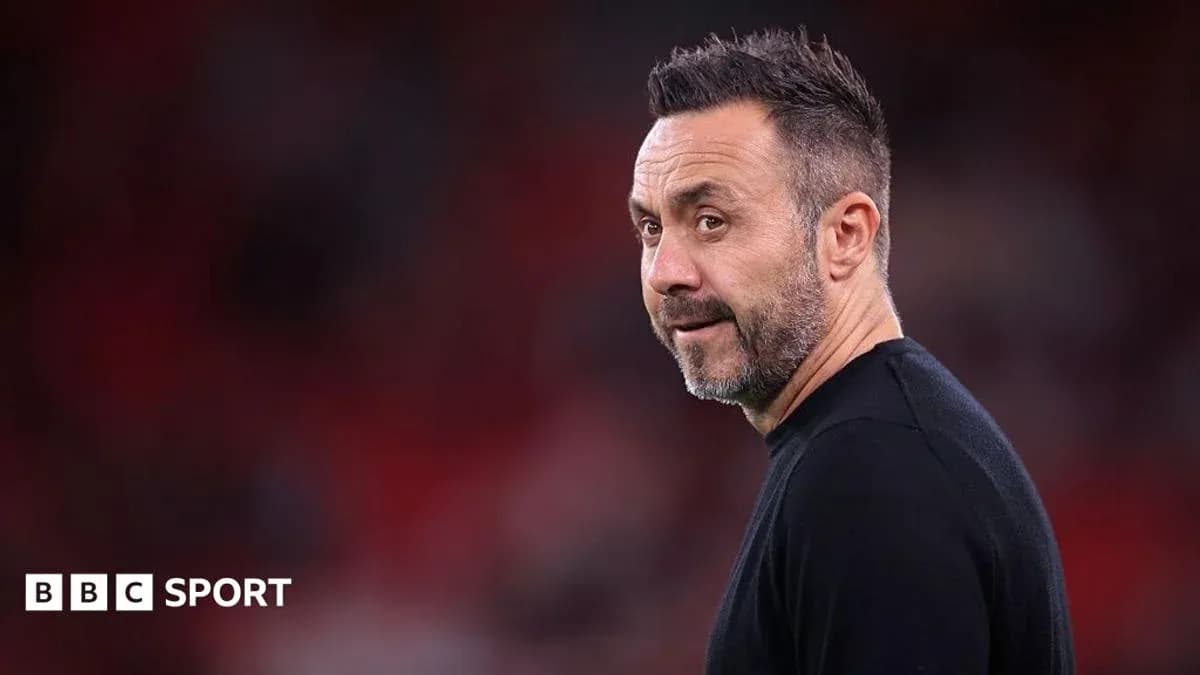
Roberto De Zerbi has not torn up his playbook since leaving Brighton in 2024. He has edited it.
His football still revolves around a calculated kind of risk. His teams tempt pressure, slow the game down, pass backwards, invite opponents to step up. Then, when the trap is sprung, they accelerate violently, punching passes or carries through the gaps left by pressing defenders.
He summed it up in a 2020 coaching seminar: “The stronger the pressure of the opponent, the more vertical [our] action becomes. [The fewer opponents behind], the easier it becomes to go and score.”
That idea hasn’t changed. The league around him has. The Italian has had to tweak, to adapt, but the core remains: drag teams in, then race past them.
We’ve already seen Spurs forwards receiving the ball in big, open spaces with fewer defenders to beat. The structure is doing its job. The final act isn’t.
A complex shape, simple demand: be brave
On paper, Tottenham’s attacking shape can look like a 2-3-2-3 when they have the ball.
Two centre-backs at the base. In front of them, a holding midfielder – usually Rodrigo Bentancur – anchoring the middle. That trio tends to stay put, providing the platform.
Ahead of them, the picture gets fluid. The wingers, full-backs and central midfielders rotate, but the overall 2-3-2-3 framework is meant to hold. When one player moves out of a zone, another slides in. Constant movement, fixed structure.
On top of that positional map sit De Zerbi’s principles. These are the same ideas that fuelled his Marseille side between 2024 and 2026, when they averaged 2.3 goals per game. That team attacked space with venom, their forwards thriving when the pitch opened up.
Tottenham are trying to do the same. They just haven’t joined the dots yet.
To make those vertical passes into the middle work, a few things must line up. The receiver has to be comfortable under pressure, often with opponents swarming from all angles. Some players relish that; others don’t.
De Zerbi has already made small adjustments. Sandro Tonali, for example, is more dangerous when he can face play and drive into larger spaces. So we’ve seen him rotate with Archie Gray, who starts nominally at right-back. Gray steps inside into those tight central pockets; Tonali moves higher or wider to attack the space.
It’s a sensible tweak. Gray, just 20, is not a natural in that role, but he has coped and, crucially, seems to grasp what his manager wants in those claustrophobic zones.
The return of James Maddison, back from a shoulder injury in the Carabao Cup tie at Liverpool, should help. Maddison is built for these spaces: quick feet, quick decisions, comfortable receiving on the half-turn with bodies around him. He gives De Zerbi a more natural conduit into the final third.
Yet even with better technicians, the system relies on something more intangible: habit. Players must internalise the manager’s demands. That takes time.
Unlearning Frank’s Spurs
This is not just about learning a new style. It’s about unlearning the old one.
Under Thomas Frank at the start of last season, Spurs largely bypassed the centre of the pitch in their build-up. They went down the flanks, avoiding the risky central zones where turnovers can be fatal.
De Zerbi is asking for the opposite. He wants his players to embrace those congested areas, to take the ball where it feels most dangerous, because that’s where the reward lies if they escape.
For a squad conditioned to play away from risk, that is a psychological shift as much as a tactical one. Some will adapt quickly. Others will need months.
Even so, the first phase is working. Spurs are regularly managing to play through pressure and emerge behind opposition midfields. From there, the game should tilt in their favour.
That’s where the real problem starts.
The final-third bottleneck
Tottenham’s biggest issue is not getting into promising attacking positions. It’s what happens once they’re there.
- recognising the best pass
- the movement of the players ahead of the ball
- the ability to execute the pass
Right now, the blockage is in the first two.
Too often, Spurs players either don’t see the through ball or choose not to risk it. The runs are there. The pass isn’t.
Omar Marmoush has been a constant outlet, making sharp runs in behind. He stretches defences, darts across centre-backs, times his movement well. But the ball doesn’t always come.
Archie Gray has tried to slide passes down the line, especially on the right, yet Spurs haven’t hit those same penetrative balls often enough through the middle. The central lanes, where De Zerbi wants the knife to go in, are not being used with enough conviction.
The return of Pedro Porro could change that dynamic. For Spain this summer, as they won the World Cup, he operated more centrally in possession, threading passes and creating chances from inside rather than hugging the touchline.
Those instincts dovetail with De Zerbi’s blueprint. If Porro carries that form into Spurs’ build-up, he can become a key supply line, feeding runners and turning promising situations into clear chances.
That’s what De Zerbi had at Marseille: wide players and full-backs who could both hit the byline and cut the ball back with their stronger foot, and forwards who lived off those deliveries.
Wide threats still learning the angles
There are hints of that in north London already.
At Anfield in midweek, Destiny Udogie repeatedly found good positions on the left as the game opened up. His power and timing troubled Liverpool when the match became stretched, even though Andy Robertson has been one of Tottenham’s more reliable performers this season.
Udogie’s surges got Spurs into crossing areas against a disorganised defence. That’s exactly the scenario De Zerbi wants: chaos at the back, space on the flanks, runners attacking the box.
When an attacking team suddenly quickens the tempo, defenders often panic and drop deep to protect their goal. That creates another pocket of opportunity – the space in front of the back line, where late-arriving midfielders or clever strikers who drift off the front can appear.
Marmoush has tried to exploit that too, pulling away from the last line to receive cut-backs. Again, he hasn’t always been picked out.
Part of this is chemistry. New combinations need time to sync up. Part of it is technical: Savio, a left-footed right winger, is more comfortable driving to the byline than chopping the ball back across goal on his weaker foot.
On the opposite flank, Udogie and Robertson, both left-footed, have been able to whip more natural, dangerous crosses from their side. Those deliveries have produced clearer chances than many of the balls from the right.
At Marseille, De Zerbi had a different balance. Both the right winger and right full-back were comfortable cutting the ball back on their right foot. The box movement of Pierre-Emerick Aubameyang, even at 37, turned those low crosses into goals. He knew exactly when to dart to the front post, when to peel off to the back, when to hold his run.
Tottenham don’t yet have that level of automatic understanding in the penalty area.
Close, but not quite
Look closely at Spurs’ attacking moves and a pattern emerges. The structure works. The pressing trap works. The rotations mostly work. The ball often reaches the right zones.
Then something small goes wrong.
A pass delayed half a second. A run not spotted. A cross hit with the wrong foot. A cut-back aimed a yard behind the striker.
These are details, but De Zerbi’s football lives and dies on details. At Marseille, he had forwards ruthless enough to punish any space they were given. Tottenham’s new-look attack is still trying to find that edge.
No system can mask a lack of quality in the box, but this one doesn’t look short of talent. It looks short of fluency.
If those fine margins sharpen – the bravery to play the through ball, the timing of the runs, the comfort in tight spaces – Spurs should start creating enough chances that the goals follow almost by force of probability.
The question now is simple: how long can a club that has spent this much, and hired a coach this bold, wait for the dam to finally burst?