.svg&w=384&q=75 "Naijagoal logo")
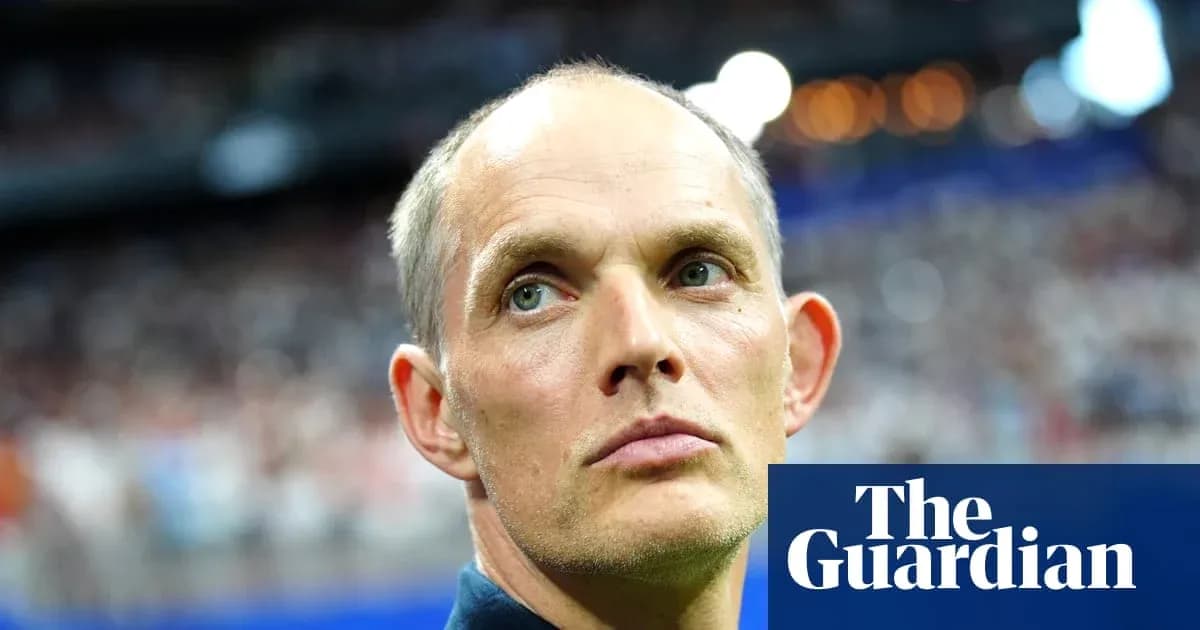

Thomas Tuchel Reflects on England's World Cup Semi-Final Collapse
Thomas Tuchel says he will live with the scar of England’s World Cup semi-final collapse against Argentina – but admits he reached for the safety net too soon.
The England head coach has defended his decision to turn to a back five in Atlanta after Anthony Gordon’s 60th‑minute opener, yet concedes the timing of his substitutions invited the storm that eventually swept his side away.
“We were waiting for death,” Tuchel reflects in a new documentary on the England app, describing an England team unable to cope with Argentina’s relentless, risk‑heavy charge in the final half-hour.
“It’s my scar, not your scar”
Tuchel, who came under intense pressure and calls for his dismissal after the 2-1 defeat, is adamant the choices were made for the right reasons in the moment – and that no one feels the consequences more than he does.
“You can try to kill me here. But it’s my scar, it’s not your scar,” he says. “No one is more hurt than me, no one wanted it more.
“They can endlessly torture you and think: ‘If I had done different substitutions, then we would have won the match.’ You just don’t know it.”
England had survived previous knockout tests by leaning on a back five, successfully closing out ties against Mexico and Norway. That history, Tuchel admits, shaped his thinking as Argentina began to throw everything forward.
He knew the alternative. He also knew how it would have been framed if it went wrong.
“Of course you could [have made attacking changes]. No one knows what would have happened. We could have done it and maybe lost 2‑1 and could have gone: ‘Is he crazy? He finished the game against Norway with a back five, why didn’t he finish the game with five?’”
Turning point at the water break
The match pivoted in a frantic spell after Gordon’s goal. England retreated, almost instinctively. Djed Spence was forced into a desperate, last‑ditch challenge. Jordan Pickford produced a big save. The pressure mounted.
Then came the hydration break – and with it, the decision that would define England’s World Cup.
Sensing his side were creaking, Tuchel replaced Gordon with defender Ezri Konsa, shifting to a more conservative shape to try to absorb Argentina’s waves of attack.
“A key moment if I look back at it and what happened to my decision-making, we conceded a big, big chance right before the water break,” he says. “And I thought: ‘We will not survive. This is waiting for death. We don’t have ball possession, we’re not defending good, we’re not defending properly in our 4-4-2. We need help.’”
“I changed to a 5-3-2, we changed the structure. Because I believe we can handle the width better and we still have three central defenders in the middle if crosses still fly in. We changed then to a 5-4-1. Even my mindset is maybe like: ‘Let’s just overcome it.’ And it’s too early. Too early for that mindset.”
The shift handed Argentina territory and initiative. England’s attacking threat evaporated. The game became a siege.
The pressure finally broke them. Enzo Fernández struck, Lautaro Martínez followed, and with those late blows England’s first World Cup final since 1966 slipped away.
“Fuck-it football” and a coach’s intervention
Tuchel insists Argentina’s wild, all‑out approach forced him into a corner.
“Argentina then play very, very quickly. Sorry for the language, [they played] fuck-it football: ‘We have nothing to lose. Let’s fuck it,’” he says. Attack after attack, substitution after substitution, Lionel Scaloni’s side hurled bodies and ideas at England’s back line.
Tuchel’s answer was to reinforce, not to trade punches.
“That was my solution to the problem,” he explains. “That’s what the intervention of a coach is. I try to help, you don’t implement anything for your ego or whatever. You just try to help.”
This time, the intervention backfired. The structure he trusted, the conservatism that had seen England through previous knockout nights, became the cage that trapped them.
Tuchel accepts the timing was wrong. He does not accept that the decision was cowardly, or made to protect himself.
He will carry that semi-final with him, he says. The question now is whether England carry it as a warning – or as the moment that hardens them for the next shot at history.