.svg&w=384&q=75 "Naijagoal logo")

Sunderland's Transition: A Day of Change in 1939
By the end of August 1939, Bill Murray was still feeling his way into the job at Roker Park. He had only stepped up in March to replace Johnny Cochrane, the man under whom he had once played and learned exactly what Sunderland standards were supposed to look like. His task was clear: drag the club back towards the heights of 1936 and 1937, when league and cup were won and Sunderland looked like giants, not relics.
An opening-day win over Derby County in the 1939-40 season hinted that the climb might already be under way. Then came Huddersfield Town. Then came a jolt.
On this day in 1939, Huddersfield arrived, organised, efficient and quietly ruthless. They left with both points and with the scoreboard – and the pattern of the game – underlining how far Murray’s Sunderland still had to go to become a serious force again.
A shaky Sunderland and a sore captain
From the back, the problems were obvious. Sunderland’s defence hesitated, failed to pick up runners and never looked certain under pressure. In attack, the gears barely meshed. Moves broke down before they had a chance to build. The crowd at Roker Park had seen enough good sides to know when one was only half-formed.
Newspapers the next morning did not spare the officials. Reports bristled with complaints that the referee had allowed Huddersfield to get away with a string of borderline fouls, the kind that disrupt rhythm and sap confidence. But the more telling detail lay elsewhere.
Raich Carter, captain, playmaker and symbol of Sunderland’s better days, took a knock and never moved with his usual authority. Once he was hampered, the team’s structure sagged. Those around him did not rise to fill the gap, and the criticism landed hard. Only goalkeeper Johnny Mapson escaped with much credit; the consensus was that he could do little about either of Huddersfield’s goals.
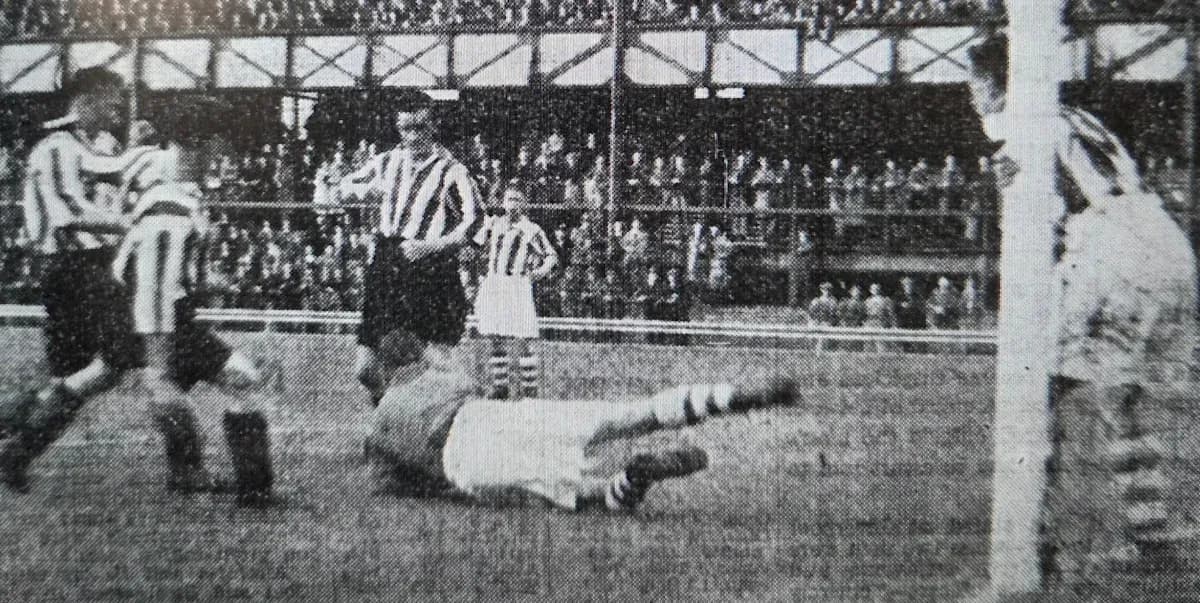
The first of those sparked argument. Clem Stephenson’s side thought Billy Price had scored outright with a firm header from a cross. Some in the ground agreed, insisting the ball had gone straight in. The referee, though, wrote it up as an own goal by Jimmy Gorman, who had challenged Price in the air and was deemed to have had the final touch. Huddersfield were ahead after just four minutes.
Carter dragged Sunderland level on 33 minutes, raising hopes that the game might yet bend their way. It never really did. Huddersfield’s shape and discipline held, and as the match wore on, their control deepened. Price finally settled it ten minutes from time with the winner, and when the final whistle went, there was little argument from the home support. The better side had won.
The questions as fans streamed away from Roker Park were familiar ones about form, tactics and the new manager’s rebuild. But those thoughts were already starting to share space with something far darker.
Football on the brink of something bigger
Anyone who had bought a paper before heading to the match knew the backdrop. The front pages were dominated not by football but by the tightening grip of international crisis and the looming prospect of a second world war.
The Sunderland Echo and Shipping Gazette carried reports of French radio being handed over to military authorities and of tense diplomatic exchanges across Europe. A photograph showed workmen stacking sandbags in front of the Royal Infirmary, a visual reminder that the danger was no longer abstract.
There was also a stark notice for parents. Helmet and respirator arrangements for Sunderland’s children were being finalised, with demonstration and collection points listed at schools across the town: Redby, Hudson Road, Cowan Terrace, Thomas Street, Commercial Road, Hylton Road, Diamond Hall, High Southwick, James William Street and Barnes. Even infants were to be fitted with specially adapted versions.
It was the kind of detail that cuts through any attempt to treat football as a simple escape.
Roker Park under a gathering cloud
The mood at Roker Park that day could never be entirely separated from those headlines. Among the 16,315 in attendance were soldiers and sailors already called up for the emergency. They were allowed in for half price, on the condition they entered through what was usually the boys’ gate. Uniforms in the stands, gas mask notices in the paper, sandbags in the streets – the city knew what was coming, even if it could not yet see the full scale.
The match itself did little to lift spirits. Huddersfield’s 2-1 win was a reminder that Sunderland were in transition, that Murray’s side was short of the authority and conviction the club once took for granted. Yet some in that crowd will have sensed something else: that this might be their last sight of their team for quite some time.
They were right to wonder.
By the time Sunderland travelled to Arsenal the following weekend, German forces had invaded Poland and full-scale war was no longer a threat but a certainty. The game at Highbury was pushed back to a 17:00 kick-off, a nod to emergency public transport timetables and to an evacuation of local children that had to be completed first. Football, already overshadowed, slipped another rung down the list of priorities.
Soon, the results against Derby, Huddersfield and Arsenal were wiped from the official records. The season, such as it was, effectively disappeared. Bill Murray’s job changed overnight. Instead of plotting a methodical rebuild, he spent his time overseeing fitness work for troops stationed in County Durham. Roker Park itself, designated as an evacuation zone, lay largely idle for the next two years.
On 30 August 1939, Sunderland lost 2-1 to Huddersfield Town in a routine league fixture that exposed their flaws and questioned their readiness. Within days, the club – and the country – were dealing with questions far beyond defensive marking and a limping captain.
The real rebuild was about to begin somewhere else entirely.
Saturday 30 August 1939
Football League Division One
Sunderland 1 (Carter 33')
Huddersfield Town 2 (Gorman o.g. 4', Price 80')
Sunderland: Mapson; Gorman, Hall; Housam, Lockie, Hastings; Duns, Carter, Robinson, Smeaton, Burbanks.
Roker Park, attendance 16,315