.svg&w=384&q=75 "Naijagoal logo")

Sunderland vs Arsenal: A Reality Check in the Premier League
Under the Stadium of Light floodlights, this was billed as a reality check: Sunderland, newly re-established in the Premier League, testing their structure and nerve against an Arsenal side that has started the 2026 campaign with a relentless, almost mechanical precision.
I. The Big Picture – Context and Contrasts
Heading into this game, the table told a stark story. Sunderland sat 14th with 4 points from 4 matches, their overall goal difference at -2, built from 3 goals scored and 5 conceded. At home they had been tight but limited: 1 goal for and 2 against in 2 league outings, an average of 0.5 goals scored and 1.0 conceded at the Stadium of Light.
Arsenal arrived in the North East as league leaders, 1st with 12 points from 4 matches, perfect across both home and away. Overall they had scored 8 and conceded just 1, a goal difference of +7. On their travels, they had 2 wins from 2, with 3 goals scored and none conceded, an away scoring average of 1.5 matched to a defensive average of 0.0.
The 0–2 full-time scoreline felt like the logical extension of those underlying trends: Sunderland competitive in phases, but Arsenal’s structure, quality and ruthlessness gradually squeezing the oxygen from the contest.
Both coaches set up in a 4-2-3-1, but the systems carried very different personalities. Régis Le Bris leaned into compactness and counter-threat, while Mikel Arteta’s shape was about territorial suffocation and positional rotations.
II. Tactical Voids – Absences and Discipline
Sunderland were without H. Diarra (hamstring) and R. Mundle (knee), two absences that subtly thinned their options for dynamism and rotation, especially in wide and transitional zones. It meant even more responsibility on the double pivot of Granit Xhaka and N. Sadiki to both screen and progress.
For Arsenal, the back line was patched but not weakened. W. Saliba (back injury) and C. Mosquera (muscle injury) were missing, forcing Arteta to lean fully into the partnership of E. Konsa and Gabriel Magalhães, with R. Calafiori at left-back. The trust was justified: Arsenal came into this fixture with 3 clean sheets in 4 league matches overall, including both away games.
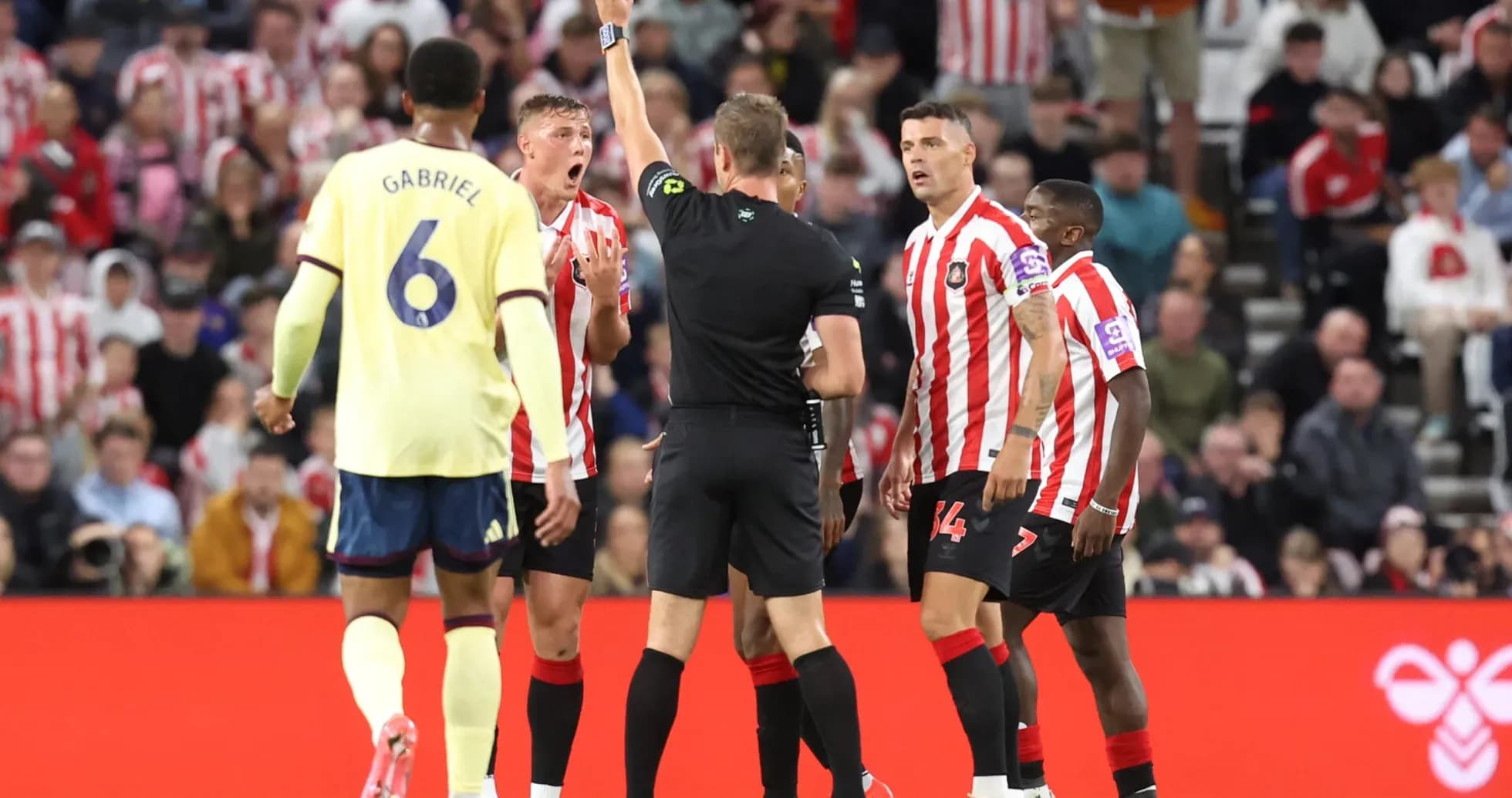
Discipline has been a defining thread in Sunderland’s early season. Their yellow-card profile shows a pronounced spike between 61–75 minutes, with 30.00% of their cautions arriving in that window, and a further 20.00% from 76–90. There is also a notable red-card flashpoint in stoppage time: 100.00% of their reds have come between 91–105 minutes. Reinildo embodies that edge – he already has a red card this season – and his inclusion at left-back added both aggression and risk.
Arsenal’s card pattern is different: 42.86% of their yellows arrive in the 91–105 window, suggesting a side that rarely loses control in the main body of the match but can still be dragged into late-game duels and time-management fouls.
From the spot, Sunderland’s narrative is fragile. Overall this season they have taken 2 penalties, scoring 1 and missing 1, a 50.00% conversion rate that underlines a lack of certainty in high-pressure moments. Arsenal, by contrast, have been flawless from 12 yards so far, scoring their only penalty and missing none.
III. Key Matchups – Hunter vs Shield, Engine Room Battles
The most compelling duel on paper was “Hunter vs Shield”: Arsenal’s attacking spearhead against a Sunderland defence that has been stretched but not broken beyond repair.
For Arsenal, Bukayo Saka is the headline hunter. Heading into this fixture he had 3 league goals in 4 appearances, with 10 shots (8 on target) and a rating of 7.49. Operating from the right of the 4-2-3-1, his duel was primarily with Reinildo and the right-sided centre-back D. Ballard. Ballard has been one of Sunderland’s most combative defenders, with 63 duels contested and 33 won, plus 2 successful blocks. Reinildo brings 8 tackles, 8 interceptions and 42 duels (24 won), but also that red card and 8 fouls committed – a profile that hinted at both heroics and hazard against Saka’s directness.
Behind Saka, Martin Ødegaard functioned as the conductor. With 2 goals, 12 key passes and 197 completed passes at 90% accuracy, his job was to manipulate Sunderland’s block, particularly the space around Xhaka and Sadiki. Ødegaard’s duel with Xhaka was the purest expression of “engine room” versus “architect”: Xhaka, with 246 passes at 86% accuracy, 6 tackles, 2 blocks and 5 interceptions, is Sunderland’s organiser, tempo-setter and emotional barometer. He also sits high in the disciplinary charts with 2 yellow cards, which made his management of Arsenal’s rotations between the lines critical.
On the flanks, Christos Tzolis provided Arsenal with a different kind of threat. From the left, he has 1 assist and 8 key passes already, but also 2 yellow cards, making him a persistent, combative outlet. His interplay with Calafiori – who himself has 2 assists this season – created a double-wide overload against N. Mukiele and T. Meunier on Sunderland’s right. Mukiele’s brief was brutal: contain the Calafiori–Tzolis lane, while Meunier had to balance his instinct to advance with the need to protect transition lanes.
At centre-forward, Kai Havertz’s role was as much about structure as finishing. With 2 goals and 5 shots on target, he posed a penalty-box threat, but his movement between lines aimed to drag K. Danso and Ballard into uncomfortable zones, opening channels for Ødegaard and Saka to exploit.
For Sunderland, B. Brobbey was left to fight isolated battles up front, supported by the trio of N. Angulo, E. Le Fée and Meunier. Le Fée’s positioning between Rice and M. Lewis-Skelly was Sunderland’s best hope of breaking Arsenal’s first press and releasing runners into the channels.
IV. Statistical Prognosis – Why 0–2 Felt Inevitable
The season’s numbers framed this as a clash between a side still learning its Premier League identity and one already operating at a near-title-contending standard.
Sunderland’s overall scoring average of 0.8 goals per game, and just 0.5 at home, collided with an Arsenal defence conceding only 0.3 goals per game overall and none away. The “Hunter vs Shield” equation was heavily tilted towards Arsenal’s shield. On the flip side, Sunderland concede 1.3 goals per game overall, including 1.0 at home, while Arsenal score 2.0 overall and 1.5 away. Even without explicit xG figures, those trends pointed towards Arsenal generating the higher-quality chances over 90 minutes.
Add in Sunderland’s late-game card spikes and fragile penalty record, and the risk profile was clear: as the match stretched, Arsenal’s control and depth from the bench (Bruno Guimarães, E. Eze, V. Gyökeres, Mikel Merino, Martín Zubimendi) were always likely to tilt the closing stages in their favour.
The 0–2 final scoreline, with Arsenal preserving their away clean-sheet record and Sunderland again failing to score at home, was less a surprise and more a confirmation of the trajectories both squads are on: Sunderland still constructing their Premier League armour, Arsenal already wielding theirs with cold, clinical assurance.