.svg&w=384&q=75 "Naijagoal logo")

St. Pauli's Journey: From Relegation to Hopeful Revival in 2. Bundesliga
The hangover hit hard at the Millerntor.
After the euphoric high of survival in 2024/25 – the club’s first successful Bundesliga stay since 1995/96 – St. Pauli’s return to the top flight ended with a brutal thud. Six wins, eight draws, 20 defeats. Bottom of the table in 2025/26. Straight back down.
Relegation stripped away more than just status. It cost the head coach, key leaders in the dressing room, and a chunk of the emotional core that had carried Die Kiezkicker back into the big time. Alexander Blessin was dismissed in the weeks after the season closed, and the squad that had felt so tight-knit only a year earlier was suddenly full of gaps.
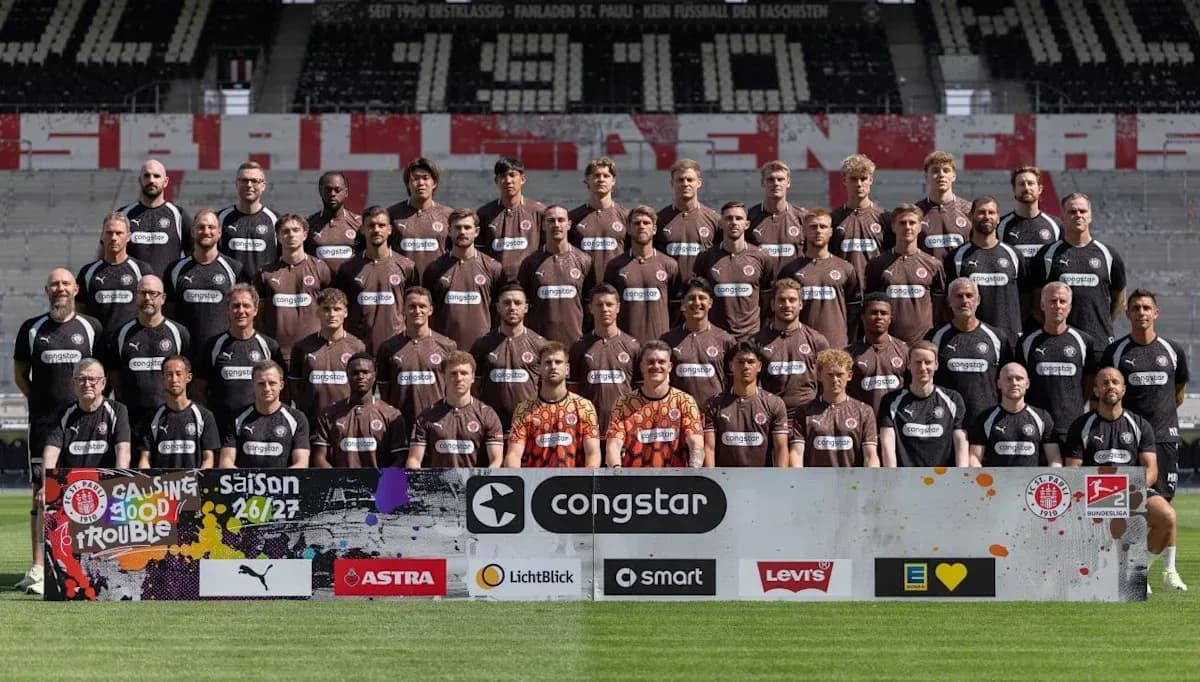
Yet the mood around the Millerntor is not one of despair. Not this time. There’s too much change, too much new energy, and just enough quality to keep the place restless rather than resigned.
A captain leaves, a spine is ripped out
The most jarring departure came late. Too late for many supporters’ liking.
Jackson Irvine, captain, heartbeat and symbol of the club’s recent rise, asked to leave and got his move to Cerezo Osaka. The timing stung: the transfer was announced less than a week before the first league fixture. The numbers tell part of the story – 153 appearances, 15 goals, 21 assists – but they don’t capture what he meant to the stands or the streets around the ground. He had worn the armband in the 2023/24 promotion season and embedded himself in the community. Losing him was about more than replacing a midfielder.
He was far from the only one out the door.
- Long-serving goalkeeper Nikola Vasilj, 167 appearances and 43 clean sheets, left for Al-Diriyah on a free.
- Karol Mets joined Bochum, also on a free, after 91 outings in brown and white.
- On the right, Manolis Saliakas moved to Olympiacos for €1.3 million following 120 appearances.
- At centre-back, Hauke Wahl departed to Wolfsburg for €2 million after 105 games.
- Further forward, Daniel Sinani exited to Sampdoria on a free after 70 appearances.
That’s not trimming. That’s tearing out the spine of a squad.
The result is a dressing room that looks very different from the one that stepped onto Bundesliga pitches a few months ago. Experience gone, continuity disrupted, leadership vacuumed out. For many clubs, that combination is a recipe for drifting in the 2. Bundesliga.
St. Pauli are betting on it being a reset instead.
Hrgota, Mathisen and the Rapp gamble
The most eye-catching arrival is a familiar name to anyone who has followed the German second tier: Branimir Hrgota.
Signed on a free from Fürth, the veteran forward is the club’s all-time leading scorer in the top two divisions, with 69 goals and 41 assists across 238 appearances. He dragged Fürth back into the Bundesliga in 2020/21 with 16 goals and 7 assists – just the second promotion in their history. That season showed what he can be at this level: a striker who doesn’t just finish chances but defines campaigns.
St. Pauli need exactly that. They need someone to take responsibility in the final third, to set standards after Irvine’s exit, to guide a reshaped attack through what will be a brutal schedule. Hrgota arrives as both goalscorer and grown-up in the room.
At the back, Marcus Mathisen joins from Magdeburg, also on a free. A seasoned 2. Bundesliga centre-back, he brings the kind of know-how that becomes invaluable across a 34-game slog. With so many defensive departures, he’s less a luxury signing and more a structural necessity.
The most important addition, though, stands on the touchline.
Marcel Rapp, 47, takes over after his impressive work at Holstein Kiel, where he coached them to their first-ever Bundesliga promotion in 2023/24. That was the same season St. Pauli won the 2. Bundesliga title. Two clubs punching above their financial weight, both riding smart coaching and clear identity.
Now those paths cross. Rapp inherits a squad in flux but with a high ceiling. His track record suggests he knows how to mould a collective, how to build a promotion push from organisation and belief rather than star power alone.
Pre-season hints: goals, gaps and a new shape
Pre-season rarely tells the full truth, but it does whisper clues. Rapp’s St. Pauli already show signs of what they might become.
The tour started locally, with a 2-6 win over city neighbours Altona 93. It was open, wild at times, but full of attacking intent. Next came a 1-3 victory over Regionalliga Nord side Kickers Emden, less spectacular but solid enough to keep the rhythm.
The third friendly had more soul than stakes. Against Babelsberg – a club whose supporters share a well-known fan friendship with St. Pauli – the visitors ran out 1-4 winners. The headline belonged to Abdoulie Ceesay, who hit a first-half hat-trick and looked every bit the breakout forward of the summer.
Then came the first European test, away to Croatian side Gorica. St. Pauli won 2-1 through goals from Louis Oppie and Ricky-Jade Jones, but the night carried a heavy price: Ceesay suffered a capsule-ligament injury in his right ankle. For a player in that kind of form, the timing was cruel. For Rapp, it removed one of his most explosive options just as the season loomed.
The penultimate friendly raised the level again. Premier League and Europa League club Bournemouth were simply too strong in Austria, winning 4-1. Kaars opened the scoring in the 22nd minute, but St. Pauli collapsed in a 27-minute spell, conceding four times. It was their only defeat of the summer, yet it exposed defensive fragility that a three-at-the-back system must address quickly.
The Millerntor finally got its first look at the new side against freshly promoted LaLiga outfit Deportivo de La Coruña. The game finished 2-2. Taichi Hara and Kaars twice put St. Pauli in front, only for an 84th-minute equaliser to deny them a statement win. It was entertaining, open, and a reminder that this team can score – but also that it still struggles to shut games down.
Across the friendlies, one pattern held: Rapp’s ideas lean towards a proactive, front-foot approach. There are risks in that. There are also rewards.
How they might line up
Tactically, the picture is becoming clearer.
Rapp looks set to keep a three-at-the-back system. With Eric Smith’s fitness uncertain ahead of the opener against Fürth, the back line will likely feature Mathisen and Nemeth, with either Tomoya Ando or Adam Dzwigala stepping in to complete the trio. It’s a unit that mixes familiarity with new partnerships and will need time to gel.
In midfield, Fujita is the natural fulcrum in the centre. Around him, Rasmussen or Metcalfe should start, giving Rapp a blend of energy and control. Out wide, Pyrka and Oppie are expected to operate on the flanks, offering width and running. Lars Ritzka and Erik Ahlstrand stand ready as reliable depth options in central areas, important insurance over a long campaign.
Up front, Hrgota is the key piece. He will almost certainly start in one of the supporting roles, paired with either Jones, Hara or Ceesay once the latter returns from injury. Kaars is set to lead the line as the central striker.
The projected XI, on paper, looks like this in a 3-4-2-1: Voll – Nemeth, Mathisen, Ando – Pyrka, Rasmussen, Fujita, Oppie – Hrgota, Jones – Kaars.
For a club that has lost so many senior figures, the depth is better than it might have been. The core is still there. The question is how quickly it can reconfigure itself into a promotion machine rather than a rebuilding project.
Promotion talk, pressure and the weight of history
History does not treat St. Pauli kindly when it comes to quick returns.
The last time they were relegated before this recent drop – back in 2010/11 – it took 13 years to get back to the Bundesliga. The fastest turnaround the club has ever managed is four years, a feat achieved twice in the 1990s and early 2000s.
Those numbers hover in the background like a warning. The 2. Bundesliga can swallow clubs whole. Get stuck, and you can stay stuck.
This time, though, there are reasons to believe the cycle might be shorter.
Despite losing Irvine, Vasilj, Mets, Saliakas, Wahl and Sinani, St. Pauli still possess one of the strongest squads in the division. They enter the season with the second-highest squad value in the league, behind only VfL Wolfsburg – albeit with a huge gap of nearly €200 million. That financial and qualitative edge matters across a long season, especially when backed by a coach with a recent promotion on his CV.
Pre-season showed that this team can still punch above its weight on the day. The Bournemouth defeat aside, they scored freely, adapted to new ideas and carried a threat against varied opposition. There is rust, there are gaps, but there is also enough talent to frighten any side in the division.
The reality of the 2. Bundesliga in 2026/27, though, is ruthless. Wolfsburg are clear title favourites. Behind them, the race for second and third will be savage, with Hannover and fellow relegated side Heidenheim among the clubs eyeing the same spots St. Pauli want.
The expectation around the Millerntor is measured but ambitious. Anything outside the top six would be a disappointment given the squad’s quality. A genuine push for the top three feels realistic if Hrgota settles quickly, Ceesay returns sharp, and Rapp’s structure locks into place.
St. Pauli have crashed before and wandered for years. Now they stand at the start of another climb, with a new coach, a new captain figure up front, and a fanbase that knows both the cost of failure and the taste of resurgence.
This time, will they make it back before history catches up again?