.svg&w=384&q=75 "Naijagoal logo")

South Africa's Banyana Banyana Show Resilience in WAFCON Draw Against Ivory Coast
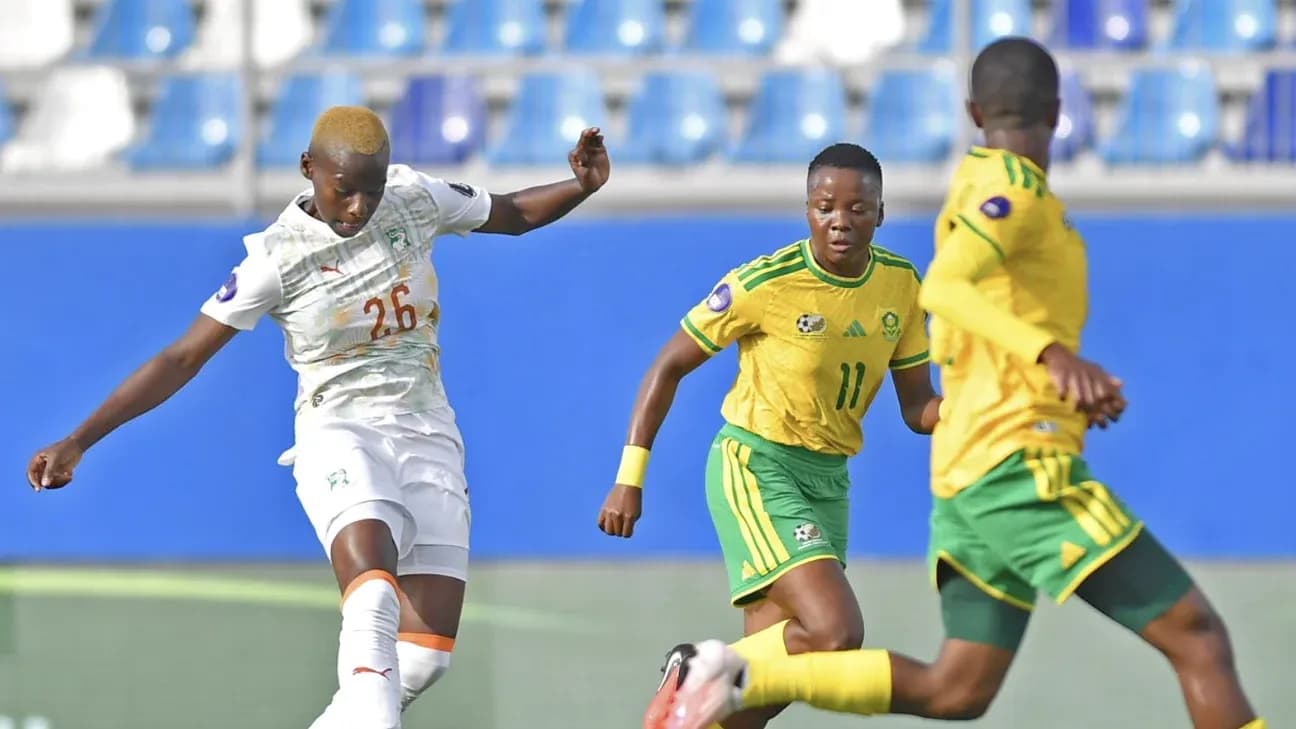
South Africa walked out of Casablanca with their WAFCON hopes still flickering, not because they were convincing, but because they refused to stay down.
A 2-2 draw with Ivory Coast on Friday keeps Banyana Banyana alive in Group B ahead of their final clash with Burkina Faso on August 4. It also reshaped the narrative around two strikers who have worn much of the recent criticism: Thembi Kgatlana and Ronnel Donnelly.
Torn apart, then dragged back
For 45 minutes, South Africa were a mess.
Ivory Coast sat deep, waited, and then sliced them open in transition. Twice. Grace Sery struck on 18 minutes and again on 36, both goals born from rapid counter-attacks that exposed Banyana’s structure and left the back line scrambling.
South Africa had almost nothing in reply. One moment, that was all: Linda Motlhalo threading a clever ball into Kgatlana’s path, forcing Aramatou Diakité to race off her line and smother. Beyond that, the Tigres UANL forward barely had a touch that mattered. Isolated. Anonymous. The kind of half that fuels the whispers that her best days in Banyana colours are gone.
The scoreboard, and the pattern of play, backed up the doubters.
Kgatlana answers, with help
The second half told a different story because Kgatlana finally had someone close enough to play off. For years that link player was Jermaine Seoposenwe, whose movement and intelligence unlocked Kgatlana’s pace and instincts. Since Seoposenwe’s retirement last year, no one has truly owned that role.
Donnelly has tried. She has also absorbed a heavy share of the criticism, especially given her limited minutes at Mamelodi Sundowns. On Friday, she came on and showed exactly why Desiree Ellis keeps turning to her.
She is not Seoposenwe. She does not need to be.
Donnelly brought her own toolkit: drawing defenders into duels, contesting everything in the air, making the ball stick long enough for runners to join. South Africa suddenly had a focal point, not a lonely striker marooned up front.
Shortly after her introduction, Donnelly carved out space for herself in the box but couldn’t get a clean shot away. Instead of the move dying there, the ball stayed alive, recycled back to Kgatlana on the edge of the area. This time, the veteran did what veterans do.
She cut inside, opened up her body, and buried a low finish to pull one back with just under 20 minutes plus stoppage time to play. One strike, and the entire mood shifted. From resignation to possibility.
Donnelly’s moment in the chaos
As Ivory Coast tired and South Africa finally played higher up the pitch, the pressure built. The clock bled into stoppage time. Banyana needed one more moment.
Donnelly delivered it.
Deep into added time, a hopeful ball forward turned into something far more dangerous when the 22-year-old rose and flicked on a deft header. Hildah Magaia, alive to the chance, pounced and smashed home the equaliser.
It was a goal that owed everything to persistence. Donnelly had spent her cameo wrestling centre-backs, contesting lost causes, and giving Kgatlana and Magaia something to work off. The assist was a simple touch, but it was the reward for an entire shift of unglamorous work.
From 2-0 down and outplayed, South Africa had clawed their way to 2-2. Not pretty. Not controlled. But full of fight.
Group B on a knife-edge
The draw leaves Ivory Coast on four points from two games with a +3 goal difference, boosted by their 4-1 win over Burkina Faso in the opener. Tanzania, who beat Banyana 2-1 in their first match, went into their Friday night meeting with Burkina Faso on three points and a +1 goal difference.
South Africa now sit on a single point with a -1 goal difference. Burkina Faso have yet to collect a point.
The maths is simple enough: Banyana Banyana must beat Burkina Faso on August 4 to have any chance of reaching the quarter-finals. There is no room for cautious calculations. Head-to-head records will decide ties on points before goal difference comes into play, so every duel, every matchup in this group carries extra weight.
Selection questions, and one bold option
Ellis knows her side cannot drift into that final group game. They need to start with the aggression they only found late on against Ivory Coast.
One tempting solution is staring her in the face: unleash the quartet that turned the game in Casablanca. Donnelly as the central reference point, Kgatlana buzzing off her shoulder, Magaia attacking from the flank, and Lebogang Ramalepe adding width and thrust. When those four combined, Ivory Coast’s back line suddenly looked vulnerable.
It would be a statement of intent, a front foot thrown at a Burkina Faso side that has already been opened up by Ivory Coast. It would also be a show of faith in players who changed not just the scoreline, but the mood around this campaign.
South Africa’s backs are against the wall now. There are no guarantees they will climb out. But if they are going to go down, this late surge in Casablanca set a clear expectation from their supporters: go down swinging, with the same pride and defiance that dragged a lost cause back from 2-0 to 2-2.