.svg&w=384&q=75 "Naijagoal logo")

Shamrock Rovers' Tactical Masterclass in 3-1 Victory Over Egnatia
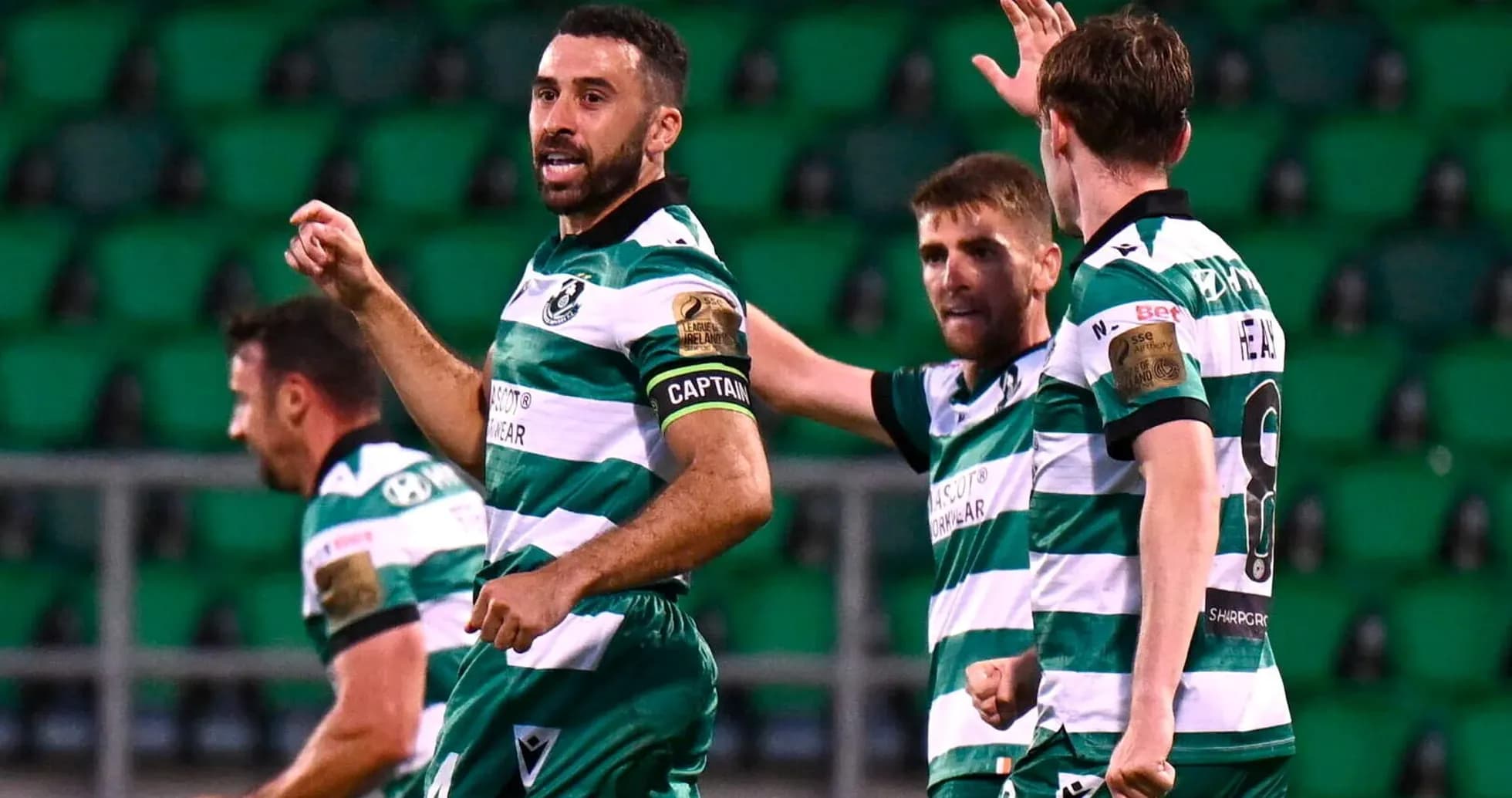
Shamrock Rovers’ 3-1 win over Egnatia Rrogozhinë at Tallaght Stadium in the UEFA Europa League 3rd Qualifying Round was shaped more by structure and game-state management than by raw statistical dominance, as most conventional metrics are unavailable. The Irish side used their 3-5-2 base to control central zones and create decisive moments around both penalty areas, while Egnatia’s mirrored 3-5-2 never quite translated into territorial or emotional control, despite a first-half equaliser and a missed penalty that could have flipped the tie.
With both teams lining up in 3-5-2, the opening phase was a question of who could impose their version of the system. Stephen Bradley’s Shamrock Rovers used their back three of T. Sobowale, R. Lopes and E. Stevens to build calmly, with the wing-backs W. Fitzgerald and A. Brennan holding very high positions. This effectively stretched Egnatia’s midfield five and forced their wide men G. Jaime and A. Yago into deep defensive roles, blunting Albanian width in transition.
The first major tactical reward for Rovers came on 29 minutes, when their aggressive occupation of the half-spaces drew Egnatia into a compromised defensive posture and led to a penalty, converted by G. Burke. That moment underlined Rovers’ willingness to commit numbers between the lines: G. Burke and A. Greene consistently dropped off the front to link with J. Byrne and M. Healy, overloading the central corridor and making it difficult for Fernando Medeiros and A. Kryeziu to screen effectively.
Egnatia’s response was instructive. Even before the equaliser, they looked to break Rovers’ central dominance by pushing I. Gruda higher from his nominal midfield-forward hybrid role, effectively turning their 3-5-2 into a 3-4-1-2 in possession. The 41st-minute sequence – first a missed penalty by Guillem Jaime, then his immediate “Normal Goal” – reflected a brief spell where Egnatia managed to pin Rovers back and attack the channels outside the Irish back three. That they generated a penalty and then scored in the same minute suggests their right side, with Jaime stepping high from the line, was a key outlet whenever they escaped the press.
However, the second half exposed the fragility of Egnatia’s structure once they began to chase the game. The triple substitution at 46' – I. Diabate (OUT) for A. Albanese (IN), I. Gruda (OUT) for K. Loukili (IN), and D. Adjessa (OUT) for J. Montenegro (IN) – was an aggressive reshaping by Nevil Dede. It signalled a desire for more direct threat and creativity, but it also disrupted the cohesion of the midfield line that had just managed to bring them level.
Bradley’s response was more subtle and controlled. The 55' goal by R. Lopes, assisted by J. Byrne, highlighted two tactical pillars: set-piece or structured attacking patterns that involved the centre-backs, and Byrne’s role as the primary technical reference in midfield. Rovers’ ability to involve a defender in the scoring, with a midfielder providing the assist, reflects a collective approach rather than reliance on the front two alone.
The third goal, an own goal by A. Yago at 57', was emblematic of Egnatia’s unraveling. It came in the immediate aftermath of Rovers regaining the lead, at a time when Egnatia were trying to push their wing-backs higher and compress the pitch. That kind of own goal typically arises when a side is under sustained pressure in its own box, struggling to clear against a team that keeps recycling possession and delivering from wide areas. It also turned a manageable 2-1 deficit into a daunting 3-1, altering the psychological landscape.
From there, Shamrock Rovers shifted into game-management mode. The substitution of A. Greene (OUT) for J. Afolabi (IN) at 58' freshened the front line for pressing and hold-up work, while the double change at 69' – G. Burke (OUT) for D. Mandroiu (IN) and D. Watts (OUT) for N. Razi (IN) – rebalanced the midfield with fresh legs and maintained their capacity to contest second balls. Later, J. Byrne (OUT) for J. O’Sullivan (IN) at 77' further underlined Bradley’s intent to protect the central block and manage the tempo with a deeper, more compact shape.
Egnatia’s own later changes, with Z. Aliyev (OUT) for N. Ajetovikj (IN) at 69' and A. Yago (OUT) for E. Ndreca (IN) at 81', looked more like attempts to patch structural leaks than proactive tactical gambits. By then, Rovers were largely dictating where the game was played, often forcing Egnatia into rushed progression and exposing them to turnovers in the middle third.
Discipline also influenced the tactical tone. Egnatia finished with two yellow cards (Ildi Gruda for “Foul” at 38', Alessandro Albanese for “Foul” at 47'), while Shamrock Rovers had one (Dylan Watts for “Foul” at 60'). All three bookings were for “Foul”, underlining how often Egnatia, in particular, had to break play to stem Rovers’ transitions or central combinations. Albanese’s early yellow, arriving just after his introduction, likely constrained his ability to be aggressive in duels, weakening Egnatia’s midfield bite at a critical phase.
With no reliable data on shots, possession, xG, passes or saves, the tactical verdict rests on structural and event-based evidence. Shamrock Rovers’ 3-5-2 was the more coherent and adaptable version: they used their wing-backs to stretch Egnatia, their midfield triangle to dominate central spaces, and their bench to sustain intensity and control once ahead. Egnatia’s similar base shape never achieved the same balance between risk and security, and their early second-half reshuffle, combined with the own goal, left them chasing a game that Rovers were increasingly well-equipped to close out. In that context, the 3-1 scoreline aligns with the tactical story of a home side that managed key moments better and imposed their structure more consistently over 90 minutes.