.svg&w=384&q=75 "Naijagoal logo")

AC Milan vs Benfica: Tactical Lessons from Europa League Clash
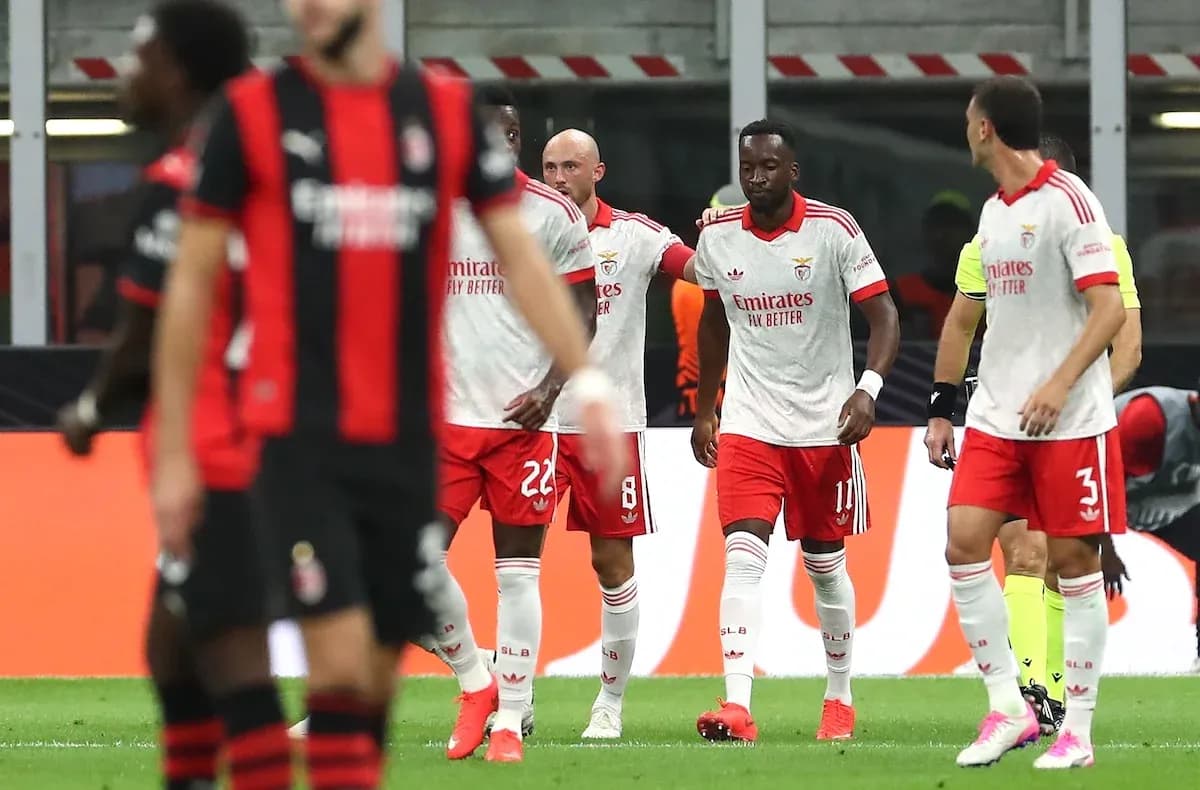
San Siro under the Europa League lights was supposed to be AC Milan’s reintroduction to continental authority. Instead, Benfica walked away with a 2–0 win that felt like a tactical lesson as much as a scoreline. Following this result, Milan sit 31st in the overall league table with 0 points, a goal difference of -2 from 0 goals scored and 2 conceded in total, and a home record of one defeat from one. Benfica, by contrast, climb to 7th overall with 3 points, a goal difference of +2 (2 scored, 0 conceded in total), and an away start that already hints at a deep run.
I. The Big Picture – Structures and Identities
Ruben Amorim’s Milan lined up in a 3-4-2-1, a system that on paper promised verticality and width but in practice exposed a side still learning its reference points. Mike Maignan anchored the back three of F. Terracciano, K. De Winter and S. Pavlovic, with a midfield line of four that blended youth and energy: S. Chukwueze and D. Bartesaghi as nominal wing-backs, and A. Jashari with Y. Musah inside. Ahead of them, O. Hutchinson and A. Cisse floated behind lone striker G. Ramos.
The numbers from Milan’s Europa campaign so far are stark. Overall, they have played 1 match, lost 1, scored 0 and conceded 2. At home, it is the same: 1 played, 0 wins, 0 draws, 1 loss, 0 scored, 2 conceded. Their average goals for at home stand at 0.0, while goals against at home are 2.0. The minute distribution of goals conceded tells its own story: 50.00% of their goals against arrived between 16–30 minutes and another 50.00% between 46–60 minutes, suggesting lapses either side of the interval rather than late collapses.
Marco Silva’s Benfica arrived with a well-drilled 4-2-3-1, and crucially, with an established Europa League rhythm. Across the season they have played 7 matches in total, winning 5, drawing 1 and losing 1. At home they have been devastating, with 3 wins from 3 and 14 goals scored, averaging 4.7 goals per game at home. On their travels, they have played 4, winning 2, drawing 1 and losing 1, scoring 7 and conceding 4, for an away average of 1.8 goals scored and 1.0 conceded. Their total goal difference in the competition is +15 (21 scored, 6 conceded overall), underlining the attacking weight behind this performance.
II. Tactical Voids – Absences and Discipline
Benfica’s only officially listed absentee was A. Bah, ruled out through injury. His absence removed a dynamic right-sided outlet, but Silva compensated by starting D. Banjaqui and S. El Karouani as full-backs and leaning heavily on the front four’s rotations.
Milan’s disciplinary profile in the competition is already a warning sign. Overall, they have received all of their yellow cards in the opening 0–15 minutes, a 100.00% early-booking concentration that speaks to anxious starts and reactive defending. No reds so far, but the timing of those cards matters: early cautions constrain aggression for the rest of the match.
Benfica’s card spread is more balanced and, crucially, more experienced. Their yellows are distributed across the 0–90+ period, with a late-game spike: 30.00% of their yellow cards arrive between 76–90 minutes, another 20.00% between 31–45, and 20.00% between 16–30. That pattern suggests a side willing to manage transitions and break rhythm when protecting a lead.
III. Key Matchups – Hunter vs Shield, Engine Room Wars
Hunter vs Shield
Milan’s “hunter” in this setup was G. Ramos, supported by the drifting runs of Hutchinson and Cisse. But the raw data shows a side not yet capable of feeding its striker: Milan have failed to score in their only Europa League outing so far, both overall and at home. Their under/over record is telling: in total, they have gone under 0.5, 1.5, 2.5, 3.5 and 4.5 goals in every category so far, underlining just how blunt they were.
Benfica’s shield, however, was more than just the back four. A. Circati and T. Araujo formed the central defensive pairing, flanked by Banjaqui and El Karouani, but the real protection came from the double pivot of F. Aursnes and J. Palhinha. Across the competition, Benfica concede only 0.9 goals per game in total, with just 0.7 at home and 1.0 away. They have kept 2 clean sheets overall and have not failed to score in any of their 7 matches, which means that once they take the lead, their structure and scoring consistency make them extremely hard to reel back in.
Engine Room – Playmaker vs Enforcer
In midfield, Milan entrusted tempo and progression to Musah and Jashari. Both are mobile and willing to carry the ball, but against Benfica’s axis they were often outnumbered. Palhinha, a natural enforcer, sat deeper, screening the defence and stepping into duels, while Aursnes linked play and covered wide spaces, allowing the front four to stay high.
Ahead of them, Benfica’s attacking band of three – D. Lukebakio, G. Sudakov and J. Kaminski – formed the creative brain. Kaminski, one of the Europa League’s standout performers so far, has 1 goal and 1 assist in total, from 6 appearances, with 3 key passes and 76% passing accuracy. Lukebakio adds vertical thrust: in total he has 1 goal, 3 shots on target from 3 attempts, and has won 7 of 10 duels, with 2 successful dribbles from 2 attempts. Together, they constantly attacked the spaces around Milan’s outside centre-backs, forcing Terracciano and Pavlovic into uncomfortable wide defending.
Up front, J. Duran provided the focal point. His movement pinned De Winter centrally, while Sudakov operated between the lines, drawing Musah and Jashari out and opening corridors for Lukebakio and Kaminski to exploit.
IV. Statistical Prognosis – Where This Leaves Both Sides
For Milan, the early numbers are brutal but clear. Overall, they have 0 wins from 1, no goals scored, 2 conceded, no clean sheets, and they have already failed to score in 1 of 1 matches. At home, they are averaging 0.0 goals for and 2.0 against. The minute distribution of goals conceded – split evenly between 16–30 and 46–60 – highlights concentration issues around tactical “reset” phases: after the opening exchanges and immediately after half-time.
Benfica, in contrast, look like a side whose underlying metrics match the eye test. In total, they average 3.0 goals scored per match and 0.9 conceded. Their attacking output is spread across the game: 19.05% of their goals come between 31–45 minutes, another 19.05% between 46–60, and another 19.05% between 76–90, with 14.29% in both the 0–15 and 16–30 windows. That even spread, combined with Milan’s vulnerability in the 16–30 and 46–60 ranges, explains how Benfica were able to strike decisively without needing a late surge.
Defensively, Benfica’s minute distribution of goals against – 33.33% between 31–45, 16.67% between 46–60 and 61–75, and 33.33% between 76–90 – suggests their only real soft spot is around the end of each half. Milan, however, never generated the sustained pressure to exploit those windows.
From a disciplinary and psychological perspective, Milan’s tendency to pick up early yellows and concede in both halves points to a team still searching for composure and structure under Amorim in Europe. Benfica, with 4 penalties taken and 4 scored in total (a perfect 100.00% record, with no misses), and no failures to score in any match, carry the aura of a side that trusts its mechanisms.
Following this result, the tactical balance of the group tilts sharply. Milan must now rebuild confidence and attacking patterns at home, perhaps by integrating the experience of L. Modric, R. Loftus-Cheek or C. Pulisic from the bench into future fixtures to add control and incision between the lines. Benfica, meanwhile, leave San Siro with more than three points: they depart with confirmation that their 4-2-3-1 structure, powered by Palhinha’s steel and Kaminski and Lukebakio’s craft, can dominate even in one of Europe’s most intimidating arenas.