.svg&w=384&q=75 "Naijagoal logo")
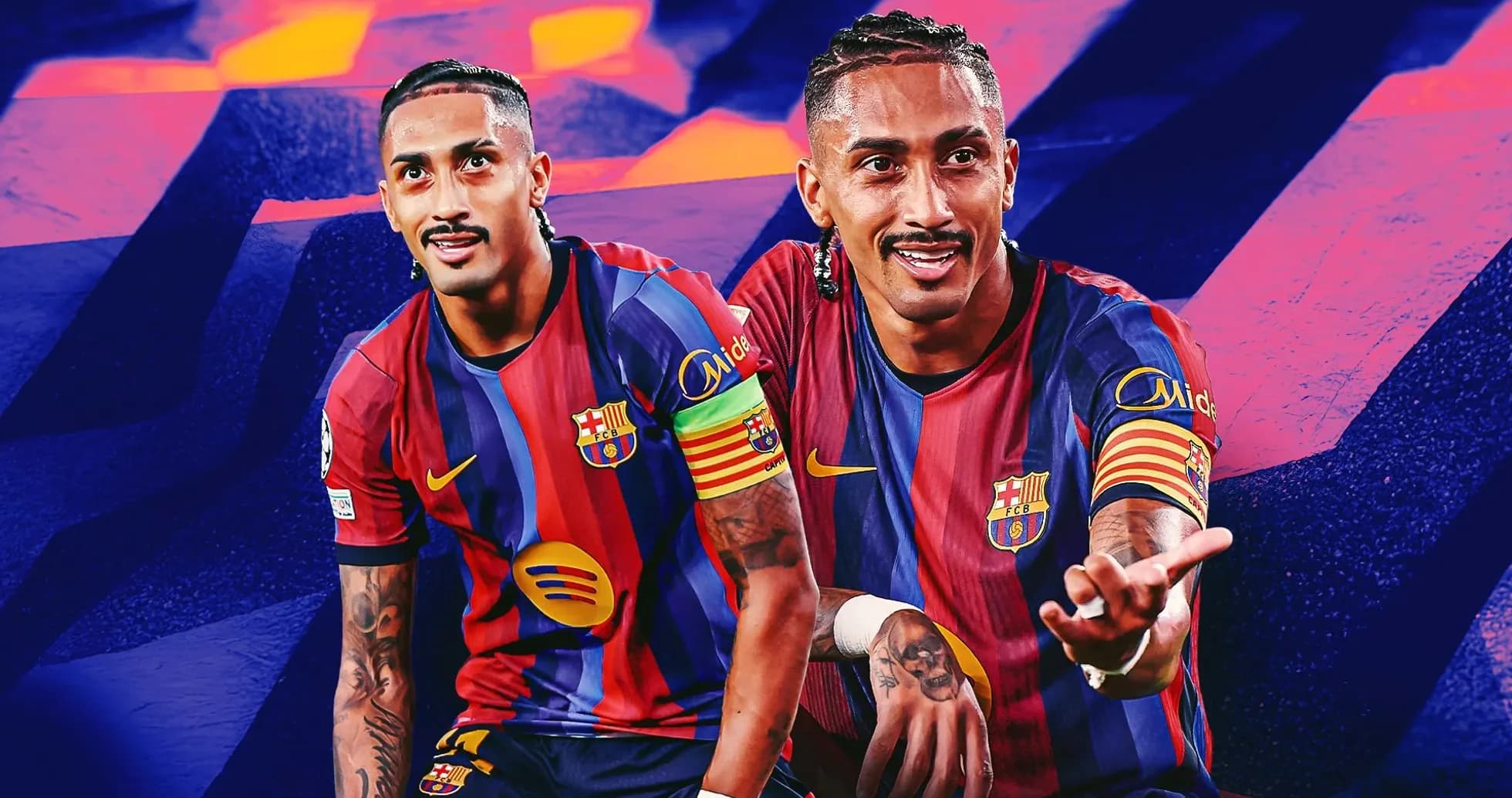

Raphinha's Transformation: From Snub to Barcelona's Star
Raphinha was supposed to be yesterday’s story.
A winger whose body kept betraying him, a nearly man who watched the Ballon d'Or slip away after a year of 60 goal contributions, then spent 125 days in the treatment room as hamstrings shredded both his season and his World Cup. From that peak, his numbers were cut in half to 29. The spotlight moved on.
Hansi Flick dragged it back.
From snub to statement
Raphinha didn’t even make the 30-man Ballon d'Or shortlist this year. For Flick, that was an insult.
“He is far too good not to be on that list, but we can’t change it,” the Barcelona coach said, with the kind of certainty that comes from seeing a player transform before your eyes. Because this is not the old Raphinha hugging the touchline. This is a 29-year-old reborn as the ruthless spearhead of Flick’s fluid attack.
The response to that Ballon d'Or snub came on Europe’s biggest stage. Feyenoord, Champions League opener, and Raphinha tearing the script to pieces.
His first goal was pure theatre. He took a slightly wayward pass from Lamine Yamal, danced past one defender, surged into the box, shaped to shoot… and then simply removed three players from the move with a dummy so audacious it looked disrespectful. Two defenders hit the deck. The space opened. The finish was ice-cold.
The second was a centre-forward’s masterclass. He moved towards Dani Olmo, dragged his marker with him, then exploded in the opposite direction. Olmo slid the pass through, Raphinha didn’t break stride, and he drilled his shot across the helpless Feyenoord goalkeeper. One run, one touch, one finish. Textbook.
Barça ran out 5-1 winners. Raphinha left with the Player of the Match award and the feeling that this was not just a great night, but the beginning of something far bigger. Right now, he’s playing with the arrogance and rhythm of the best footballer on the planet.
“Rapha has played fantastic,” Flick said. “He's on another level - he's unbelievable.”
Numbers that echo through history
The data does not argue.
Raphinha already has 11 goals this season. No Barcelona player in the last 60 years has started a campaign like that. Not even Lionel Messi. The Argentine reached 10 in his first seven games in 2012-13 and twice hit nine at this stage. Ronaldo, in 1996-97, also topped out at nine.
Raphinha has gone past them.
His transformation through the middle is the single biggest reason Flick’s Barça feel so different. Robert Lewandowski offered a classic back-to-goal presence. Ferran Torres gave sharp, clever movement in behind. Raphinha brings both threat and chaos.
He floats between the lines, bursts into pockets of space, and uses his speed and technique to pull defences apart. He links play, stretches backlines, and still has the instincts of a killer in the box. His movement opens lanes for Yamal and Anthony Gordon out wide, but he’s just as ruthless at exploiting those gaps himself.
The Racing Santander game in La Liga underlined it again. Barça won 7-2, Raphinha walked away with a hat-trick. Two came from the penalty spot. The one in between was the purest expression of a striker who understands space.
Olmo again found the angle. Raphinha ghosted between Racing’s centre-backs, waited, then pounced. One touch to set, one half-volley guided into the corner. No fuss. No panic. Just a forward who looks like he’s playing on fast-forward while everyone else is stuck in real time.
On the ball, he makes the game look simple. Off it, he is merciless. Barça’s press begins with him, a captain sprinting himself into the ground to force mistakes. Flick wants intensity and dynamism. Raphinha gives him both, plus an end product that has turned a tactical idea into a winning machine.
Somewhere in the background, the failed move for Julian Alvarez suddenly looks like a blessing.
The Brazilian standard at Camp Nou
Barcelona know what Brazilian greatness looks like. Romario. Rivaldo. Ronaldinho. Neymar. And above them all, at least in terms of a single season in blaugrana, Ronaldo.
R9 arrived from PSV in 1996 for a world-record $19.5m, just 20 years old and already terrifying. He scored 47 goals in 49 games, ripped La Liga apart, and left with the Copa del Rey, UEFA Cup Winners' Cup and Supercopa de España. He took the Pichichi with 34 league goals, claimed the European Golden Shoe and topped the 1997 Ballon d'Or voting.
The memories from that year are burned into Barça folklore: the solo run against SD Compostela, the hat-trick that turned a Copa del Rey quarter-final against Atletico Madrid into a 4-3 comeback epic.
“He is the most spectacular player I've ever seen,” said Sir Bobby Robson. Laurent Blanc called him “a freight train coming at you with a ball at his feet.”
Ronaldo was a fixed reference point up top. Raphinha isn’t. Yet the parallels are impossible to ignore. The same directness. The same refusal to waste time on the ball. The same ability to shred a defensive structure in seconds.
If Raphinha sustains this level, his numbers could start to resemble Ronaldo’s. The difference? He has the chance to anchor a treble-chasing side, not just a one-season whirlwind.
A captain who almost walked away
This version of Raphinha almost never happened.
His first two years at Camp Nou were underwhelming. He struggled to nail down a place under Xavi, looked like a luxury piece in a squad that needed steel. By 2024, an exit felt more likely than a starring role.
Flick changed everything.
“He is the coach who changed the way I think and how I see myself,” Raphinha said after the Racing win. He insisted he would “never say I am performing well,” stressing that he is always chasing improvement. Happy with the goals, happy with the win, but never satisfied.
He also made it clear: he feels “comfortable” as a central striker now. That comfort has reshaped the club.
After Marc-André ter Stegen’s loan to Ajax, Flick didn’t hesitate. Raphinha became Barcelona’s new permanent captain, the first Brazilian ever to wear the armband in Catalunya. It was a bold call. It looks inspired.
He leads with intensity, not speeches. His work rate and team-first mentality set the standard for a dressing room packed with young talent. When games drift, he grabs them by the throat. When pressure rises, he wants the ball.
A frontline reborn
Lewandowski and Torres are gone. Marcus Rashford is back at Manchester United. On paper, Barça should have lost firepower. On the pitch, they look sharper than at any point in recent years.
That’s not just Raphinha. Gordon, Karim Adeyemi and Gabriel Jesus have all settled quickly after their summer arrivals. And there’s more. Flick can now turn to 18-year-old Egyptian striker Hamza Abdelkarim, promoted from Barça B and already part of the rotation.
“Raphinha, Gabby and Hamza are three different profiles, but there are other ways we could play,” Flick said. “Anthony and Karim can also play in this position. Or Dani Olmo. Dani has showed us in last two years he can play there - the same with Fermin [Lopez]. We have a lot of options.”
Those options are crucial. Raphinha’s body has betrayed him before. Flick is determined not to let it happen again. He has already been managing the minutes: early substitutions against Feyenoord, Athletic Club and Racing, all with one eye on the long haul.
The same care is being taken with Yamal. The teenager has become even more dangerous operating closer to Raphinha. Their connection is almost telepathic. The moment a centre-back shifts to track Yamal, the ball is slipped into Raphinha, already darting into the blind-side gap.
Yamal doesn’t seem bothered about who gets the headlines. Raphinha has the armband and the goals. The youngster has the freedom and the future. Inside the dressing room, egos stay in check. Flick has star power, but he also has a collective that looks ready to chase something historic.
Chasing the ghosts of greatness
Raphinha stands at the centre of it all, the embodiment of Flick’s Barça: relentless, inventive, unforgiving.
He is carrying the captain’s armband once worn by icons and doing it as the club’s first Brazilian skipper. He is leading the press, leading the line, and leading a team that suddenly believes every competition is within reach.
Ronaldo’s single season in Barcelona still feels mythical, a standard that no Brazilian has matched since. If Raphinha keeps this up, that conversation will change.
Soon, the question won’t be whether he deserved a place on a Ballon d'Or shortlist.
It will be where, exactly, his name belongs in Barcelona’s Hall of Fame.