.svg&w=384&q=75 "Naijagoal logo")

Raphinha's Transformation Under Hansi Flick: From Injury to Barcelona's Star
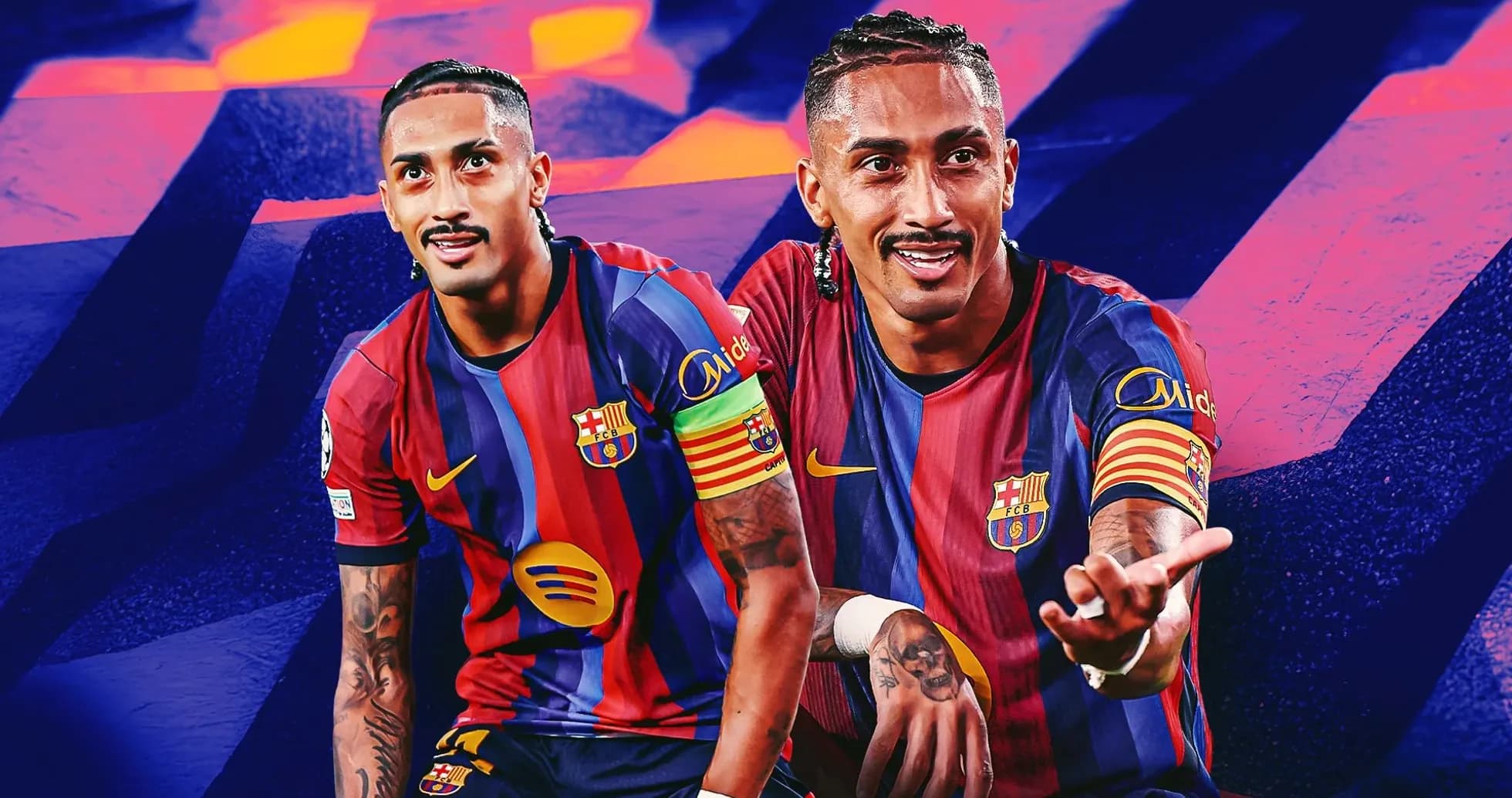
Raphinha was supposed to be yesterday’s story.
A winger with fragile hamstrings, a World Cup wrecked by injury, a Ballon d’Or nearly but not quite within reach. Sixty goal contributions in 2024-25, then the body gave way: 125 days out, the tally halved to 29, and his name missing from the 30-man shortlist the following year.
Hansi Flick took one look at that snub and bristled.
“He is far too good not to be on that list, but we can’t change it,” the Barcelona coach said, standing behind his new No. 9 with the certainty of a man who knows what’s coming. By then, Raphinha had already started ripping up the script.
From touchline to centre stage
Under Flick, Raphinha has been pulled off the chalk of the left wing and dropped right into the heart of the pitch. The move has transformed both player and team.
The Champions League opener against Feyenoord felt like a declaration. Raphinha didn’t just score twice; he announced himself as the reference point of a new-look Barca.
The first goal was pure theatre. A slightly loose pass from Lamine Yamal, one defender beaten, then a glide into the box. He shaped to shoot, froze the entire back line with a dummy so audacious it left two defenders on the turf, then rolled the ball into the corner as if he had all the time in the world.
The second was the work of a centre-forward who has studied the craft. When Dani Olmo picked up possession in the centre-circle, Raphinha initially checked towards the ball, dragged his marker with him, then exploded in the opposite direction. Olmo slid the pass in behind, Raphinha took it in stride and drove his finish across the helpless goalkeeper. Feyenoord never recovered. Barca ran out 5-1 winners, and the Brazilian walked away with Player of the Match.
“Rapha has played fantastic,” Flick said afterwards. “He’s on another level – he’s unbelievable.”
The numbers agree. Eleven goals already this season, a start no Barcelona player has matched in the last 60 years. Lionel Messi hit 10 in his first seven games of 2012-13 and reached nine twice more. Ronaldo peaked at nine in 1996-97. Raphinha has gone past them all at the same stage.
Right now, he is playing with the swagger of the best footballer on the planet.
The perfect spearhead for Flick’s chaos
Barcelona’s attack has changed shape with him at its tip. Robert Lewandowski gave them a classic target man, supreme with his back to goal. Ferran Torres stretched defences with sharp runs in behind. Raphinha offers something more volatile.
At 29, he floats between the lines, never still, always probing. His acceleration and close control drag centre-backs into places they don’t want to go. He links play, spins away, then reappears in the gaps he has just created. Yamal on one flank and Anthony Gordon on the other suddenly have room to breathe, and Raphinha is constantly first to sense where the next opening will appear.
Racing Santander discovered that the hard way in La Liga. Barca smashed seven past them in a 7-2 demolition, Raphinha helping himself to a hat-trick. Two came from the penalty spot, but the middle goal was a masterclass in timing and space.
Again, Olmo was the architect. Again, Raphinha’s movement was the difference. He drifted between the centre-backs, paused, waited. When the pass arrived, one touch set the ball, the next sent a half-volley skidding into the corner. Simple to watch, anything but simple to execute.
On the ball, he makes complex actions look routine. Off it, he sets the tone. Barca’s high press starts with Raphinha charging full tilt at defenders, forcing hurried clearances and panicked decisions. The intensity and dynamism Flick demands are wrapped inside his captain.
No wonder the coach will quietly be relieved that a move for Julian Alvarez never materialised. The frontline is humming without him, and the club can channel resources into other areas in the coming transfer windows.
Walking in Ronaldo’s shadow – and toward his company
Barcelona know what it looks like when a Brazilian forward owns the Camp Nou. Romario, Rivaldo, Ronaldinho, Neymar: each left a different kind of mark. Yet none has eclipsed the single, ferocious season of Ronaldo in 1996-97.
Ronaldo arrived from PSV for a then-world record $19.5 million at just 20 years old and detonated La Liga. Forty-seven goals in 49 games, a Copa del Rey, a UEFA Cup Winners’ Cup, a Supercopa de España. He bullied defenders with frightening strength, shredded them with raw pace and finished with an accuracy that bordered on cruel.
He took the Pichichi with 34 league goals, claimed the European Golden Shoe, and topped the 1997 Ballon d’Or vote. The memories from that year still feel fresh: the slaloming solo run against SD Compostela, the hat-trick that dragged Barca from the brink to a 4-3 comeback over Atletico Madrid in the Copa del Rey quarters.
“He is the most spectacular player I’ve ever seen,” Sir Bobby Robson said at the time. Team-mate Laurent Blanc summed up what defenders felt: “He was like a freight train coming at you with a ball at his feet.”
Ronaldo – R9 – was a fixed reference point in attack, a central battering ram. Raphinha roams more, but the instincts are similar. The eye for goal. The directness. The willingness to carve through a back four in seconds with a burst of pace and a touch of flair.
If he maintains this level, his numbers could creep into Ronaldo territory. The difference? Raphinha has the chance to lead Barca to a more complete haul of trophies.
The captain who almost left
None of this felt inevitable a year ago. Raphinha’s first two seasons at Camp Nou were frustrating, flashes of talent drowned out by inconsistency and injury. Under Xavi, he never fully nailed down a starting spot. A summer exit in 2024 would not have shocked anyone.
Flick changed everything. He saw a player to build around, not move on. From day one, the German handed him responsibility and trust.
When Marc-Andre ter Stegen left on loan for Ajax in the summer, Flick didn’t hesitate. Raphinha became Barcelona’s new permanent captain, the first Brazilian ever to wear the armband in Catalonia. It was a bold call. It already looks inspired.
His passion is obvious. His work rate is relentless. He leads by example, dragging games towards him when they start to drift, demanding more from himself and those around him.
After the Racing Santander rout, he refused to bathe in the praise. “I will never say I am performing well; I always strive to improve everything I can,” he said. “I am happy with the goals, and with the win, and that is the most important thing, but we have to keep improving.”
He spoke of feeling “comfortable” through the middle and pointed directly at Flick as the architect of his evolution. “He is the coach who changed the way I think and how I see myself. I am extremely grateful.”
From nearly out the door to the face of the project. That is one coach’s conviction turning a career around.
Depth, protection and a devastating partnership
Raphinha is not carrying this attack alone. Flick’s Barca are more fluid and dangerous than at any point in recent years, despite losing Lewandowski and Torres and sending Marcus Rashford back to Manchester United.
Gordon, Karim Adeyemi and Gabriel Jesus have all settled quickly after arriving in the summer. Behind them, 18-year-old Hamza Abdelkarim has stepped up from Barca B to offer a different profile in the box.
“Raphinha, Gabby and Hamza are three different profiles, but there are other ways we could play,” Flick has said. “Anthony and Karim can also play in this position (as striker). Or Dani Olmo. Dani has showed us in last two years he can play there – the same with Fermin [Lopez]. We have a lot of options.”
That depth matters. It gives Flick the freedom to manage his captain’s minutes. Raphinha was withdrawn early against Feyenoord, and again in league wins over Athletic Club and Racing, a clear attempt to keep those hamstrings from becoming a storyline again.
Similar care will be needed with Yamal. The teenager has exploded alongside Raphinha, especially when allowed to drift closer to the centre. Their understanding is almost telepathic.
The pattern repeats: a centre-back shifts his body to track Yamal, the youngster slips a pass into the gap, and Raphinha is already sprinting into the blind side. One glance, one movement, and the defence is gone. Yamal seems content to let the older man take the spotlight. That says plenty about the dressing room Flick has built.
No ego arms race. No tug-of-war for status. Just a fierce collective edge.
At the heart of it stands Raphinha, the captain who chases, scores, presses and never stops demanding more. The ultimate embodiment of the spirit Flick wants.
Barcelona’s Hall of Fame already has a seat reserved for R9. If this version of Raphinha endures, it may not be long before another Brazilian forward takes his place alongside him.