.svg&w=384&q=75 "Naijagoal logo")

Premier League Trophy Returns After 22 Years
The Premier League trophy finally belongs to them again, 22 long years after they last finished on top of English football. Under the Selhurst Park floodlights last month, Martin Odegaard raised it high into the south London sky, a captain framed in silver and gold. The title was sealed, the wait was over, and a fanbase starved of this moment drank in every second as the trophy began its new life in their hands.
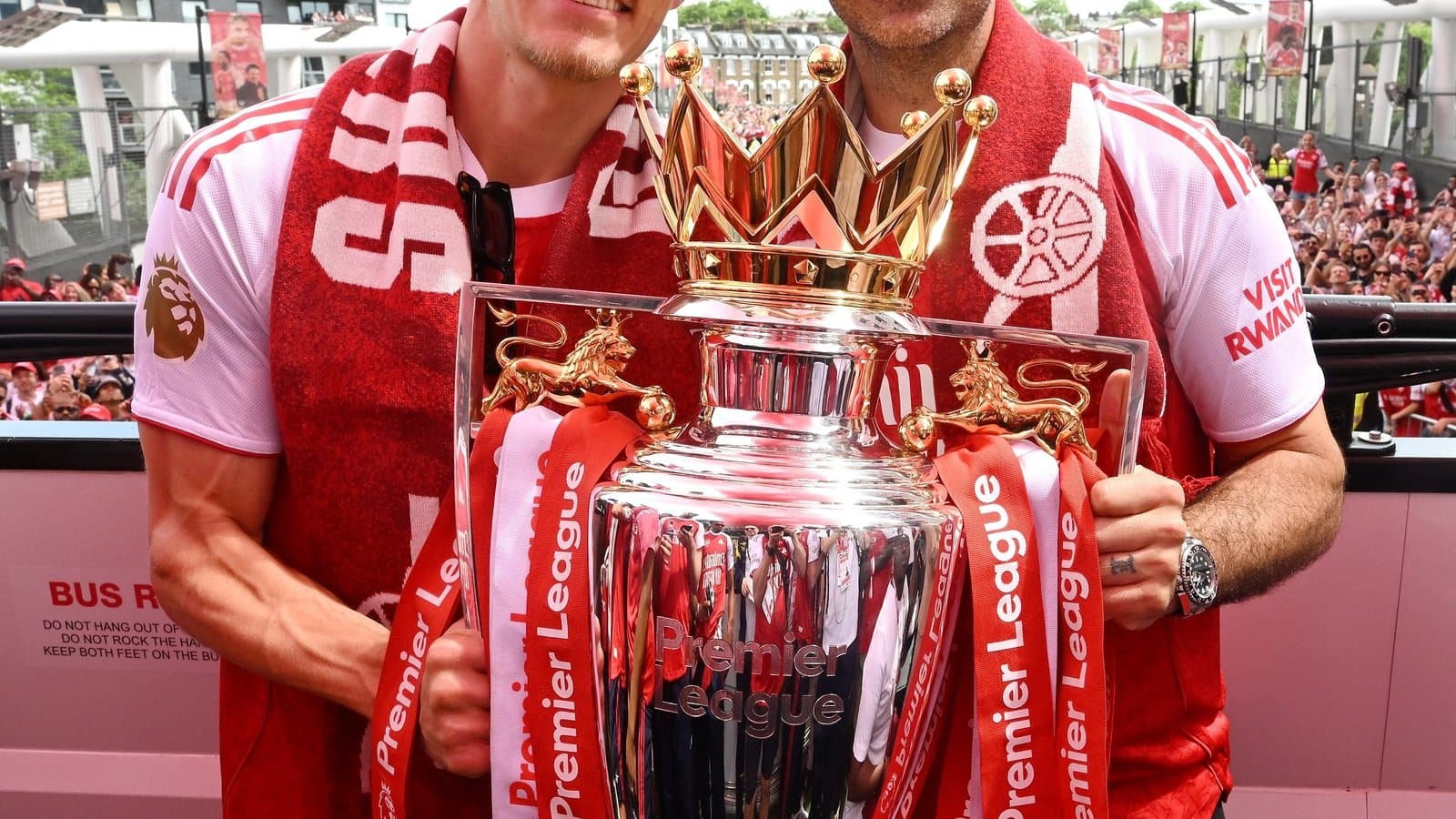
The party didn’t stop there. The champions parade turned the city into a moving sea of colour, the trophy glinting from an open-top bus as it rolled past thousands of supporters who had lived every twist of the season. Now it rests in the club’s cabinet, secure at last, its details suddenly far more interesting to those who can finally call it “ours”.
A heavyweight prize
It looks elegant on television. Up close, it’s a brute.
Every player who took a turn lifting it in front of the fans felt the same thing: this is no lightweight prop. The Premier League trophy weighs 9.5kg – about 1.4 stone – before you even count the base. Add the engraved base that carries the roll call of champions and the total mass jumps to 25.4kg, or 4 stone.
By the time it reaches the captain’s hands on that makeshift podium, it’s not just the weight of metal. It’s the weight of a season.
A crown that towers
From a distance, the trophy’s proportions can be deceptive. Up close, it dominates the room.
From the bottom of its engraved base to the tip of the crown, the Premier League trophy stands 104cm tall – roughly 3ft 5in. Across, it stretches 61cm, around 2ft wide, broad-shouldered and imposing, built to command attention on any stage.
And there isn’t just one. There are two identical Premier League trophies in existence, each carrying the names of the champions etched around the base. One lives with the holders, the other stays with the league, a twin ready for official duties and obligations while the title winners celebrate with their own.
Built like a jewel, rooted in the pitch
Look closer at the base and the story of the modern Premier League era runs in a tight circle. Every champion from 1993 is there, the list now running all the way through to the new inscription: 2025/26.
That base is more than just a plinth. It’s made from malachite, a semi-precious stone sourced from Africa. The deep green band circling the opaque stone isn’t a random flourish; it represents the field of play, the pitch on which every title is won and lost.
Above it rises the work of Asprey London, the Crown Jewellers. They cast the main body in solid sterling silver, a polished shell that reflects floodlights, flashbulbs and flares. The crowns that sit atop are fashioned from 24-carat silver gilt, a nod to royalty in a competition obsessed with its own kings.
The design leans into a clear idea: “The Three Lions of English Football”. Two golden lions grip each side of the trophy. When the captain steps forward and lifts it, arms locked, he becomes the third lion in the tableau. For a few seconds, with confetti falling and cameras snapping, that symbolism becomes reality.
How long does it stay?
For now, one of those trophies belongs to the new champions. It will remain in their possession through the season, a constant, gleaming reminder in the training ground or the boardroom of what it took to get there.
The other trophy is retained by the Premier League for its own use – events, displays, and the relentless marketing machine that follows the competition around the globe.
There is, however, a deadline. The holders must return their trophy to the Premier League at least three weeks before the final league match of the following season. By then, the story will be ready to turn again. The names on the base will not change, but the space at the top of the game will be up for grabs once more.
The question now is simple: how long can they keep their grip on it?