.svg&w=384&q=75 "Naijagoal logo")

Olympiakos Piraeus vs NEC Nijmegen: Tactically Tight 0-0 Draw
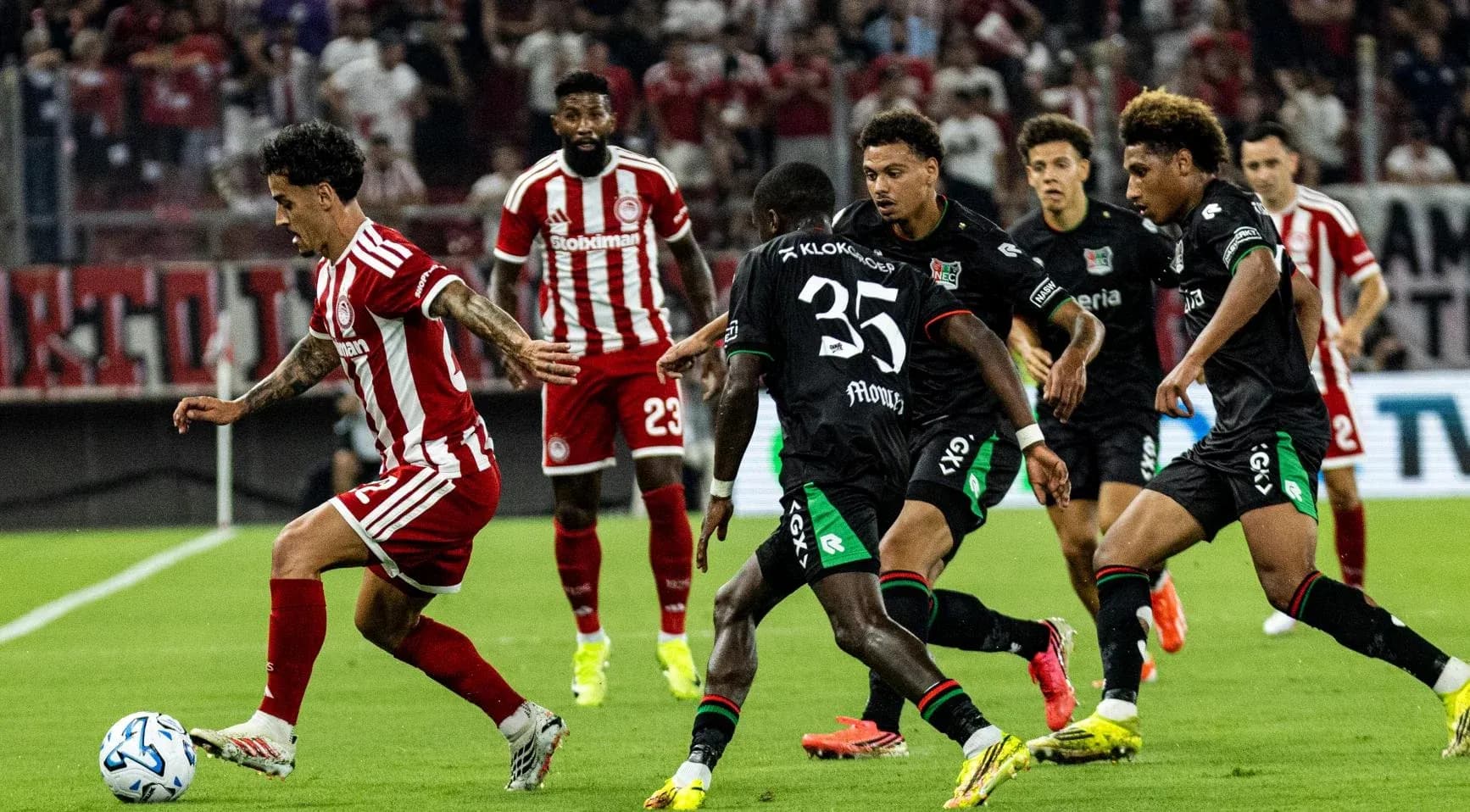
Olympiakos Piraeus and NEC Nijmegen produced a tactically tight 0-0 in the 3rd Qualifying Round of the UEFA Champions League at Georgios Karaiskakis Stadium, a match defined more by structure and control than by chaos or clear chances. Olympiakos had a marginal edge in territory and initiative, but NEC’s compact 3-4-2-1 and disciplined defensive work ensured that neither side could tilt the tie decisively before the return leg.
Team Formations
Olympiakos started in a 4-2-3-1 under Luis Mendilibar Jose, using a clear double pivot and full-backs as key outlets. B. Popovic (Olympiakos Piraeus) anchored the build-up, with the back four of M. Saliakas, P. Retsos, D. Carmo and B. Onyemaechi providing a broad platform. Ahead of them, Dani García and C. Mouzakitis operated as the screening and circulation pair, while Rodinei, Chiquinho and J. Roca supported lone striker A. El Kaabi.
NEC Nijmegen’s 3-4-2-1 under Dick Schreuder was designed to absorb pressure and spring selectively. G. Crettaz (NEC Nijmegen) sat behind a back three of T. Storm, P. Sandler and D. Fonville, with wing-backs S. Ouaissa and C. Bischoff tasked with shuttling vertically. The central midfield duo of J. Monteiro and D. Nejasmic protected the half-spaces, while N. Lebreton and B. Linssen floated behind T. Chery to contest second balls and counters.
Statistical Overview
The statistical profile underlines a balanced contest with a slight home tilt. Olympiakos recorded 54% possession to NEC’s 46%, reflecting more sustained phases of controlled build-up. The hosts completed 394 passes to NEC’s 348, but with a lower accuracy (67% vs 73%), suggesting Olympiakos tried more vertical, riskier passes into advanced zones, while NEC prioritized secure circulation and selective progression.
In terms of shooting volume, NEC actually edged the total with 13 shots to Olympiakos’ 12, but the quality and distribution were comparable. Olympiakos produced 5 shots on goal and 5 off goal, with 2 blocked efforts, and split their attempts 5 inside the box and 7 from range. NEC matched the threat in a different way: 4 shots on goal, 5 off, and a higher count of blocked shots at 4, with 7 inside the box and 6 from distance. That pattern indicates NEC were able to work the ball into the area with reasonable frequency, but Olympiakos’ block line and recovery defending were effective at getting bodies in the way.
Goalkeepers' Performances
The goalkeepers’ performances were symmetrical in outcome but not in context. B. Popovic (Olympiakos Piraeus) made 4 saves, a solid return that reflects NEC’s ability to generate moments of danger despite ceding possession. G. Crettaz (NEC Nijmegen) registered 5 saves, underlining that Olympiakos, particularly in their stronger spells either side of half-time, were able to test him with a similar level of threat. Both defensive units protected their penalty areas well enough that neither goalkeeper was overwhelmed; rather, they were asked to make routine to moderate stops as the final layer of compact defensive structures.
Disciplinary and Substitution Patterns
The disciplinary and substitution patterns reveal how the tactical story evolved. Olympiakos’ aggression out of possession showed in their 11 fouls and 2 yellow cards, compared to NEC’s 16 fouls and 1 booking. The first card, at 11’, went to David Carmo (Olympiakos Piraeus) — Foul — an early marker of how front-foot defending from the centre-backs risked individual punishment. Later, at 67’, Dani García (Olympiakos Piraeus) — Foul — was also booked, reflecting the demands placed on the double pivot to break up NEC transitions and cover large spaces as the full-backs advanced.
NEC’s single card came deep in stoppage time: 90+1’ Willum Thor Willumsson (NEC Nijmegen) — Foul — a late intervention that summed up their readiness to disrupt Olympiakos’ attempts at a final push. The card totals locked in at Olympiakos Piraeus: 2, NEC Nijmegen: 1, Total: 3, with all three cautions arising from Foul incidents rather than dissent or time management, underlining a physically contested but not ill-tempered match.
In-Game Adjustments
Mendilibar’s in-game adjustments show a clear attempt to tilt the balance further towards attacking control. At 46’, G. Martins (IN) came on for J. Roca (OUT), a half-time change that injected fresh creativity between the lines and slightly altered the dynamics of the 4-2-3-1, with more direct ball-carrying and final-third combinations. On 56’, Jota Silva (IN) came on for Chiquinho (OUT), adding verticality and penetration from wide areas, while L. Pirola (IN) came on for D. Carmo (OUT) at the same minute, a like-for-like defensive switch that maintained structural integrity while refreshing the back line.
Further defensive rotation came at 57’ when P. Maffeo (IN) came on for M. Saliakas (OUT), and at 64’ when Z. Smajlovic (IN) came on for P. Retsos (OUT). These successive changes in the back four suggest a dual objective: keeping intensity high in defensive duels against NEC’s front line and possibly managing fitness or minor knocks, without altering the fundamental 4-2-3-1 shape.
Schreuder’s substitutions were more about preserving energy and maintaining the counter-attacking threat within the same 3-4-2-1 framework. At 70’, E. Mor (IN) came on for S. Ouaissa (OUT) and B. Pereira (IN) came on for T. Storm (OUT), refreshing both a wing-back lane and a centre-back role. The introduction of Mor in a wide role added dribbling threat on transitions, even if NEC’s primary posture remained cautious. At 74’, D. Tadic (IN) came on for B. Linssen (OUT) and I. Hansen-Aaroen (IN) came on for P. Sandler (OUT), moves that rebalanced the front and back lines while preserving the 3-4-2-1’s basic spacing. Finally, at 90’, W. T. Willumsson (IN) came on for J. Monteiro (OUT), a late tweak that offered fresh legs in midfield to help see out the draw.
Corner and Offside Data
The corner and offside data further illuminate the tactical battle. Olympiakos earned 5 corner kicks to NEC’s 2, reflecting more sustained pressure and territorial advantage, especially as they pushed late for a breakthrough. NEC’s 6 offsides versus Olympiakos’ 2 point to a visiting side willing to play on the edge of the last line, trying to exploit space behind an advancing back four, even at the cost of repeated marginal calls.
Statistical Verdict
Ultimately, the statistical verdict is of a match where Olympiakos had a slight initiative advantage without clear dominance. Their extra shot on goal (5 vs 4), more corners, and higher possession were offset by NEC’s comparable total shots, greater passing accuracy, and strong defensive blocking. With no goals, no penalties, and no red cards, the tie remains finely poised; the first leg becomes a study in two well-organized sides cancelling each other out, leaving tactical refinements and individual quality to decide the second leg rather than any obvious structural weakness exposed in Piraeus.