.svg&w=384&q=75 "Naijagoal logo")

Newcastle vs Liverpool: A Tactical 2-2 Draw at St James' Park
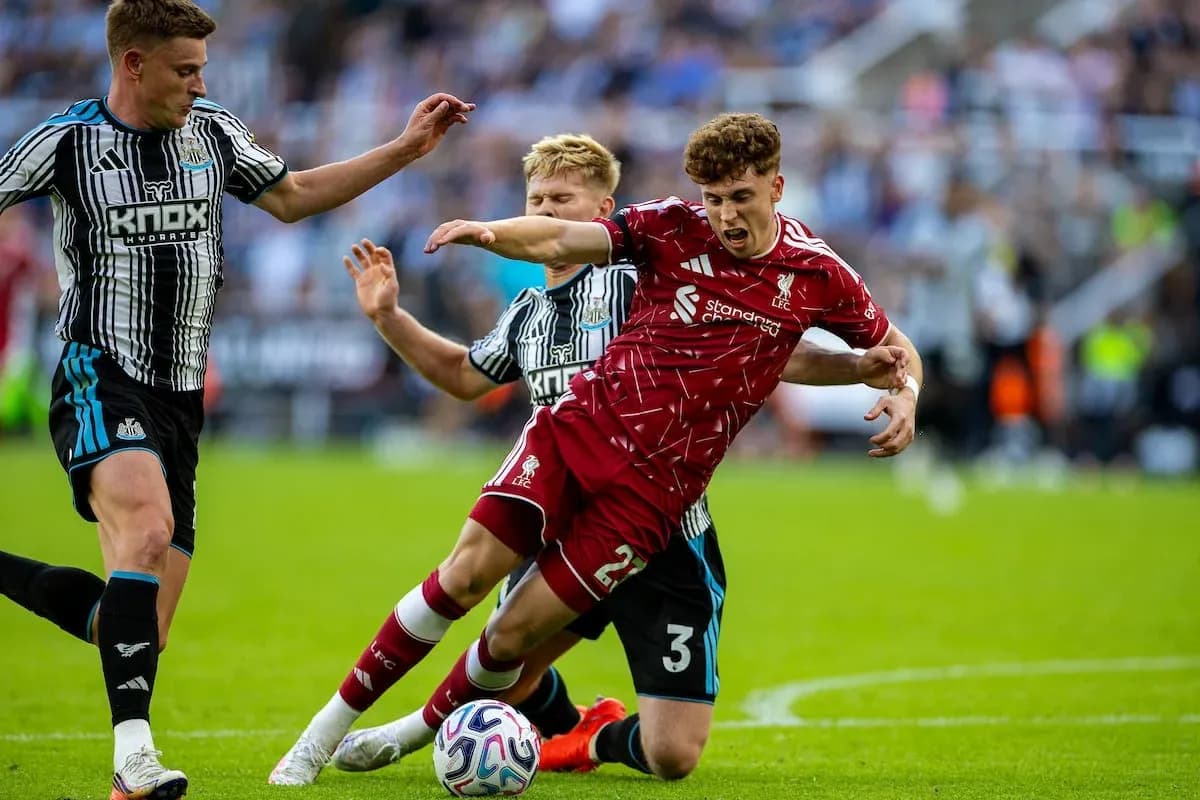
St James’ Park had the feel of a new era as the first whistle cut through the Tyneside air. Newcastle, under Matthias Jaissle, and Liverpool, reshaped by Andoni Iraola, both arrived with identical statistical DNA: heading into this game each had played 1 match, drawn 1, scored 2 and conceded 2 overall. The table reflected the deadlock: Liverpool 10th, Newcastle 11th, both on 1 point with a goal difference of 0 (2 goals for, 2 against).
The 2–2 draw that followed felt less like a conclusion and more like an opening chapter. Two sides, both committed to a 4-2-3-1, traded control and ideas as much as they traded goals.
I. The Big Picture – Two 4-2-3-1s, two identities
Newcastle’s shape was clear from the first phase. L. Hornicek behind a back four of A. Dedic, M. Thiaw, S. Botman and L. Hall gave Jaissle a platform to build from, with the double pivot of S. Steur and L. Miley tasked with threading the ball into an aggressive line of three: A. Elanga to the right, Y. Wissa central between the lines, and H. Barnes off the left, all feeding W. Osula as the lone forward.
Statistically, Newcastle’s early-season profile is stark. At home they average 2.0 goals scored and 2.0 conceded, with no clean sheets and no failures to score. It is high-event football, and this match was no exception. The 4-2-3-1 they used here is already their most common shape this season, having been deployed in 1 out of 1 league matches.
Liverpool mirrored the structure but not the rhythm. Alisson anchored a back four of J. Frimpong, J. Jacquet, V. van Dijk and M. Kerkez. Ahead of them, D. Szoboszlai and R. Gravenberch formed a technically gifted double pivot, with R. Ngumoha, F. Wirtz and C. Gakpo supporting A. Isak up top. Away from home, Liverpool also average 2.0 goals scored and 2.0 conceded, with 0 clean sheets and 0 failures to score. Like Newcastle, they have leaned on the 4-2-3-1 in 1 out of 1 league fixtures.
II. Tactical Voids – Absences and discipline
Both managers had to navigate notable absences that shaped the tactical tone.
For Newcastle, Joelinton and V. Livramento were both ruled out through injury. Joelinton’s absence stripped Jaissle of a powerful, box-to-box presence who might have added physicality to the midfield duels, particularly against Liverpool’s technically strong but still robust central pair. Without Livramento, the right flank’s rotation patterns were simplified, placing more onus on A. Dedic to balance his forward runs with defensive stability.
Liverpool’s missing list was longer: C. Bradley, H. Ekitike, J. Gomez and G. Leoni all unavailable. The absence of Bradley and Gomez reduced Iraola’s flexibility in the defensive line, making the selection of Frimpong and Jacquet almost obligatory. Without Ekitike, Liverpool lacked an alternative profile in the forward line to change the dynamic late on.
Discipline added another layer. Newcastle’s yellow card distribution this season is spread across time: 20.00% of their yellows between 16–30 minutes, another 20.00% between 31–45, then again 20.00% between 61–75, 76–90, and 91–105. It paints a picture of a side that tackles aggressively in every phase rather than only in desperation.
Liverpool’s bookings are more front-loaded. Away from home this campaign, 66.67% of their yellow cards have arrived between 16–30 minutes, with 33.33% between 76–90. That suggests an early spike in intensity—pressing and counter-pressing at maximum throttle—followed by a late-game rearguard where fatigue and game state force more cynical interventions.
III. Key Matchups – Hunter vs Shield, Engine Room battles
The “Hunter vs Shield” narrative for Newcastle is currently shared. A. Elanga and J. Willock both lead the club’s scoring charts in the league with 1 goal each. Elanga, starting here, brought direct running and incision: in his only league appearance he has 2 shots, both on target, and 1 goal, supported by 21 passes at 71% accuracy and 9 duels contested, winning 5. Willock, from the bench in that same match, showed he can change a game: 1 goal from 1 shot on target in 34 minutes, plus 2 tackles and 8 duels, signals a high-impact, box-arriving midfielder.
Opposite them stood Liverpool’s defensive core: V. van Dijk and J. Jacquet shielding Alisson, with Szoboszlai and Gravenberch screening in front. Gravenberch in particular has emerged as a quiet “shield-playmaker” hybrid. In his single league outing he has completed 47 passes at 91% accuracy, with 1 key pass and 2 interceptions. His ability to step into passing lanes while progressing the ball makes him a key figure in resisting Newcastle’s central surges from Willock or Wissa.
The “Engine Room” duel, though, is defined by youth and poise. L. Miley, at the base of Newcastle’s midfield, has already put together a well-rounded statistical line: 36 passes at 83% accuracy, 2 key passes, 1 tackle, 1 block and 1 interception, plus 7 duels contested and 5 won. He is both metronome and disruptor. Across from him, Szoboszlai offers verticality and long-range threat, while Gravenberch supplies control and line-breaking passes. This triangle—Miley vs Szoboszlai and Gravenberch—shapes how quickly either side can turn regain into chance.
On the flanks, Y. Wissa is a tactical hinge. Officially listed as a midfielder, he plays high and narrow, linking with Osula and crashing the box. His numbers underline his dual role: 4 shots (1 on target), 1 assist, 17 passes with 1 key pass, and 4 tackles, plus a massive 19 duels contested, winning 11. He is both outlet and first defender. Against Frimpong and Ngumoha on Liverpool’s right, Wissa’s willingness to track back and then spring forward creates a constant transition threat.
For Liverpool, the creative axis runs through F. Wirtz and R. Gravenberch. Wirtz’s positioning between the lines forces Miley and Steur to compress centrally, potentially opening lanes for Gakpo and Ngumoha to attack the half-spaces.
IV. Statistical Prognosis – A draw that fits the numbers
Following this result, both sides remain perfectly symmetrical in their early-season metrics. Newcastle at home: 1 match, 0 wins, 1 draw, 0 defeats, 2 goals scored, 2 conceded, goal difference 0. Liverpool away: 1 match, 0 wins, 1 draw, 0 defeats, 2 goals scored, 2 conceded, goal difference 0. Neither side has kept a clean sheet; neither has failed to score. Liverpool’s only penalty of the season has been converted, giving them a 100.00% success rate from the spot so far, with 0 penalties missed.
Without explicit xG values, the statistical prognosis leans on patterns rather than precise models. Both teams are currently tracking at 2.0 goals for and 2.0 against per match overall, suggesting open, chance-rich contests. Newcastle’s card spread hints at sustained aggression, while Liverpool’s early yellow-card spike aligns with Iraola’s high-intensity press.
Tactically, Jaissle’s Newcastle look built for chaos: dynamic wide players like Elanga and Barnes, a relentless presser and carrier in Wissa, and a late-arriving threat in Willock. Iraola’s Liverpool, by contrast, are sculpted for structured aggression: a ball-playing double pivot, attacking full-backs like Frimpong and Kerkez, and a technically sharp front four led by Isak.
A 2–2 draw at St James’ Park, in the opening round of the Premier League season, feels almost mathematically appropriate. Two 4-2-3-1 systems, two evolving projects, and for now, two teams whose numbers and narratives are in perfect balance.