.svg&w=384&q=75 "Naijagoal logo")
Myles Lewis-Skelly's Journey: From Shadows to Spotlight
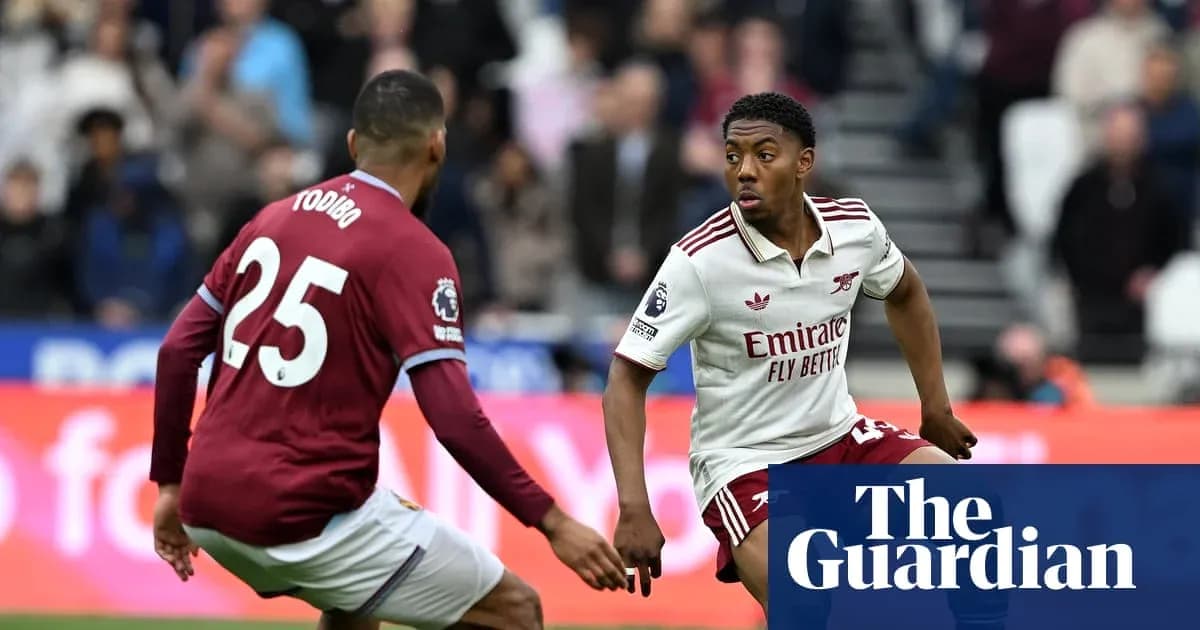
At full time at the London Stadium, it felt less like a refereeing decision and more like a reprieve. Arsenal’s players stood frozen, the away end held its breath and Chris Kavanagh listened to the voices in his ear. Ninety-fifth minute. Callum Wilson wheels away, West Ham think they have snatched a point, Arsenal feel the title slipping from their grasp.
Then the words crackle out over the stadium PA: Pablo has fouled David Raya. Goal disallowed. “Final decision, direct free-kick.”
For Ian Wright, it was poetry. Asked on Sky Sports whether those were the sweetest words he had ever heard, the Arsenal legend reached for history. “The sweetest words since Martin Luther King’s ‘I have a dream’,” he said, half-joking, half-serious, fully swept up in the drama of a title race that now refuses to loosen its grip on Arsenal’s nerves.
Inside the dressing room, Myles Lewis-Skelly tried to process it all. Relief came first.
“It is just a huge sense of relief,” he said, before the dam broke. Joy. Excitement. Fulfilment. The whole emotional range of a team that knows exactly what is at stake and exactly how fragile it all still is. Arsenal sit five points clear of Manchester City with two games left – Burnley at home, Crystal Palace away. City, with a game in hand, still have Palace at home, Bournemouth away and Aston Villa at home to come.
“We are buzzing,” Lewis-Skelly admitted. “But we know that the job is not done. We have got two more finals left.”
VAR, faith and a season on the edge
The VAR check dragged on, every second tightening the knot in Arsenal stomachs. West Ham’s fans roared for confirmation. Arsenal’s bench stared at the monitor. Players on both sides paced, pleaded, prayed.
“How did you live it?” Lewis-Skelly was asked.
“I don’t even know … it was just God on our side,” he said. “We are so grateful.”
A desperate situation, followed by a sudden, almost surreal release. Faith, belief, and then the outcome they needed. It could double as the story of Lewis-Skelly’s season.
Because until last weekend, this campaign had mostly been about waiting. And wondering. And swallowing frustration.
Last year, Lewis-Skelly looked like he was writing his own legend. Fifteen Premier League starts. A first Arsenal goal in a 5-1 demolition of Manchester City, capped with a cheeky imitation of Erling Haaland’s “Zen” celebration. A teenager stepping into elite football and behaving as if he had been there all his life.
He is not built for the shadows. On his England debut, he scored against Albania inside 20 minutes. At the Bernabéu in the Champions League quarter-final, he ran the game to such an extent that Real Madrid’s grandees in the directors’ box were reduced to one question: who is this kid?
From the fast lane to the hard yards
This season stripped away the sheen. League minutes vanished. His place in the England squad went with them. When Mikel Arteta finally turned to him again in the Premier League, away to Bournemouth on 11 April, it was only his second start of the campaign. Arsenal lost badly. The spotlight that had once felt warm now burned.
Arteta has not hidden it. He has been hard on Lewis-Skelly. Demanding. Uncompromising. And yet, nine days ago, the manager went with his instinct. A “gut feeling” told him to start Lewis-Skelly against Fulham – not at left-back, where he had broken through, but back in his natural habitat in midfield, the role he had played coming through the academy.
The response was emphatic. Lewis-Skelly drove Arsenal through a 3-0 win, snapping into duels, carrying the ball, punching passes through the lines. That performance lit something again – in him, in the manager, in the crowd.
Arteta kept faith. Lewis-Skelly started the 1-0 Champions League semi-final second leg against Atlético Madrid, helping to drag Arsenal into a final showdown with Paris Saint-Germain. Then he stayed in the side for the trip to West Ham, trusted again on a day when one slip could have been fatal.
“It was tough for me initially,” Lewis-Skelly said of the long, quiet months. “But I pride myself on having mental strength. Sport is not one pathway because there are ups and downs. It’s how you bounce back from that, how you are in those moments when you face adversity. That is what defines you.”
He shut out the noise. Or tried to.
“I spoke with my family and friends. I just told them: ‘I don’t want to hear all the noise that is coming from social media. Let me stay in this moment, let me continue to face this adversity and let me come out the other side of it.’”
So he trained as if he were starting. Every session, every drill, every tactical tweak. No sulking. No public complaints. Just the quiet conviction that when the door opened, he had to be ready to sprint through it.
“It is always being prepared, always feeling like I prepare as a starter because you never know when your time will come,” he said. “Luckily enough, it came against Fulham. I took my opportunity and helped the team out as much as I can.”
Midfield rebirth and a ruthless pecking order
The impact has been immediate. Almost overnight, Lewis-Skelly has leapt ahead of Martín Zubimendi in Arteta’s midfield hierarchy. That is no small statement. The competition is fierce and unforgiving.
Even on Sunday, with Arsenal’s display drifting, the captain altered the picture. Martin Ødegaard came on after 67 minutes, shifted the tempo and the angles, and the visitors found a second wind. Lewis-Skelly shuffled to left-back to accommodate him, a reminder of his versatility and of the standards around him.
Yet when he talks about midfield, there is no doubt where he feels he belongs.
“It feels so natural for me to be there,” he said. “I have been training there a lot so [against Fulham] I felt comfortable. The boss told me: ‘You are going to play midfield, so go for it.’ That is what I did. I had to be bold and play with courage because that is what this league demands.”
Bold. Courage. Words that cut through the spreadsheets and the balance sheets that swirl around his name. For months, his future has been a topic for the accountants as much as the analysts. “Pure profit” – the cold phrase that hangs over any academy graduate in an era of financial fine print.
Right now, that conversation can wait.
Lewis-Skelly is starting games in a title run-in. He is playing in Champions League semi-finals. He is hearing his manager’s voice in the dressing room and his own heartbeat on the pitch. The rest is noise.
“I am focused on the games we have got coming up,” he said. “And bringing this club back to glory.”
Two league matches. A Champions League final on the horizon. A teenager who has already lived a season’s worth of doubt and redemption. The margins could not be finer; the stakes could not be higher.
For Arsenal, and for Myles Lewis-Skelly, the next few weeks will decide whether this is just a stirring subplot – or the moment a career, and a club, change course for good.