.svg&w=384&q=75 "Naijagoal logo")
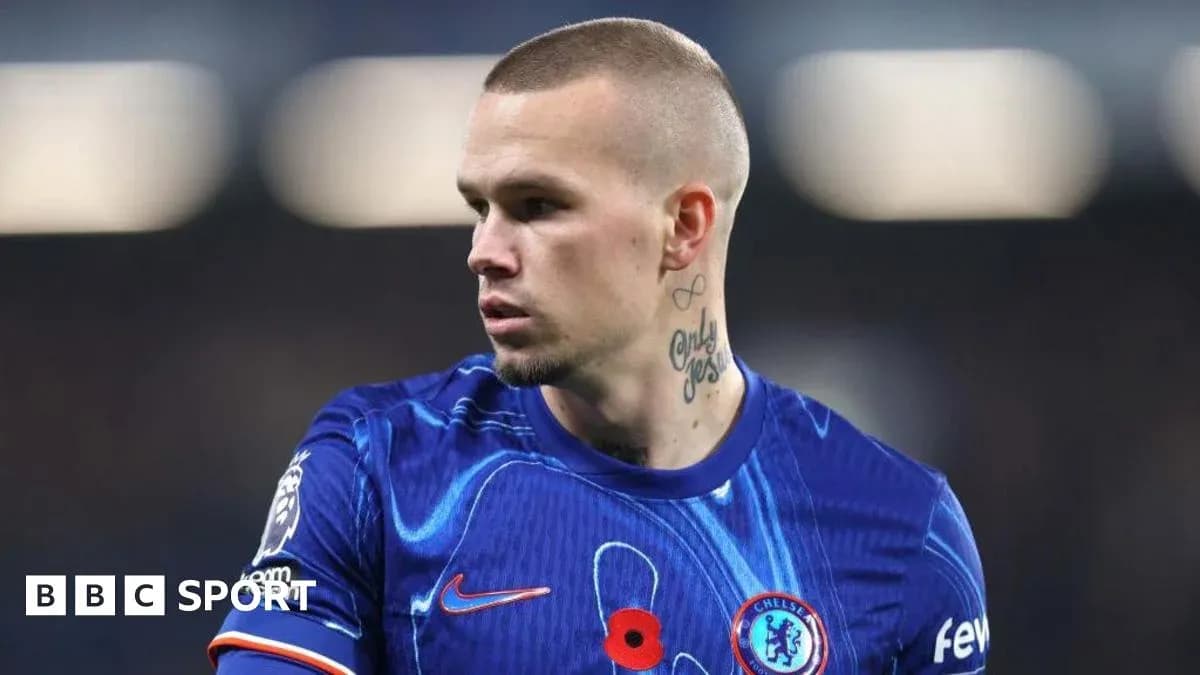

Mykhailo Mudryk Cleared to Return to Football After Doping Saga
Mykhailo Mudryk’s long exile from football is over. After 20 months in the wilderness, the Chelsea winger has been cleared to play again with immediate effect, bringing a turbulent doping saga to an abrupt and decisive close.
The 25-year-old Ukraine international had not kicked a ball in competitive action since November 2024, frozen out under a provisional suspension after an “adverse finding” for meldonium, a banned cardiovascular substance that can boost stamina and respiratory capacity. In January, the Football Association handed him the harshest possible punishment: a four-year ban. On paper, his career at the elite level looked in serious danger.
Mudryk appealed to the Court of Arbitration for Sport. Now that appeal has led to a very different outcome.
A ban overturned by time and science
The FA confirmed on Friday that its anti-doping disciplinary process with Mudryk has been resolved. He accepted that he broke anti-doping rules, but the punishment has effectively been limited to the period he has already spent on the sidelines. He can play again “with immediate effect”.
Key to the resolution was context. The FA revealed publicly for the first time that Mudryk’s positive test came from an out-of-competition sample taken while on international duty with Ukraine in October 2024. The test showed a low concentration of meldonium.
Since then, the World Anti-Doping Agency has updated its technical document on the substance. Those changes do not apply retrospectively, but the FA acknowledged that if Mudryk’s sample had been taken under today’s guidelines, “the concentration of meldonium in the sample would not have been reported” and no adverse finding would have existed at all.
That is the hinge on which this entire case has swung. The rules moved; the science shifted. The player did not suddenly become innocent, but the framework around his offence changed enough to reshape the punishment.
With WADA’s agreement, Mudryk and the FA have now settled the appeal, erasing the prospect of him being barred from competition until roughly December 2028.
“The most difficult period” — and a way back
Mudryk described the saga as “the most difficult period” of his career and said he was “grateful” to return. He again insisted he had never “knowingly or intentionally” taken a banned substance.
Chelsea, who invested £61m to bring him from Shakhtar Donetsk in 2022 on a long contract that runs to 2031, have stood by him in public while carefully respecting the integrity of the anti-doping process. The club said it is “pleased that the matter has now reached a conclusion which allows him to return to football with immediate effect” and stressed it had “always supported Misha throughout this process while fully respecting the integrity of the anti-doping system and the legal process”.
The Blues also pointedly highlighted the updated testing standards that would have meant “no anti-doping rule violation would have resulted” from his sample under current rules, calling that “an important part of the context” that allows all parties to move on.
Mudryk, for his part, spoke of “deep gratitude” towards everyone at Chelsea and talked about the “next chapter” of his career. That chapter starts immediately: he will join the club’s pre-season tour as he begins the task of turning private graft into public performance.
Training in exile
The ban cut Mudryk off from the daily life of a Premier League footballer. Under the terms of his suspension, he could not enter Chelsea’s training ground or work with club staff. Those close to him describe an extremely testing spell, one in which the club offered support from a distance but could not integrate him into any formal work.
His only known public moment around the first team came at Chelsea’s Conference League final celebrations in May 2025. Otherwise, he trained alone.
To keep himself in shape, Mudryk paid out of his own pocket for private coaching and hired goalkeepers for individual sessions. He used a pitch at non-league Uxbridge FC in west London and organised a training camp in Austria, where footage showed him sprinting, shooting, and drilling attacking patterns as if preparing for a season that might never arrive.
Those around him admit there is no true replacement for training with and against elite players every day. The rhythm of high-level football cannot be replicated in isolation. But they insist he has worked obsessively to maintain his fitness and is confident he can climb back to his best.
Realistic, too. Mudryk is said to understand the size of the challenge after 20 months out of competition. Belief alone will not bridge that gap. Minutes will.
Chelsea’s next move
Chelsea now face a decision. They have protected their asset, supported their player and welcomed the resolution, but how they reintroduce Mudryk to top-level football is a delicate call.
The club is prepared to provide a pathway back into the professional game. What form that takes is still open. Reintegration into the first team is one option, especially with a full pre-season to assess his sharpness and mentality. A loan move is another, with sister club Strasbourg an obvious candidate if Chelsea want him to rebuild rhythm away from the Premier League spotlight. A permanent transfer cannot be ruled out either, given the constant churn of their squad and the financial calculus of amortised contracts.
For now, the only certainty is that Mudryk’s Chelsea story is not finished. When he arrived at Stamford Bridge in one of the most scrutinised transfer battles of 2023, he was cast as a symbol of the club’s aggressive new era — young, expensive, and tied down on a long-term deal designed to spread cost across the books.
The doping case threatened to freeze that story in place, leaving Chelsea with a high-value asset unable to play and a legal cloud hanging over both parties. Friday’s announcement blows that cloud away.
What remains is a winger with blistering pace, a reputation still to fully justify his fee, and a rare second chance at the highest level. How he uses it — and how Chelsea choose to stage his return — will shape not just his career, but the legacy of one of the most dramatic transfer sagas of the modern era.