.svg&w=384&q=75 "Naijagoal logo")

Manchester City Faces Transition: Rodri's Future and Team Dynamics
Manchester City stand at a crossroads.
A decade of Pep Guardiola has given way to Enzo Maresca, and the Etihad is no longer the fortress of familiar faces it once was. Change isn’t coming. It has already walked through the door, taken a seat in the dressing room and started rearranging the furniture.
Four starters from the Treble-winning side of 2022-23 have gone: Manuel Akanji, Nathan Ake, Bernardo Silva and John Stones. Cornerstones of a dynasty, stripped out in one summer. In their place, City have pushed £116m across the table for Elliot Anderson and moved early for 17-year-old Jeremy Monga, a bet on tomorrow in a squad that once felt built for eternity.
And the most important piece on the board is currently under the knife.
Rodri at the centre of the storm
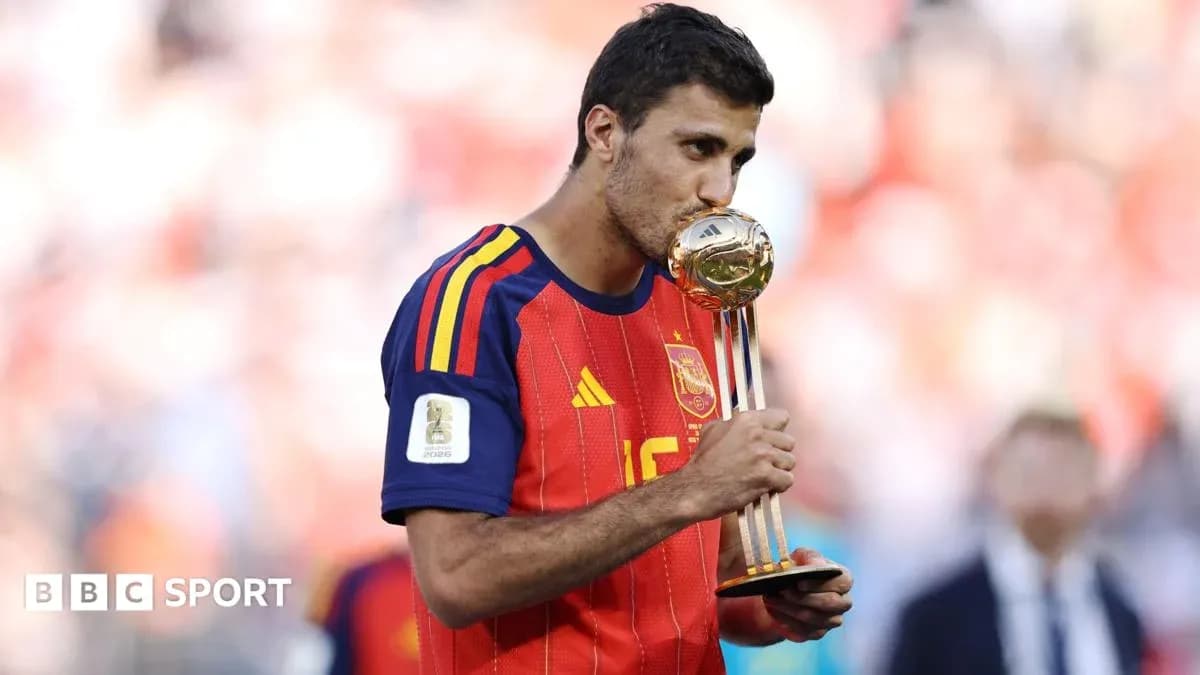
Fresh from captaining Spain to World Cup glory and collecting the Golden Ball as the tournament’s outstanding player, Rodri will undergo back surgery on Monday. He has a year left on his contract. His future is the question everyone in Manchester and Madrid keeps circling back to.
The timeline for his return is unclear. The importance of his role is not.
Maresca, in his first news conference, did not dance around it. He wants Rodri. He wants the brain of his midfield to stay exactly where it is.
“I think every manager wants to have Rodri because he is a top player,” he said. Then came the reality: surgery, rest, recovery. The message beneath it all was simple enough – the plan is to bring him back into a City shirt, not usher him towards the exit.
Yet the noise refuses to die. Reports in Spain suggest Real Madrid are “operating on the basis” that Rodri will eventually join them. That phrase alone forces City into a strategic dilemma.
Do they cash in once he is fit, maximising value on a 30-year-old midfielder with a year left on his deal? Or do they hold their nerve, back Maresca’s conviction and build his first City side around the man who has become the reference point for modern holding midfielders?
Life with – and without – Rodri
The question is not simply whether Rodri stays. It is what this City team looks like in either scenario.
When he returned from an anterior cruciate ligament injury last year, there were quiet doubts. Could he really climb back to the Ballon d’Or-winning heights of his peak? Guardiola never wavered. “In the World Cup, he will be the best Rodri, and next season he will be the best Rodri,” he said last October.
The first part has already been vindicated. Spain’s World Cup win, Rodri’s Golden Ball, his authority in and out of possession – all of it underlined why Maresca would be desperate to keep him.
But contingency planning is no longer a luxury in this squad. It is a necessity.
City have moved for Anderson and are closely monitoring 18-year-old Lille midfielder Ayyoub Bouaddi, who impressed for Morocco at the World Cup. Those are not like-for-like replacements for Rodri; they are pieces Maresca believes he can develop and reposition inside his own structure.
To understand how this might work, you have to understand the Italian’s footballing religion.
Maresca’s chessboard
Maresca is a disciple of positional play. He talks about football the way a grandmaster talks about the middle game.
“There are a lot of similarities,” he has said of chess and football. “The most important is positional play and strategy. For a coach, it's important to have the mentality of a chess player: develop a plan, study counter-moves, choose the arrangement of the pieces.”
His teams tend to morph into a 3-2-2-3 shape with the ball. That is the framework. Within it, the real work begins: rotations, occupation of zones, constant rebalancing of risk and security.
This is where Rodri becomes priceless.
At the World Cup, he repeatedly dropped into Spain’s backline when Aymeric Laporte stepped forward with the ball, creating a back three in build-up. He then slid back into holding midfield, dictating tempo, before stepping into more advanced pockets when space opened up. One player, several roles, all within the same structure.
Maresca’s best sides use those internal rotations to unhinge opponents. The shape stays the same; the faces inside it move. During City’s Treble-winning season, when Maresca worked under Guardiola, John Stones famously stepped out of centre-back to join Rodri in a double pivot. City defended as a 4-4-2, then attacked in that 3-2-2-3, with Stones transforming the geometry of the game from inside.
At Chelsea, Maresca pushed the concept even further. Moises Caicedo started at right-back on the team sheet, defended in a back four, then slid into one of the holding midfield slots when Chelsea had the ball. The pattern remained, the path to get there changed.
Rodri, with his feel for space and timing, fits that ideology almost perfectly. He reads danger, judges when to accelerate play, and understands when to hold his position. That blend of positioning, speed of thought and risk management is not easily replicated, no matter how much potential Anderson or Bouaddi might carry.
It took Rodri himself several seasons under Fernandinho’s guidance to fully adapt to the demands of Guardiola’s City. Maresca knows any successor will need time.
If the king falls
So what happens if Madrid get their way and City lose the man who knits their structure together?
Maresca’s track record offers one answer: he finds new roles for existing players and trusts his system to absorb the shock. Stones into holding midfield. Caicedo into full-back. Marc Cucurella into attacking midfield. He has repeatedly spotted positions that players could occupy but never had the chance – or the coach – to explore.
With or without Rodri, he will look at this City squad as a board with more movable pieces than Guardiola ever really wanted. The Catalan preferred a smaller, tightly controlled group. Maresca appears more open to variety and depth, more willing to carry extra options and reconfigure them.
That alone could define City’s next phase. A larger squad, more tactical flexibility, more ways to reach that familiar 3-2-2-3.
The ideal version of this project still has Rodri at its heart, stepping between lines, anchoring the build-up, setting the rhythm. The alternative is a more experimental City, forced to accelerate Anderson’s development, perhaps to fast-track someone like Bouaddi, and to lean even harder on Maresca’s eye for reinvention.
Either way, the days of automatic continuity at the Etihad are over. The pieces are moving. The question now is whether City can keep their king on the board, or whether Maresca’s first great act in Manchester will be to win without him.