.svg&w=384&q=75 "Naijagoal logo")

Manchester City at a Crossroads: Maresca's Tactical Puzzle and Rodri's Future
Manchester City are not just changing manager. They are changing skin.
After a decade of Pep Guardiola, the club have stepped into the Enzo Maresca era with a squad that suddenly looks unfamiliar. Four pillars of the Treble-winning side of 2022-23 – Manuel Akanji, Nathan Ake, Bernardo Silva and John Stones – have gone in one summer. In their place, City have pushed £116m towards Elliot Anderson and added 17-year-old Jeremy Monga, a teenager with promise rather than pedigree.
This is not a gentle evolution. It is surgery.
And the most delicate operation of all is still to come.
Rodri on the table, Madrid in the background
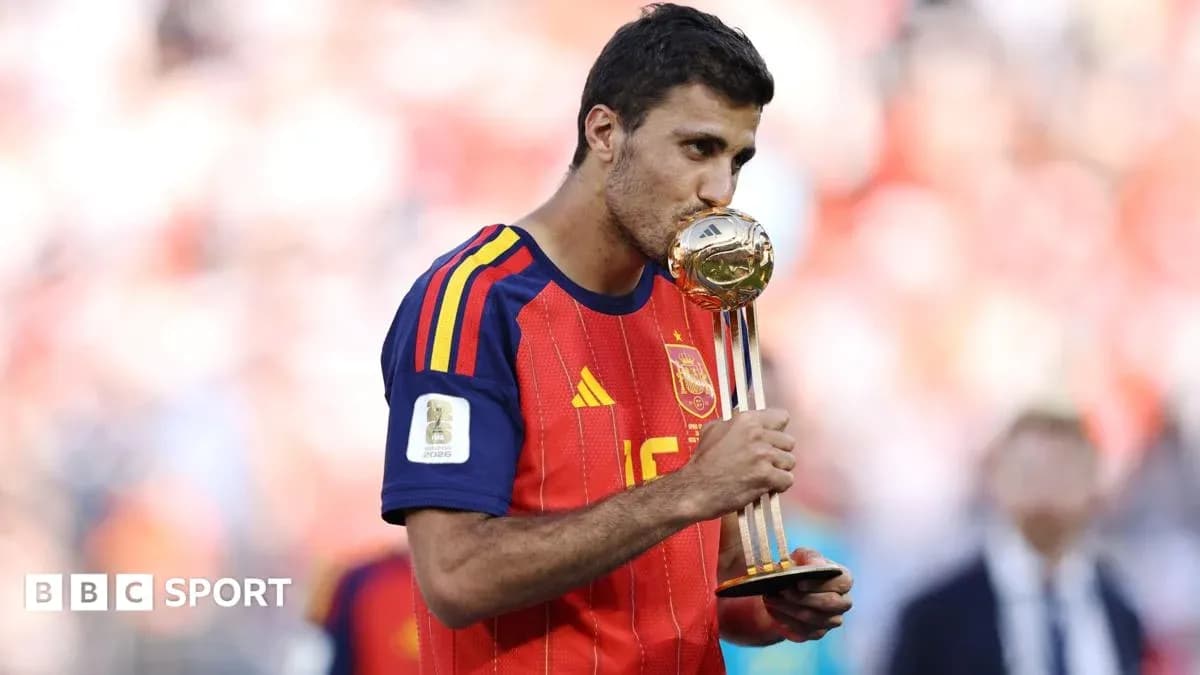
Rodri, fresh from captaining Spain to World Cup glory and collecting the Golden Ball as the tournament’s outstanding player, goes under the knife on Monday for back surgery. He has a year left on his contract. Speculation about his future is no longer background noise; Real Madrid are reported to be “operating on the basis” that he will eventually join them.
That is the storm Maresca walked into on day one.
The new manager did not flinch when asked where he stood.
“I think every manager wants to have Rodri because he is a top player,” he said. The rest was practical: surgery, holiday, rest, recovery, then back with the team. The message was simple. The plan, at least publicly, is to keep him.
But plans meet markets. If Madrid push and Rodri hesitates, City face a brutal choice: cash in on a 30-year-old midfielder returning from serious injuries, or hold their nerve and anchor the Maresca project around him.
That decision will shape everything.
The player who learned the game within the game
When Rodri suffered an anterior cruciate ligament injury last year, the question hung over him: could he get back to the Ballon d’Or-winning level he had hit at his peak?
Guardiola never doubted it. Last October he said: “In the World Cup, he will be the best Rodri, and next season he will be the best Rodri.” The first prediction landed perfectly. Rodri dominated the World Cup, ran Spain’s games from the back of midfield, and lifted the trophy as captain.
He did it in a way that speaks directly to Maresca’s football.
The Italian is a disciple of positional play. He talks about football like a grandmaster talks about chess. Not in clichés, but in the cold geometry of space, angles, and sequences.
“There are a lot of similarities,” Maresca has said. “The most important is positional play and strategy. For a coach, it's important to have the mentality of a chess player: develop a plan, study counter-moves, choose the arrangement of the pieces.”
Rodri is one of the few midfielders in the world who already plays that way, almost by instinct.
During the World Cup, he dropped into Spain’s backline when Aymeric Laporte surged forward with the ball, then stepped back into midfield when the picture changed. He sat as the holding pivot, then advanced into space when it opened up. He did not just occupy zones; he stitched them together.
For Maresca, who builds his teams in an on-the-ball 3-2-2-3 shape, that is gold.
Inside Maresca’s board
Maresca’s template is clear. Out of possession, his teams often resemble a 4-4-2. On the ball, they morph into a 3-2-2-3, with constant rotations to create and exploit superiorities.
City fans have already seen a version of it. During the Treble season, when Maresca worked as Guardiola’s assistant, John Stones stepped from centre-back into midfield alongside Rodri, turning a back four into a three and giving City that 3-2-2-3 structure. It was one of the tactical shifts that defined their run.
At Chelsea, Maresca took the same idea and twisted it. He used Moises Caicedo at right-back, defending in a back four. When Chelsea had the ball, Caicedo tucked inside to become one of the holding midfielders, again building that 3-2-2-3 pattern from a different starting point.
This is how Maresca thinks: same structure, new routes. He looks at players and sees not just what they are, but what they could be in a different square on the board.
Rodri fits that thinking perfectly. He can sit as the deepest midfielder, slide into the back three to start attacks, or step into more advanced pockets when the game demands it. He reads risk, tempo and spacing in a way Anderson and any future arrivals will need time to learn.
It is worth remembering: Rodri himself needed time. It took him a few seasons, under Fernandinho’s guidance, to fully adjust to the demands of Guardiola’s City. Positioning, pressing triggers, angles of support – none of that came overnight.
Now he is the reference point. The standard.
Life with Rodri, life without him
City, on paper, are planning for life with Rodri. Maresca wants him. The club know what he brings. But they cannot ignore the possibility that he goes.
That is where the rest of the recruitment – and Maresca’s imagination – comes in.
Anderson, signed for £116m, is one part of the contingency. City are also tracking 18-year-old Lille midfielder Ayyoub Bouaddi, who impressed for Morocco at the World Cup. Both are talented, both are comfortable on the ball, both could be shaped to fit Maresca’s system.
Yet none of them is Rodri. Not yet.
If he stays, the transition could be smoother. Rodri would act as the stabiliser while Maresca installs his positional play, rotates players through new roles, and gradually expands the squad – a notable shift from Guardiola’s preference for a lean group of trusted lieutenants.
If he goes, Maresca’s reputation for reimagining players will be tested from day one.
He has done it before. Stones into holding midfield. Caicedo into full-back. Marc Cucurella pushed into attacking midfield. Each move looked bold on paper, logical on the pitch.
The pattern is obvious: Maresca sees roles others do not. He builds his 3-2-2-3 not by insisting on specialists, but by teaching adaptable players to move between lines and positions as the game evolves.
That flexibility could be the difference between a season of turbulence and one of controlled transition.
More pieces, new picture
One thing is certain: City under Maresca will not be a copy of City under Guardiola.
The squad is already larger in concept, if not yet in numbers. Maresca wants more pieces to move, more options to reshape the team within games, more ways to reach the same structure from different starting points. It is a deliberate departure from Guardiola’s tight, meticulously curated core.
Whether Rodri stays or leaves, that shift gives Maresca a better chance of landing on a formula that works over a long, demanding season.
The question is not whether City can find a new system. They will. The real question is whether the man who best understands the old one will still be standing at the heart of the new.