.svg&w=384&q=75 "Naijagoal logo")
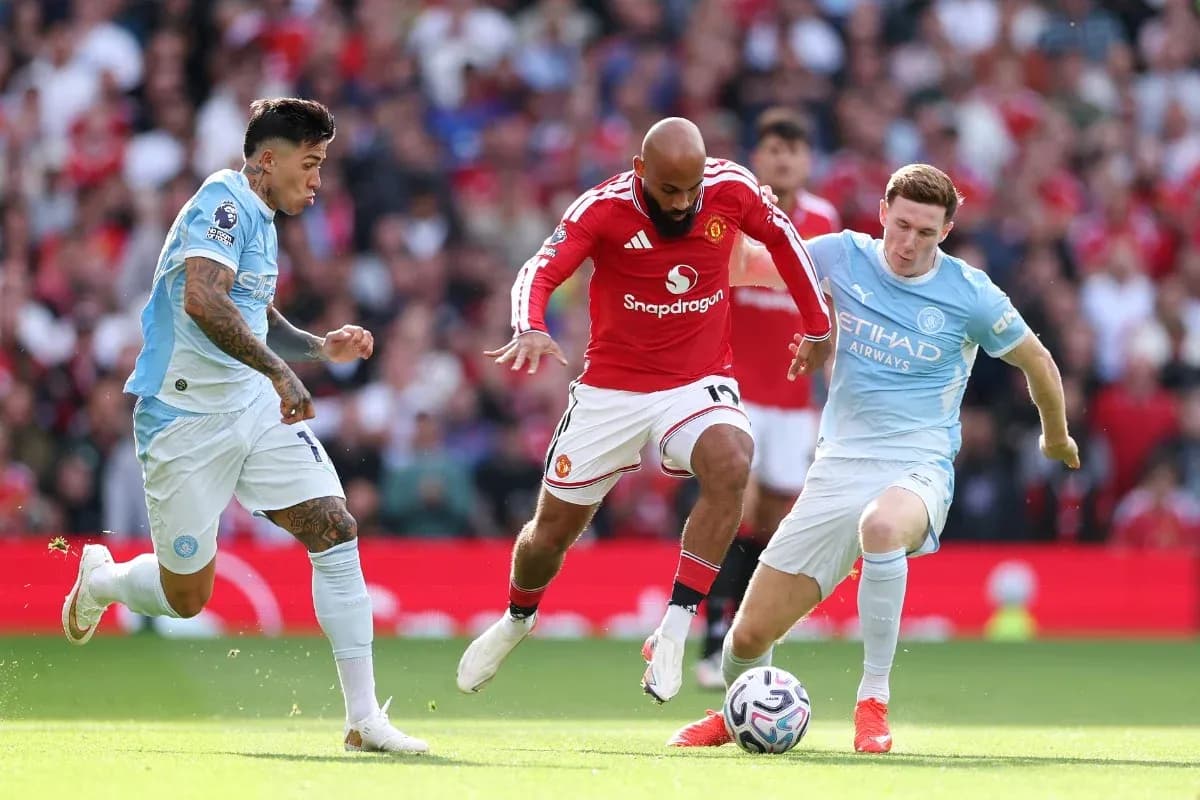

Manchester City Prevails Over Manchester United in Derby Showdown
Old Trafford under grey Manchester skies, the kind of afternoon that turns a derby into a referendum. The Premier League’s Regular Season - 4 fixture ends with Manchester City leaving with a 1–0 win, and the table tells the story: City sit 2nd with 12 points from 4 matches, perfect and relentless; Manchester United are 13th on 4 points from their 4 games, their goal difference locked at 0 after 7 scored and 7 conceded overall.
I. The Big Picture – Two 4-2-3-1s, Two Different Realities
Both sides lined up in a mirrored 4-2-3-1, but the systems carried very different identities.
Michael Carrick’s United started with S. Lammens in goal behind a back four of Diogo Dalot, H. Maguire, Lisandro Martínez and P. Dorgu. In front, Y. Tielemans and K. Mainoo formed the double pivot, with an attacking line of B. Mbeumo, Bruno Fernandes and M. Rashford supporting Matheus Cunha as the lone forward.
Enzo Maresca’s City answered with G. Donnarumma in goal, a defensive line of Matheus Nunes at right-back, M. Guéhi and Rúben Dias centrally, and J. Gvardiol on the left. E. Fernández and E. Anderson anchored midfield, with P. Foden and A. Semenyo wide and R. Cherki floating as the central creator behind E. Haaland.
Heading into this game, United’s season profile already hinted at volatility. Overall they had 1 win, 1 draw and 2 defeats from 4 matches, scoring 7 and conceding 7. At home, though, they were more expansive: 5 goals scored and 3 conceded across 2 games, an attacking average of 2.5 goals at Old Trafford but also 1.5 conceded. They had yet to keep a clean sheet anywhere and had already failed to score in 2 of their 4 fixtures.
City arrived as the league’s metronome of control. Overall they had 4 wins from 4, with 8 goals for and just 2 against. On their travels, they had been particularly ruthless: 2 away games, 2 wins, 5 goals scored and only 1 conceded, an attacking average of 2.5 away goals and a defensive average of 0.5 away goals conceded. They had 2 clean sheets in total and had not failed to score in any match.
II. Tactical Voids – Who Was Missing and What That Changed
United’s squad sheet came with a heavy asterisk. C. Baleba (ankle injury), A. Diallo, T. Heaton, L. Shaw, M. Ugarte and M. de Ligt were all ruled out. The absence of Shaw and de Ligt in particular stripped Carrick of his most natural left-back and a high-level ball-playing centre-back. That forced P. Dorgu into a demanding derby start at left-back and kept Maguire as the senior organiser in the back line.
Without Ugarte, United lacked a true destroyer at the base of midfield. Tielemans and Mainoo are both progressive and intelligent, but neither is a pure ball-winner. That shaped the entire defensive posture: United had to defend more in zones and blocks rather than through aggressive duels in midfield.
City’s only listed absentee was J. Doku with a calf injury. Maresca lost his most explosive one-v-one winger, but the structure of his first-choice XI remained largely intact, with Cherki and Foden tasked with carrying the creative load between the lines and in the half-spaces.
Disciplinary patterns from the season added another layer. United’s yellow-card distribution showed a clear late-game spike: 50.00% of their yellows had come between 76–90 minutes, with further cards in the 31–45 and 61–75 ranges. City’s yellows also peaked late, with 42.86% between 76–90 minutes and a notable 28.57% between 46–60. Crucially, City already had a red card on the board this season, shown to Foden, while United’s H. Maguire had collected 2 yellows overall. This underlined a risk zone: a frantic final quarter where both sides tend to play on the disciplinary edge.
III. Key Matchups – Hunter vs Shield, and the Engine Room
The derby’s headline duel practically wrote itself: E. Haaland against a patched-up United defence.
Haaland came into this fixture as the league’s most efficient finisher: 4 goals from 4 appearances, with 15 shots and 9 on target, and a strong duels record (17 duels won from 30). He is not just volume; he is precision. Facing him was a United back line that, heading into the game, had conceded 7 goals in 4 matches overall and had not kept a single clean sheet. At Old Trafford, they had allowed 3 goals in 2 games. The numbers framed Haaland as the hunter and United’s defensive unit as a shield with visible cracks.
Maguire was central to that shield. Across the season he had 246 passes at 88% accuracy, 5 interceptions, 1 blocked shot and 21 duels won from 34. Those metrics suggest a defender who reads danger and can step in front of it, but also one who is frequently exposed to direct contests. His disciplinary record – 2 yellow cards – hinted at the cost of operating on that line against a striker like Haaland.
In midfield, the “engine room” duel was more nuanced. Bruno Fernandes arrived as United’s creative heartbeat and one of the league’s top performers: 3 goals and 1 assist from 4 appearances, 262 passes at 85% accuracy, 9 key passes, 8 shots with 5 on target, and 1 successful penalty from 1 taken. He had also blocked 1 shot and made 1 interception, underscoring his work rate without the ball.
Opposite him, City’s creative triangle of Cherki, Foden and Semenyo offered a different kind of threat. Cherki had 2 goals and 2 assists, 10 key passes and 1 blocked shot, functioning as the primary playmaker. Foden and Semenyo each had 2 assists, with Foden adding 7 key passes and Semenyo 7 of his own. Together, they formed a layered supply line into Haaland, capable of overloading Bruno’s zones and forcing United’s double pivot to defend deeper than they would like.
IV. Statistical Prognosis – Why City’s Structure Prevailed
Even before a ball was kicked, the metrics leaned heavily toward City. Overall, they averaged 2.0 goals scored per match and only 0.5 conceded. United, by contrast, averaged 1.8 goals scored and 1.8 conceded overall, a profile of a side that lives on the edge of chaos rather than control.
United’s lack of clean sheets, combined with their tendency to collect yellows late, suggested a pattern: as games stretched, their structure frayed. City, with 2 clean sheets and no failures to score, were built to punish exactly that kind of fatigue and indiscipline. The late-card spikes for both sides hinted that the decisive phases would likely come after the hour mark, when concentration wanes and space opens.
The 1–0 full-time scoreline at Old Trafford ultimately fit the statistical logic. City’s away defensive record – 1 goal conceded across 2 away matches heading into this game – dovetailed with United’s increasing struggle to break down organised blocks when Bruno is crowded and the wide players are forced into low-percentage decisions. Donnarumma’s presence behind a disciplined back four maintained the away side’s defensive averages, while Haaland and his creators needed only a single decisive moment to tilt the derby.
Following this result, the trajectories feel stark. United remain a team whose attacking flair at home is undermined by defensive fragility and the absence of key structural pieces like Shaw, de Ligt and Ugarte. City, meanwhile, extend a perfect start built on balance: a ruthless finisher in Haaland, a multi-headed creative unit in Cherki, Foden and Semenyo, and a defensive platform that, statistically and tactically, continues to suffocate opponents on their travels.