.svg&w=384&q=75 "Naijagoal logo")

Major League Soccer's Moment: From Obligation to Ambition
“Thanks world, we’ll take it from here.”
It is a slogan, but it lands more like a statement of intent. Lionel Messi, Son Heung-min, David Beckham and a cast of Major League Soccer stars stare out from a slick new campaign, calling on the millions swept up by the World Cup to stay with the sport – only this time, to follow MLS.
The message is simple: you’ve seen the global show, now come and see what’s being built in your own backyard. The league is even dangling free tickets in front of new fans. No subtlety. Just a clear grab for a once-in-a-generation wave of attention.
Dan Courtemanche has been around long enough to understand how rare this moment is. The MLS executive vice-president joined the league in 1995, before a ball had been kicked, when the whole project was still an obligation tied to the 1994 World Cup bid. Three decades later, he sees a different landscape.
“The World Cup has now exposed millions of people to Major League Soccer,” he says. “We’re going to continue to capitalise on that momentum.”
The question hangs over everything: could this World Cup’s legacy be the moment MLS finally muscles its way into the elite tier of global leagues?
From obligation to ambition
MLS was born out of a FIFA mandate, not a romantic vision. As part of the United States’ successful bid to host the 1994 World Cup, the country had to create a professional league. So in 1996, MLS launched with 10 teams, no purpose-built stadiums and plenty of scepticism.
Thirty years on, the numbers tell a very different story. The league now boasts 30 clubs and almost as many football-specific stadiums, a physical footprint that would have been unthinkable in those early days of cavernous, half-empty NFL venues.
The World Cup has supercharged that growth curve. Fears that sky-high ticket prices would leave swathes of empty seats never materialised. Stadiums filled, atmospheres crackled, and television audiences across the United States followed along long after the US men’s national team exited the tournament.
The USA’s last-16 defeat by Belgium drew more than 33 million viewers on Fox – the most-watched football match ever on a single US network. England’s last-16 win over Mexico went even bigger, pulling in a combined 45 million viewers across English and Spanish coverage on Fox and Telemundo, the most-watched football game in US history.
Those figures live in the same neighbourhood as big NFL broadcasts. They do not yet touch the sport’s ultimate behemoth, the Super Bowl, but they no longer feel like a different sport’s niche sideshow either.
In 2025, the Super Bowl hit a record 127.7 million viewers across English and Spanish broadcasts and streaming in the US, helped as always by the gravitational pull of the half-time show, headlined that year by Kendrick Lamar. Football – the American version – still rules the mass-market roost. Soccer, though, is no longer just knocking on the door.
MLS commissioner Don Garber knows exactly where he thinks the league already stands.
“I think we’re looked at as the top, one of the top leagues commercially,” he says. “We’ve cracked that code. Now we’ve got to crack the rest of it.”
Beyond the ‘retirement league’ label
On the pitch, MLS is no longer a mere retirement home with good weather and better wages. At this World Cup, 45 MLS-based players took part, including two in the final for Argentina: Messi and Rodrigo de Paul.
The old stereotype persists – legends like Beckham and Messi arriving after their European peaks – but it no longer fits the full picture. Courtemanche points to the data: the average age of new international arrivals is now 23.8 years. Many still see MLS as a stepping stone to Europe, but they are coming earlier, hungrier, and with careers ahead of them rather than behind.
The league is adjusting its structure to match that ambition. From 2027, MLS will shift to a summer-to-spring calendar, mirroring Europe’s schedule to smooth player movement and align transfer rhythms. It is a clear admission: if you want to be taken seriously in the global market, you have to move in sync with it.
Inside its own borders, MLS is betting heavily on youth. All 30 clubs now run academies, and the league has invested in youth development competitions designed to sharpen the next generation.
You can see the culture taking root in small, telling scenes. At LA Galaxy’s viewing party for the US win over Bosnia-Herzegovina, the giant screen showed the national team. The soundtrack was the crowd’s roar. But dozens of children barely looked up. They were too busy playing three simultaneous games on nearby pitches, sprinting, tackling, scoring, pausing only when the noise from the big screen told them something major had happened.
In a country where children’s lives are usually carved into rigid schedules, these were rare pick-up games – and the standard was high. Some of those kids already belong to MLS academies.
One of them, eight-year-old Landon, is named after US legend Landon Donovan. He grins as he switches from goalkeeper to forward, his mother, coach Jen Wing, watching on. The family has travelled from New Jersey, where her children attend MLS camps and play for travel teams.
Landon doesn’t hesitate when asked about his dream. He wants to be a professional. He wants to play in MLS.
“LAFC,” he says.
The pay-to-play problem
For all the optimism, there is a structural flaw MLS cannot ignore. Critics argue the league will never truly compete with Europe while youth development in the US remains shackled to a pay-to-play culture.
At the top, MLS academies train and develop players free of charge, mirroring European models. The barrier comes before that stage. To get noticed by an academy, families often spend thousands of dollars on private coaching, elite travel teams and tournament fees. It is a familiar pattern across American youth sports – and a filter that locks out swathes of talent.
League officials insist the system is changing. Development leagues are evolving, they say, and every MLS club offers scholarships to gifted youngsters who cannot afford the pathway. Garber talks about constant improvement and a clear target: producing more, and better, young players for both MLS and the US men’s national team.
He wants players who are “better, bigger, stronger, faster,” a conveyor belt capable of feeding a national side with genuine global aspirations.
The stakes are obvious. Get this right, and MLS becomes a true producer of talent rather than just a buyer and borrower. Get it wrong, and the league risks building a gleaming structure on a narrow foundation.
Star power, ownership and serious money
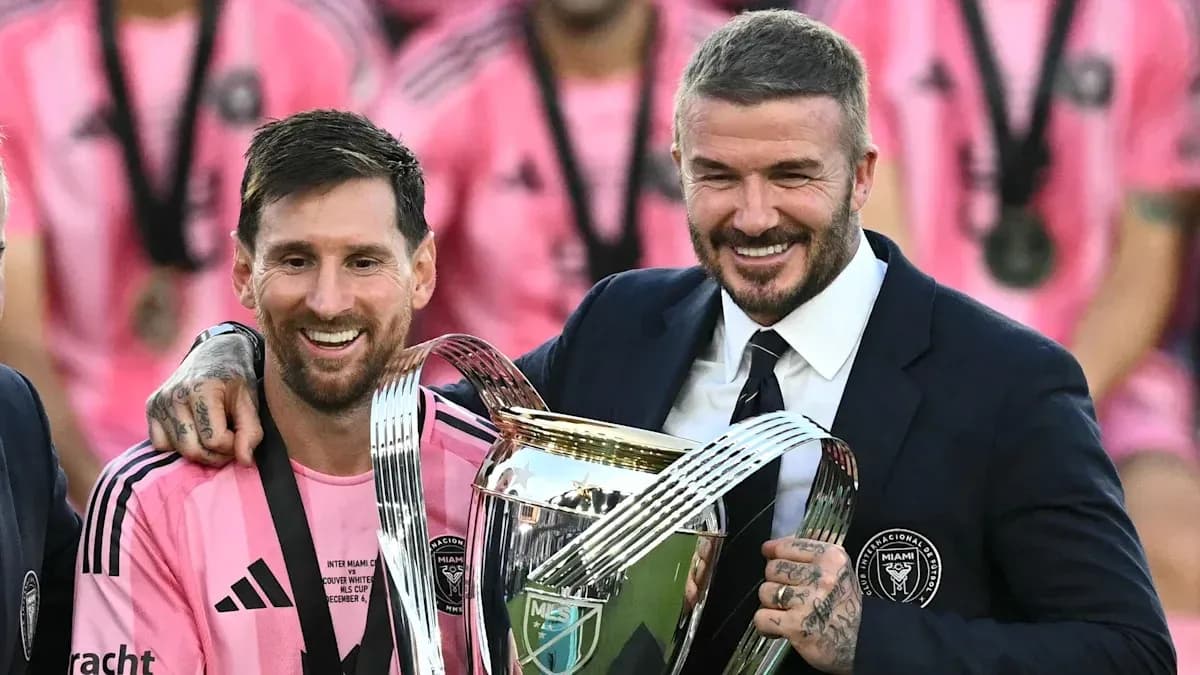
For now, Messi remains the league’s brightest beacon. His presence at Inter Miami CF has transformed attendances, shirt sales and global interest. When he plays, neutral fans tune in. When he travels, stadiums fill.
But MLS has leaned into celebrity culture well beyond the pitch. More than two dozen entertainers and athletes hold ownership stakes in clubs. Will Ferrell and Magic Johnson are part of the LAFC group. Reese Witherspoon has a share of Nashville SC. Matthew McConaughey is the most visible face of Austin FC’s ownership.
The money has followed. Drew Carey bought into Seattle Sounders in 2009 when the club joined MLS for a $30m expansion fee. Today, the Sounders are valued at more than $900m. Beckham’s 2007 LA Galaxy contract included an option to buy an expansion team for $25m. That clause eventually became Inter Miami CF, now valued by experts at over $1bn.
This is no longer a modest, experimental league scraping for relevance. It is a serious business, drawing serious capital, with franchises that appreciate like tech stocks.
Battling America’s first football
Yet the cultural battle remains brutal. For all the current soccer fever, American football still owns the rituals that shape teenage dreams.
Brian Udovich sees it first-hand. His 12-year-old son Croil plays in an MLS Next Level league in Southern California, one of the many promising youngsters in a system that prides itself on elite development. But when those kids hit high school, the gravitational pull of Friday nights can be hard to resist.
Under the lights, American football players have their names on scoreboards, marching bands on the field, cheerleaders on the sidelines and thousands in the stands. It is spectacle, status and community all rolled into one.
Soccer? That is usually Saturday mornings. A few mums and dads in folding chairs. No marching band. No lights.
“It just means so much more to other cultures than us,” Udovich says, capturing a tension that has dogged the sport in the US for decades.
Michael Bradley, now coaching New York Red Bulls, recognises the same cultural gap but senses something shifting. He talks about a country that never had the long, storied football history of Europe or South America, and about the inferiority complex that came with that – the nagging fear that soccer would never truly stick.
This World Cup has changed the mood. Bradley sees pride replacing insecurity, a fanbase that no longer feels the need to apologise for loving the game.
“I think we can all unequivocally say in 2026, football is not going anywhere,” he says.
The World Cup has left MLS with a rare opportunity: a nation paying attention, a league flush with money and star power, and a generation of children dreaming not of Europe, but of LAFC, Inter Miami and the clubs on their doorstep.
The world has handed over the spotlight. Now MLS has to prove it knows what to do with it.