.svg&w=384&q=75 "Naijagoal logo")

Liverpool's World Cup Contingent: How the Reds Fared
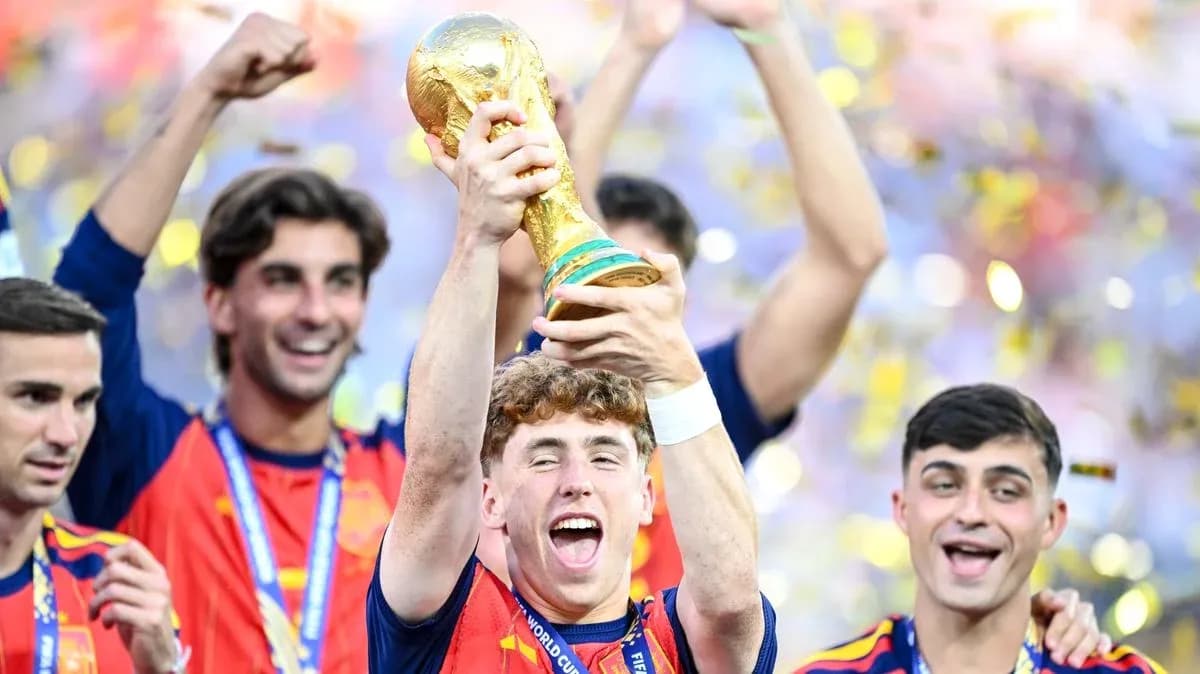
After 104 games, VAR storms and tactical trench warfare, the World Cup finally staggered to a close. Spain lifted the trophy, Argentina snarled their way through a grim final, and somewhere inside that bloated spectacle, Liverpool’s present and future quietly wrote their own stories.
Eight Reds went to North America. One came back as a world champion without playing a minute. Another dragged his country to the brink of glory. A few reminded everyone why they’re so highly rated at Anfield. Others left a hint of frustration behind.
Here’s how Liverpool’s World Cup contingent really fared.
Victor Munoz – N/A
A World Cup winner without kicking a ball. Not a bad way to arrive at Liverpool.
Spain were still wondering how they had failed to score against Cape Verde in their opening group game when the news dropped: Liverpool had triggered Victor Munoz’s £34.5m release clause at Osasuna, making him the first signing of the Andoni Iraola era.
Supporters settled in, ready for a month-long scouting mission on their new winger. Then came the twist. Munoz picked up an injury, disappeared from the teamsheet for a spell and never played a single minute as Spain marched to the title.
For the player, it will sting. For Liverpool, it changes little. Munoz now joins a very small, very select group: only the sixth serving Liverpool player to win the World Cup, following Roger Hunt, Ian Callaghan, Gerry Byrne, Fernando Torres and Pepe Reina. His real audition starts in red, not red and yellow.
Alexis Mac Allister – 7
Argentina’s final was forgettable. Mac Allister’s tournament was not.
He struggled, like so many of his team-mates, in that dour showpiece against Spain, but by then his work was largely done. Across eight games, with only the dead rubber against Jordan off his feet, he had been one of Argentina’s most reliable outlets.
From a more advanced midfield role, he knitted moves together and carried threat. He created a goal against Cape Verde, then stepped up with the opener in the quarter-final win over Switzerland. In the chaos of Argentina’s comeback against England, he was one of the few who kept his head and kept taking the ball.
Perhaps most striking of all, he only picked up one booking in eight matches. For a 27-year-old who usually walks the disciplinary tightrope, that discipline will not go unnoticed at Kirkby.
Liverpool needed Mac Allister to come back sharper, not shattered. On this evidence, he returns as one of the form midfielders in world football.
Alisson Becker – 7
Brazil were a shadow of their storied selves. Alisson was not.
Back from injury and back in goal, he offered the same calm authority Liverpool fans see most weeks. His handling was clean, his positioning sound, his decision-making largely impeccable.
He had no real chance with Erling Haaland’s two goals in the defeat to Norway that sent Brazil home. The issues lay in front of him, not behind. The back line creaked, the structure faltered, but Alisson still looked every inch one of the best goalkeepers on the planet.
The question for Liverpool is simple: can he now stay fit long enough to anchor a season that will demand everything from him?
Alexander Isak – 6
Three 90-minute outings in four games for Sweden. None all season for Liverpool. That contrast will not be lost on anyone at Anfield.
Isak began the tournament in full flow. A goal and two assists against a poor Tunisia side showcased his touch, movement and finishing. He looked loose, confident, the focal point of everything Sweden did well.
He added another assist in the heavy win over Holland, yet the returns started to dwindle as the stakes rose. The sharpness remained, but the influence faded. By the end, his World Cup had become a story of early promise and diminishing impact.
For Liverpool, the frustration is obvious. Sweden saw the fully unleashed version of Isak. Iraola will want to know when he’ll see the same.
Cody Gakpo – 8
Cody Gakpo needed this World Cup. And he played like it.
After a Liverpool season where criticism grew louder than his goal tally, he looked liberated in orange. No tactical handbrake, no positional compromise. Stationed on the left for Holland, he attacked with conviction and clarity.
The standout came against Sweden: two goals, one assist, and a performance that crackled with intent. He drove at defenders, found space inside, and finished with the kind of certainty that deserted him at times at Anfield.
Then came the most human moment of his tournament. In the round of 32 defeat to Morocco, Gakpo scored shortly after the devastating news of the loss of his unborn son. It was a goal wrapped in grief, courage and raw emotion.
On the pitch, he looked revitalised. Off it, he showed a resilience that will resonate in any dressing room.
Virgil van Dijk – 7
Virgil van Dijk remains a lightning rod in his homeland. Criticism follows him, even when the numbers don’t justify the noise.
Holland’s captain chipped in at both ends. He scored in the entertaining group draw with Japan, then turned provider with an assist against Tunisia. On the ball, he remained the calm distributor at the base of Ronald Koeman’s attack-minded side.
But Koeman built a team to go forward, not sit in. Holland conceded in all four of their games, and the collective frailty at the back gave Van Dijk’s detractors more ammunition.
The reality: he was part of a defence left exposed by design, not dereliction. Still, the bar for Van Dijk is higher than for most. He returns to Liverpool knowing that every slip, for club or country, will be magnified.
Ryan Gravenberch – 7
This was a different Ryan Gravenberch to the one Liverpool fans saw last season.
Koeman pushed him higher up the pitch at the start of the tournament, and the change suited him. Against Japan he stitched play together and produced two clever assists, timing his passes and runs with the kind of confidence that once made him one of Europe’s most coveted young midfielders.
Then the pendulum swung. For the defeat to Morocco he dropped into a more defensive role, tasked with screening rather than breaking lines. He did the job, then left the stage before Holland conceded the late equaliser that dragged the tie to penalties.
It was a mixed World Cup, but an encouraging one. Gravenberch showed he can hurt teams further up the pitch. The question now is whether Iraola sees him as a controller, a runner, or something in between.
Florian Wirtz – 6
The numbers flatter Florian Wirtz. The eye test left you wanting more.
Three assists in four games is a strong return on paper, especially in a Germany side that never truly found its rhythm. Operating mainly off the left, he drifted inside to link play, finding pockets and slipping passes that hinted at his quality.
Yet the sense persisted that he never quite grabbed the tournament. He influenced, but rarely dominated. When Germany’s campaign ended in a controversial penalty shootout defeat to Paraguay, Wirtz was already off the pitch, unable to shape the defining moments.
For a player of his talent, that feels like a missed opportunity. For Liverpool, if they are to build around him, the hope will be that the next big stage sees him step out of the shadows and into the spotlight he’s been tipped to own.
The World Cup has emptied out, the confetti swept away across three countries. For Liverpool, the real business starts again on their own American tour, with Sunderland, Leeds United and Wrexham on the schedule and Iraola waiting to knit all these stories into a single, coherent side.
Which version of these World Cup Reds will Anfield see when the serious games return?