.svg&w=384&q=75 "Naijagoal logo")

Liverpool's Future: Investment Talks and New Beginnings in New York
Liverpool have always known America was fertile ground. When you claim more than 26 million supporters in the United States, a pre-season tour across the Atlantic is not a marketing gamble, it’s a duty.
So here they are in New York, under the lights of Yankee Stadium, preparing to face Wrexham on Wednesday night. A new coach in Andoni Iraola, a new voice on the training pitch, a sense of renewal after a bruising, “super difficult year,” as chief executive Billy Hogan puts it.
But before anyone gets carried away with talk of pressing triggers and tactical tweaks, the real story sits away from the touchline.
A £4.5bn valuation and a new investor at the table
Last week, Fenway Sports Group – Liverpool’s owners since 2010 – confirmed what had been quietly brewing for some time. A consortium led by British-Indian businessman Amit Bhatia is in talks over a strategic minority investment. Not a sale. Not a handover. A slice.
Those talks are ongoing and, inside the club, there is growing confidence that the deal will happen. The Financial Times has already put a number on it: any agreement would value Liverpool at more than £4.5bn.
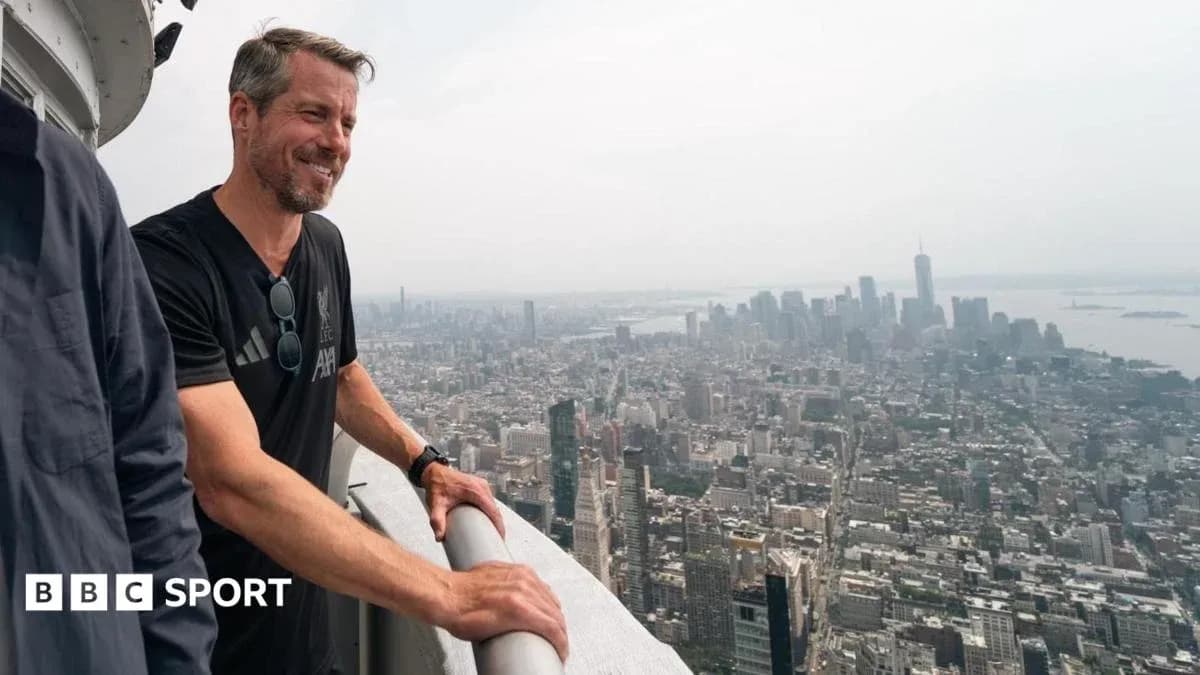
Hogan, speaking to BBC Sport in Manhattan, is careful not to step beyond the official line.
“John Henry and FSG have always said that if there was an interest in an investment that would help the football club, then they would consider it. That was said many years ago and that remains the case here,” he says.
“At this point, I wouldn’t say anything different to the statement that a consortium led, managed and represented by Amit Bhatia has come forward and expressed an interest in a minority investment.”
The message is clear: FSG are not edging for the exit. Hogan, who has been with the group since they bought Liverpool for £300m in 2010, stresses commitment, not retreat. The Boston Red Sox owners are not walking away from Anfield; they are looking for extra fuel.
“There’s a huge opportunity still,” Hogan says. “This is the biggest and most popular sport in the world and we’re one of the biggest clubs in the biggest league in the biggest sport in the world. So that’s a great place for us to be. The Premier League has a tremendous amount of momentum behind it.
“We’ve definitely not peaked. We’re in a good place to continue to grow and that’s why everyone across both sides of the club, football and business and whether they kick a ball or not, is focused on driving the club forward and winning trophies.”
Revenues up, trophies demanded
Liverpool’s financial muscle has rarely looked stronger. Fifth in the Deloitte Football Money League. Highest revenue in the Premier League at £702m. A club that once stared down administration now sits among the game’s economic heavyweights.
“On the pitch, our goal every season is to win trophies. Off the pitch, our priority is to continue driving overall revenues and expand and build the club,” Hogan says. “We’re really happy with the trajectory and direction of the club… All of that investment, as has always been the case since 2010, goes back into the club. It’s about running the club sustainably.”
Yet numbers alone do not quiet the noise. Last season Liverpool spent a record £450m in the summer window. The return was underwhelming. Performances sagged, the project lost its edge, and by the end of the campaign Arne Slot was out of a job.
Senior figures in the dressing room have gone too. Mohamed Salah, Andy Robertson and Ibrahima Konate all departed on free transfers, taking with them experience, goals and personality. The spine of a recent era, stripped away in one hit.
For a club that has prided itself on joined-up thinking, it has been a jarring period.
A summer of churn and a new voice in the dugout
The upheaval has not stopped at the technical area. Michael Edwards, FSG’s CEO of football and one of the architects of Liverpool’s data-driven rise, has stepped down after plans for a multi-club ownership model were abandoned.
Richard Hughes, the sporting director tasked with shaping the next squad, is being linked with a move to Al Hilal in Saudi Arabia. It all feeds into an obvious question: who is steering the football side, and where is the long-term stability?
Hogan does not flinch at the word “transition”.
“Transition and change is inevitable in football. In our case, with a new coach coming in, there’s real excitement around Andoni’s mindset and philosophy that supporters will really enjoy,” he says.
“That will take time but in terms of transition, I would send a message that we are in a very healthy place as a football club – the leadership from ownership is in a very steady place and we’re looking forward to the next season and the season ahead.”
The recruitment model, Hogan insists, remains intact. No panic, no lurch away from the principles that have underpinned the last decade.
“It’s important to keep in mind that last season, a considerable amount was invested but also generated in terms of sales of players going out,” he says. “Over the course of FSG’s stewardship, the investment has always been focused on doing what’s best to put us in a place to win.
“Sometimes that means significant expense and other times it doesn’t like in the summer of 2024 when there was only one addition (Federico Chiesa for £12.5m). It depends on where we are at the club and the improvements needed. Ultimately Mike Gordon, who is really our managing owner, will make those decisions.”
One signing, one new coach, a reshaped hierarchy. For a fanbase used to relentless forward motion, this is a different kind of summer: cautious, reflective, strategic rather than spectacular.
Women’s team back in focus
Not every area of the club has been handled with the same precision in recent years. Hogan is blunt about one of them.
“To be self-critical, that is probably an area that we maybe took our eye off the ball several years ago but we’ve changed that,” he says of the women’s team.
Liverpool finished 11th in the WSL last season and have not won the top-flight title since 2014. For a club of this size, that gap between ambition and reality has become too wide.
“We now have one of the best training centres at AXA Melwood, we are investing in the squad and we will approach the women’s team the same way we approach the men’s team – which is to run it sustainably. There’s tremendous growth in the women’s game and a huge opportunity going forward to really drive that.”
The intent is to bring the women’s side into the same performance and infrastructure conversation as the men, not leave them as an afterthought.
From brink of bankruptcy to billion-pound powerhouse
To understand FSG’s confidence, you have to go back to 2010. Liverpool were on the verge of administration. The club’s future, in a legal and financial sense, was in genuine doubt.
Hogan does not romanticise the journey, but he knows how far they have come.
“Back when FSG acquired LFC, a number of similarities were drawn with Boston Red Sox and Liverpool and one of them was this idea of an iconic venue that truly sits in the community,” he says.
Under FSG, Anfield has been reshaped rather than abandoned. Two of the four stands have been redeveloped in the last decade, capacity has grown, and the old ground has been dragged into the modern era without losing its edge.
“One of the things we’re focused on now is making improvements in the footprint around Anfield the neighbourhood whether that’s infrastructure or transport and getting people in on non-match days. We’re proud of how we’ve expanded while keeping the soul but also modernising it in the way that’s befitting of the football club.”
There have been flashpoints. Hogan wrote to fans this year over ticket price increases; protests forced the club to scale back planned rises for the next couple of seasons. Sustainability and supporter sentiment do not always sit easily together.
Yet from the boardroom’s perspective, the fundamentals are transformed.
“What I would say I am most proud of is that the club is in such a positive and good financial position,” Hogan says. “If you go back to that point in 2010, the club was literally on the brink of bankruptcy. Now it has the right foundations underneath it. There’s improvements across the infrastructure, the ability to stay at Anfield for the long-term and the stuff that doesn’t always get headlines but are super important for the health of the club.”
Trophies, memories and the next step
For all the spreadsheets and stadium plans, Liverpool still live and die by silverware. Hogan knows that.
“Ultimately, it’s about winning trophies and I wish we could win more but we’ve been fortunate to win a few,” he says.
He talks about the Champions League finals, the fan parks, the travelling support that turned foreign cities into temporary outposts of Anfield.
“I think our supporters have had a great time and I often think about the fan parks at the Champions League finals – we lost a couple but just that joy and the memories and frankly the fun of it is what I look back from time to time. And it’s something that everyone associated with Liverpool should be proud of because it happens together and we all want this club to be the best in the world.”
That is the bar now. Not survival. Not stability. Being “the best in the world”.
After a year that shredded confidence on the pitch and reshuffled power off it, Liverpool have chosen New York – the self-styled city of dreams – to start again. A new coach, a potential new investor, a club that insists it has “definitely not peaked”.
The next trophy will show whether that belief is justified or just another bold promise in a sport that rarely waits for anyone.