.svg&w=384&q=75 "Naijagoal logo")

Lise Klaveness: A Reluctant Rebel in FIFA's Power Struggle
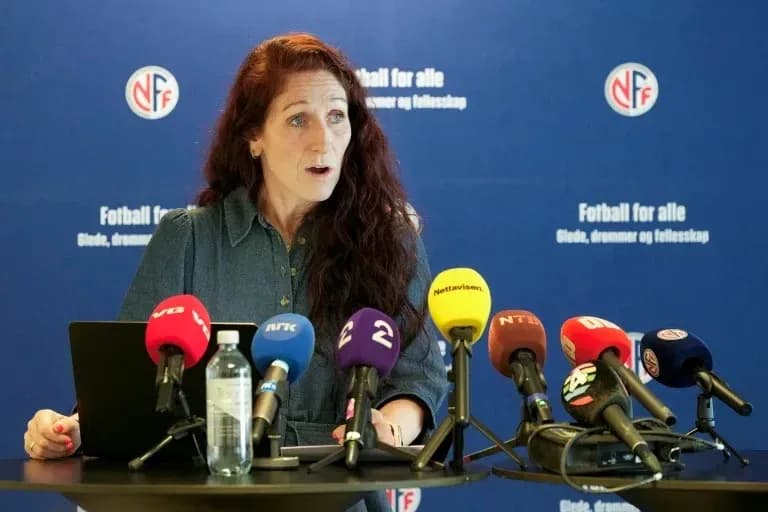
In the corridors of global football power, Lise Klaveness has become something rare: a voice that does not lower itself to a whisper when the room turns cold.
The 45-year-old head of the Norwegian federation, a former international with 73 caps and a law degree to match her playing career, has spent the Infantino era doing what so many others in Zurich have carefully avoided. She has named the problems. Out loud.
Now, with Gianni Infantino under fire and his authority shaken by a string of controversies, there are growing calls for the woman who has tormented him from the sidelines to step into the centre of the stage.
From Reform Hopes to Open Conflict
When Infantino swept into FIFA’s presidency in 2016, Klaveness, like many in the game, heard the right words. Reform. Governance. Independence.
That promise, in her eyes, has long since evaporated.
“He was a candidate who had been elected on a reform programme focused on good governance,” she told AFP. Then came what she describes as a rapid slide: distance from political interference gave way to proximity, then to capitulation, and finally to outright backtracking, all against a backdrop she sees as dangerously cosy ties with heads of state and powerful World Cup hosts.
By 2022, barely settled into her role at the helm of Norwegian football, she stopped hinting and started firing.
From Doha, at the very heart of the World Cup she believed should never have been awarded under those conditions, Klaveness delivered a speech that cut straight through FIFA’s carefully curated spectacle. Human rights. Equality. Democracy. For her, these “core interests of football” had not even made the starting XI.
The message was unmistakable. And unwelcome.
Norway followed words with action. In 2023, the federation refused to back Infantino’s re-election bid, a rare and pointed snub that underscored just how disillusioned it had become with his leadership.
“She was in a way the first standard-bearer for much of this criticism that many others now share when it comes to the way Infantino runs FIFA,” said Mina Finsted Berg, sports commentator for Norwegian channel TV2. Klaveness, she added, is relentless when it comes to rules, decisions and the principle that they must actually mean something.
Trump, Balogun and the Battle Over Investors
The rift has only deepened in recent months.
Infantino’s FIFA has lurched from one contentious decision to another, and Klaveness has kept a running tally.
- The award of a FIFA “Peace Prize” to US President Donald Trump, with whom Infantino has maintained a conspicuously close relationship.
- The lifting of US player Folarin Balogun’s suspension at the 2026 World Cup following an intervention by Trump.
- And the most explosive of all: a plan to open FIFA competitions, including the World Cup, to private investors.
That last move was slapped down swiftly last week, the proposal rejected before it could reshape the sport’s financial architecture. But the damage to Infantino’s authority was done. On Friday, Klaveness went a step further and called for him to resign.
Norway is not just grumbling from afar. The federation has decided to bring all three issues – the Trump prize, the Balogun case and the investment scheme – before FIFA’s Ethics Committee. It is a direct challenge to the president’s judgment and his way of doing business.
A Moral Voice With a Growing Audience
Klaveness’s words carry more weight now than when she first stepped behind a podium.
Norway, long a bystander at major tournaments, produced a strong run at this year’s World Cup before falling to England in the quarter-finals. That surge on the pitch has amplified her presence off it. She no longer speaks only for a principled outsider; she speaks for a federation back in the competitive conversation.
Internationally, commentators have begun to frame her as something more than just a critic. “Strong moral compass” has become the stock phrase attached to her name. In a landscape where many prefer silence to confrontation, that alone makes her stand out.
Some now see her as a serious candidate to replace Infantino, should the president’s position finally buckle under the strain. For the moment, that remains hypothetical. Infantino is standing for a fourth and final term next March and, tellingly, is still the only declared candidate.
Yet even one of his most infamous predecessors has joined the chorus.
“She was the only one who always took a clear stand and did not go along with the mainstream. And at FIFA, the time is right for a woman to take the lead,” former FIFA president Sepp Blatter wrote on X. The irony of a disgraced ex-leader endorsing a reformist critic of the current regime will not be lost on anyone.
Power, Principles and the Ballot Box
Klaveness herself has tried to pull the conversation away from personalities and palace intrigue.
The crisis in world football, she insists, cannot be reduced to a “Game of Thrones” storyline. For her, the fight is about governance, not thrones.
“For us, it has never been a personal issue against Gianni Infantino,” she told AFP. “The problems go beyond the person of the president.”
She knows her name is being floated as a possible successor. She has “registered” the speculation. But she refuses to play the candidate just yet. “We’re not there yet,” is as far as she will go.
The obstacles are obvious and heavy.
“In addition to being seen as extremely radical in many places, especially outside Europe, she is a woman. That is also likely to count against her in many regions of the world,” said TV2’s Mina Finsted Berg.
The resistance is not only global. It is local, too.
Within UEFA, where one might expect her ideas and profile to find their warmest reception, Klaveness failed in her first attempt to win a seat on the Executive Committee in 2023. She only joined in 2025, and then only as the sole candidate for the seat reserved for women.
That detail matters. If Europe itself took time to embrace her, what chance does she have in continents where tradition, politics and gender bias remain even more entrenched?
Former Norway goalkeeper and now commentator Erik Thorstvedt put the question bluntly: “If she already has such a hard time getting elected in Europe, how could she convince Africans and South Americans?”
It is the hard arithmetic of football politics. Principles travel slowly. Power, often, not at all.
Yet the fact remains: while many in world football have chosen quiet corridors and closed doors, Lise Klaveness has chosen the microphone. She has challenged the sitting president, taken her grievances to the Ethics Committee and refused to soften her stance.
Whether that makes her unelectable or inevitable is the question that now hangs over FIFA’s future.