.svg&w=384&q=75 "Naijagoal logo")

Lionel Messi Shines Again with 20th World Cup Goal
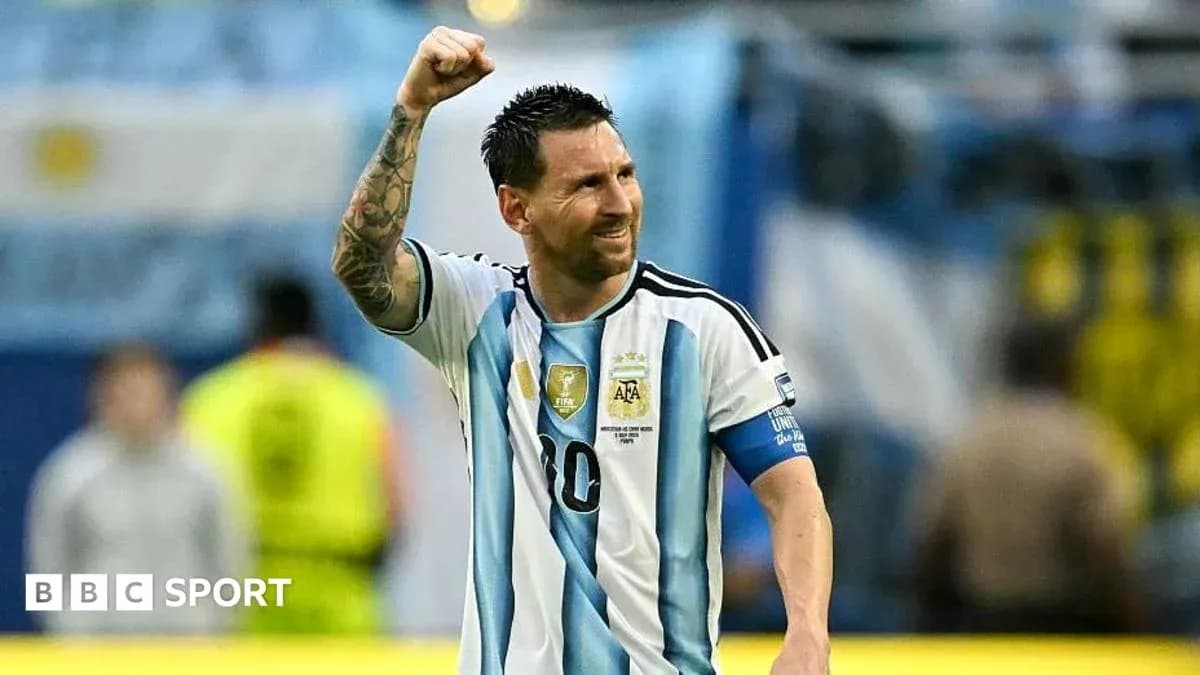
Lionel Messi did it again. Of course he did.
Fresh from putting three past Algeria, two beyond Austria and one against Jordan, he added Cape Verde to the list, scoring the opener as Argentina squeezed through a wild, breathless 3-2 World Cup last‑32 tie in Miami.
This one was more than just another goal. It was his 20th at World Cup finals, extending the record he had already prised away during the group stage in the United States. His seventh of this tournament. Another number to file under “unthinkable” for almost anyone else, routine for him.
A city painted in sky blue and white
The game felt like an Argentine home match long before the teams emerged. Hours before kick-off, the streets around the stadium pulsed with drums and horns, a tide of sky blue and white shirts rolling towards the ground. Giant Argentina flags hung from railings and lampposts. Fans sang, posed for photos, and turned Miami asphalt into a slice of Buenos Aires.
Inside, the scene was even more one‑sided. Blue and white everywhere. The number 10 on backs in every direction. Over one railing, a striking banner showed Messi and Diego Maradona side by side, rendered like saints, a piece of fan art that captured a very real belief: these are not just footballers, they are footballing deities.
The language from the stands matched the imagery. “He’s our hero. He’s like our God,” said one supporter before kick-off. Another reached for a classic metaphor: “He has aged like fine wine. The older he gets, the better he gets.”
Talk of the Golden Boot felt almost casual. Could Messi finish as top scorer? “If Argentina make the final, he will,” came the confident reply. Others shrugged at the prospect. “If he wins it, fantastic, but everything he’s already done for Argentina is enough. He is incredible.”
A quiet game, a loud moment
By his own outrageous standards, this was not a performance that bent the entire match to his will. Cape Verde refused to play the role of grateful guests. They were organised, bold on the ball, and showed none of the inferiority their world ranking – Argentina second, Cape Verde outside the top 60 – might suggest.
They annoyed Argentina. They slowed them down. They broke forward with purpose and belief.
And then Messi did what Messi has done for nearly two decades: he waited for one opening and tore the game open.
The move was simple, which made it even more devastating. A perfectly timed run beyond the back line. Lisandro Martínez picked him out with a pass that begged to be finished. One velvet first touch to gather the ball in stride, then a deft lift over the onrushing goalkeeper. No fuss, no drama. Just cold, clinical brilliance.
On BBC Radio 5 Live, former Scotland forward James McFadden could only marvel. The run “beyond the backline” and its timing, he said, were “excellent”. The pass was “outstanding”. The first touch? “Exquisite.”
On ITV, Ally McCoist went straight to the heart of it, calling it “genius at work” and shaking his head at the relentlessness of it all: “It’s just one record after another. It’s amazing.”
The numbers back him up. Messi’s seven goals at this World Cup would have been enough to win the Golden Boot at five of the past six tournaments. Since 1978, there have been 13 World Cups; a tally of seven would have made him outright top scorer in all but two of them.
He is now the first player, male or female, to reach 20 World Cup goals. He has scored in eight consecutive World Cup appearances, something no one else has done. And he is the first player to score seven or more goals at two different World Cups, having hit the same mark in 2022.
Master of space, not of sprints
What separates Messi at 39 is not a refusal to age, but a refusal to waste movement. While others burn through energy chasing shadows, he spends long passages of play walking, almost detached, scanning the pitch like a chess grandmaster studying the board.
He looks, waits, stores information. Then, when the pattern finally breaks in his favour, he strikes.
That economy of effort has always been part of his genius. Now it is the foundation of his longevity. He conserves energy until the moment matters most. One run, one touch, one finish. Goal.
Yet this World Cup has shown another layer. McFadden noted something different about his work without the ball: “Throughout the years, Messi has walked at times in games to assess what is happening. But here he is getting back to try and win the ball and is leading the press. It’s not a full, high-energy press, but he is leading it.”
Even in the autumn of his career, he is not just the artist; he is still willing to be part of the labour.
Miami, capital of Messi mania
If there is a city outside Argentina that feels built to host this chapter of Messi’s story, it is Miami.
Since his arrival at Inter Miami in 2023, the bond between player and place has deepened by the week. The Argentine community has wrapped itself around him, and the city has responded in kind. His face is on murals across neighbourhoods. His name hangs from flags and fills shop windows. Memorabilia spills out of market stalls and club stores.
On the beaches, children in Argentina number 10 shirts dribble balls across the sand, copying that familiar left‑footed sway. In stadiums, his name is chanted long before he appears, a drumbeat of anticipation that rarely stops once he does.
Even Miami’s food scene has folded him into its story. Argentine restaurants proudly serve milanesa – the breaded beef or chicken dish widely known as one of his favourites – and some have gone further, naming those plates in his honour. A comfort food turned tribute.
The frenzy reaches its peak once the final whistle goes. In the mixed zone, where players walk past the media, the usual post‑match routine disappears the moment he appears. Conversations die mid‑sentence. Journalists surge forward, microphones rise above heads, cameras tilt and stretch for a clear shot. For a few seconds, every eye and every lens is fixed on one man. Then he is gone down the corridor, and the spell breaks.
Around the world, entire digital platforms are devoted solely to tracking these moments. Every goal, every record, every walk from tunnel to team bus is documented and dissected, another line in a career that still commands global attention.
This World Cup, then, is not just about Argentina’s push for another trophy. It is also about time – how much of Messi’s there is left on this stage, and how many more nights like this he can still summon.