.svg&w=384&q=75 "Naijagoal logo")

Lionel Messi's Historic Hat Trick in Kansas City
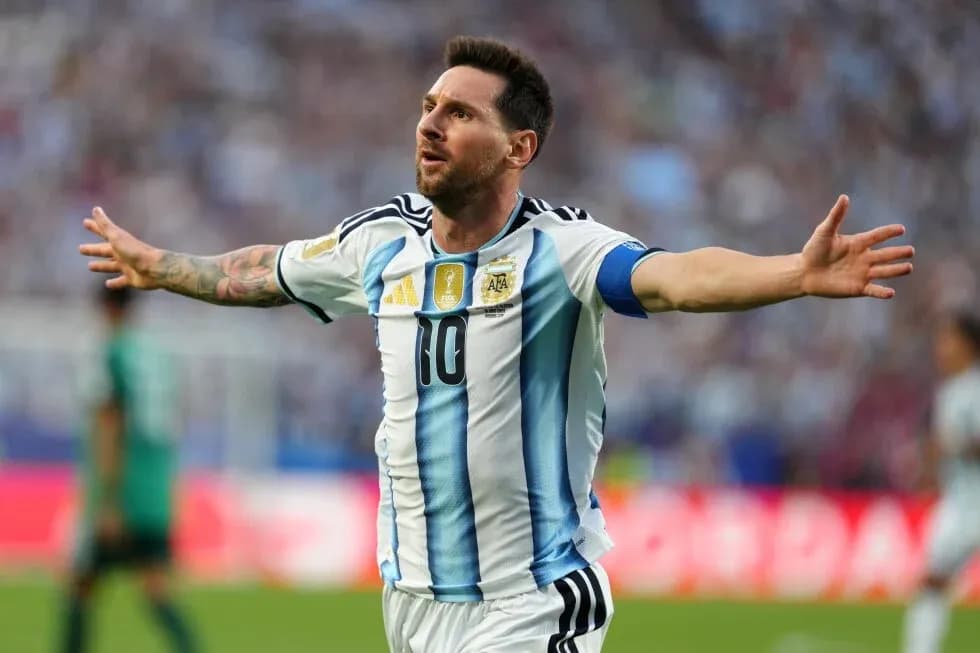
KANSAS CITY, Mo. — Lionel Messi stood in the Kansas heat with his jersey pulled up over his face, wiping away tears that refused to stay hidden. The blue and white was soaked, the usually unshakeable No. 10 suddenly human, vulnerable, overwhelmed.
Then he went back to being Lionel Messi.
One goal wasn’t enough. Nor two. By the time he walked off to a standing ovation from 69,045 fans, Argentina’s captain had delivered a hat trick, a 3-0 win over Algeria and another seismic shift in World Cup history.
Any doubts about the hamstring? Gone. Any questions about whether a 38-year-old, days from turning 39, could still drag a nation with him through another World Cup? Answered with ruthless clarity.
A Record Chase, Delivered in Three Acts
The opening goal came early, and it came with meaning. Rodrigo De Paul, his Inter Miami teammate and ever-willing lieutenant in the national shirt, slipped a clever ball into space. Messi glided onto it, finished, and then broke.
The tears came in those seconds after the net bulged.
“My tears after the first goal? I’ve had some tough days. It wasn’t related to football. And those feelings were because of that,” Messi said later, declining to say more. “I thank my teammates, the coaching staff and the delegation for helping me.”
The second goal was pure predatory instinct. Early in the second half, he followed up on a rebound, alive to the loose ball before anyone in green could react. The third? A crisp, clinical strike, the kind he has made look routine for two decades, buried just moments before he was substituted to a roar that rolled around the home of the NFL’s Chiefs.
By the end of the night, Messi’s hat trick had pulled him level with Miroslav Klose atop the men’s World Cup scoring charts. Sixteen goals on the game’s biggest stage, tied with the German great, and the sense that the record is now living on borrowed time.
Argentina coach Lionel Scaloni could only shrug.
“At a loss for words about Leo. What can I say?” he said. “He’s incredible.”
It was the 61st hat trick of Messi’s career, his 11th for Argentina, his first at a World Cup — and his fifth consecutive World Cup match with a goal. The numbers keep stacking up, but the story refuses to feel like a spreadsheet.
Twenty Years On, Still the Center of the World
This all unfolded exactly 20 years to the day since Messi first stepped onto a World Cup pitch, against Serbia and Montenegro. He scored then, too. The boy from Rosario has become the man who bends tournaments around him.
Now he stands as only the second player to score in five editions of the men’s World Cup. Six World Cups. Sixteen goals. An era in boots.
“It makes me very happy to have lived through everything that came my way. What I’m living though now is the cherry on top,” Messi said. “I’m very happy and grateful for this wonderful group. I enjoy it so much.”
While he was dismantling Algeria, two other global stars tried to muscle into the conversation. Kylian Mbappé scored twice in France’s 3-1 win over Senegal, moving to 14 World Cup goals and into a tie for fourth on the all-time list. Erling Haaland hit two in Norway’s 4-1 victory over Iraq.
Both had big nights. Messi stole the day.
“Messi is a madman,” Haaland posted on Snapchat as Argentina’s No. 10 went to work in Kansas City. It sounded less like a rival’s barb and more like a striker’s confession.
The Hamstring Question Fades
Messi arrived at this World Cup under a cloud of concern, nursing a minor hamstring problem from his time with Inter Miami. He had tiptoed through the buildup, managed minutes, avoided unnecessary strain.
Then came the tuneup against Iceland last week, a 20-minute runout, a penalty converted, sharp touches, and a first hint that the worry might be overblown.
“This is my sixth World Cup, and I still feel like I’m in good shape,” Messi said. “Fortunately, I’m doing well, and today we managed to win a tough match. It’s important to start the tournament with a victory in the first game, as that’s never easy in a World Cup.”
His body language against Algeria told its own story. He dropped deep to dictate play, burst forward when space opened, pressed when needed. No visible limp, no protective half-pace. Just Messi, again the engine of Argentina’s attack.
This was also his 200th appearance for the national team, a journey that began in 2005 when he was an 18-year-old with oversized expectations and a borrowed shirt number. Only Cristiano Ronaldo, on 228 caps and set for his 229th, and Kuwait’s Bader al-Mutawa, with 202, have played more times for their countries.
Messi and Ronaldo now share another line in the record book: the only men to score in five World Cups.
“Class is permanent,” Algeria coach Vladimir Petkovic said. “He’s fortunate to have the privilege that the entire Argentina team works for him, and supports him, and for a number of years now — decades — he’s done incredible things.”
Heartland, Hijacked by a No. 10
Argentina chose the Kansas City metro area as one of four World Cup base camps, and the city has responded by turning itself, temporarily, into an outpost of Rosario and Buenos Aires.
Messi-mania has swept through the Heartland. On match day, thousands in his No. 10 shirt streamed toward the stadium, turning the outskirts of the city into a moving, singing tribute. Drums, flags, chants — an away game for Algeria in everything but name.
Downtown, at the Power & Light District, a watch party turned surreal when a goat was led on stage wearing an Argentina jersey, alongside former NFL quarterback-turned-broadcaster Jameis Winston. A joke, a stunt, a meme-in-waiting — and, as it turned out, a neat bit of foreshadowing.
An hour later, Messi scored. The debate over the sport’s GOAT — greatest of all time — shrank a little more.
“It’s an advantage to have Leo because of how he handles the group and pushes it forward. Because of who he is,” De Paul said. “He doesn’t care about individual records. He prioritizes the group, and for us it’s incredible.”
The numbers will keep coming. The records will fall, one by one. But on a hot night in Kansas City, in his sixth World Cup and on the 20th anniversary of his first steps on this stage, Messi reminded everyone that his legacy isn’t just in what he’s done.
It’s in the unnerving sense that, even now, he’s not quite finished.