.svg&w=384&q=75 "Naijagoal logo")

Levski Sofia and AEK Athens FC Play to Tactical Stalemate in UEFA Play-offs
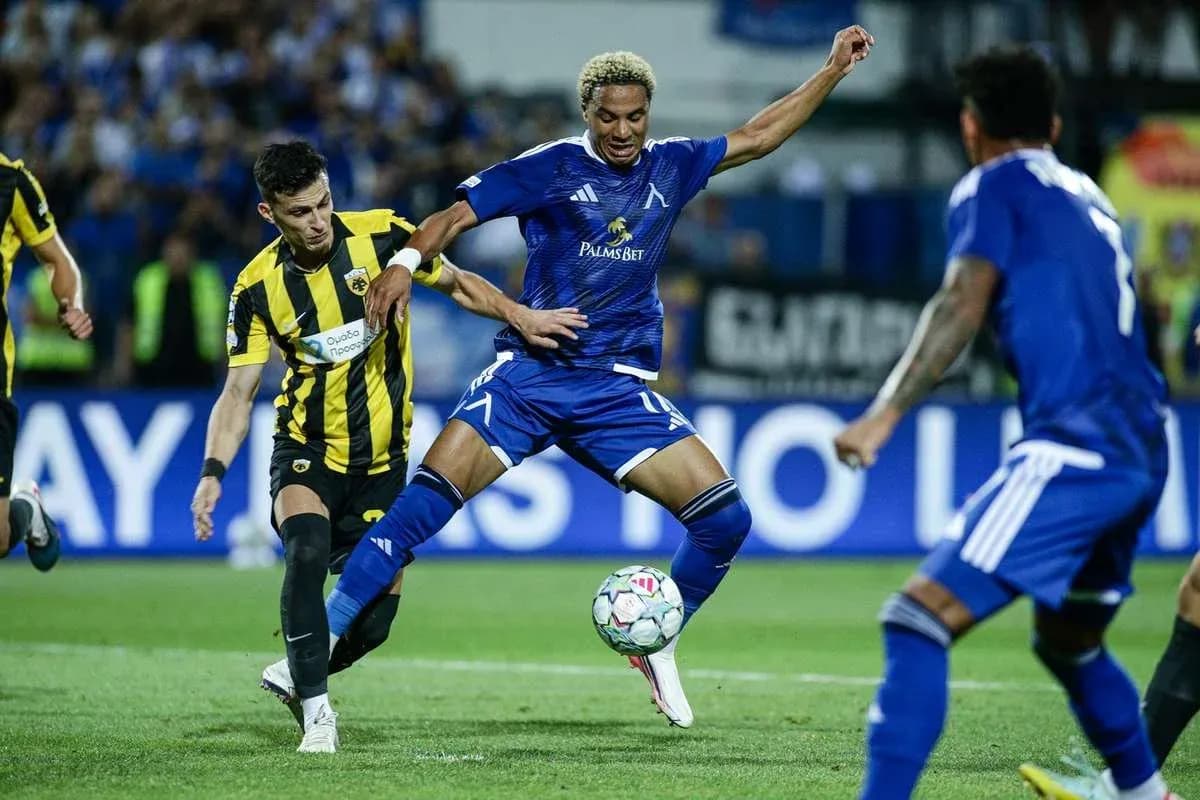
Levski Sofia and AEK Athens FC played out a goalless but tactically rich stalemate at Georgi Asparuhov Stadium, a first-leg style contest in the UEFA Champions League Play-offs that was defined more by structure and control than by penalty-box chaos. Across 90 minutes, Levski shaded possession at 52% and out-shot AEK 15–12, yet both sides ultimately protected their defensive principles more than they risked numbers in attack, leading to a 0-0 that keeps the tie finely balanced.
Levski's Tactical Setup
Julio Velazquez set Levski up in a 4-2-3-1 that aimed to dominate the ball and progress methodically through the thirds. The double pivot of M. Moubarik and Maicon acted as the platform: Moubarik largely anchoring in front of the centre-backs, Maicon stepping higher to connect with the line of three – A. Oko-Flex, Serginho and Everton Bala – behind lone forward Reinaldo. The structure gave Levski clear passing lanes into the half-spaces, reflected in their 485 total passes with 428 accurate at an 88% completion rate, slightly superior to AEK’s 453 passes at 87%. This technical edge allowed Levski to dictate tempo for long spells, but their 6 shots inside the box from 15 overall attempts show that many attacks stalled before truly high-quality final actions.
AEK's Response
AEK, under Marko Nikolic, responded with a compact 4-4-2 that was clearly designed for control without the ball and quick transitions. The front pairing of Zini and L. Jovic worked primarily as the first defensive line, screening passes into Levski’s pivots rather than pressing wildly. Behind them, the midfield four of L. Majer, R. Marin, K. Kairinen and A. Koita stayed narrow, inviting Levski to circulate wide and then closing the box with numbers. AEK’s foul count – 17 compared to Levski’s 8 – underlines how willing they were to disrupt rhythm when Levski did threaten to break lines, trading fluidity for territorial security.
In possession, AEK were more selective. Their 12 total shots included 5 inside the box, but only 1 was on target, which illustrates how often their attacks ended with rushed or pressured efforts once they reached the final third. The 4-4-2 shape meant they relied heavily on timing from the wide midfielders and overlapping full-backs, especially L. Rota and S. Pilios, to create overloads. However, Levski’s back four of A. Neves, K. Dimitrov, N. Serafimov and A. Centelles generally held their line well, with the double pivot screening effectively enough to force AEK into 7 attempts from outside the box.
Goalkeepers' Performances
The goalkeepers were rarely overworked but remained important reference points for their teams’ risk management. S. Vutsov (Levski Sofia) made 1 save, a figure that highlights how well Levski limited AEK’s clean looks at goal despite occasionally conceding territory. His role was more about sweeping and distribution, helping maintain Levski’s build-up rhythm from the back. At the other end, T. Strakosha (AEK Athens FC) produced 3 saves, crucial in a match where Levski generated 3 shots on target and 6 from inside the area. His interventions, particularly against Levski’s more promising central incursions, preserved AEK’s clean sheet and justified the visitors’ conservative defensive posture.
Substitution Patterns
The substitution pattern from both coaches underlined their reading of a tight, balanced tie. At 57', Nikolic made a double change to refresh AEK’s midfield and attack: L. Majer (OUT) with P. Mantalos (IN), and L. Jovic (OUT) with B. Varga (IN). This shifted AEK slightly towards a more fluid, support-striker dynamic, with Mantalos offering better ball retention and Varga providing fresh running in depth. The intent was clear: maintain the defensive block but add more composure and vertical threat in transitions.
Velazquez’s response came on 67', when A. Oko-Flex (OUT) made way for J. Perea (IN). This tweak aimed to inject more direct running and penalty-box presence from the right side, trying to turn Levski’s territorial control into more incisive final-third actions. Later, at 79', he doubled down on attacking freshness: Everton Bala (OUT) for M. Soula (IN) and Reinaldo (OUT) for A. Mitkov (IN). Those changes effectively reconfigured the attacking unit, seeking different profiles between the lines and in the box rather than altering the core 4-2-3-1 structure.
Nikolic’s 81' double switch – A. Koita (OUT) for M. Gacinovic (IN) and Zini (OUT) for O. Zubkov (IN) – further underlined AEK’s intention to preserve energy and maintain tactical discipline. Gacinovic offered defensive work rate and intelligence between the lines, while Zubkov’s introduction provided fresh legs for late counters without compromising the team’s compactness.
Levski’s final changes at the back and in midfield in the closing minutes were more about preserving intensity and guarding against late transitions than about chasing chaos. At 88', A. Neves (OUT) was replaced by S. Hevertton (IN), a like-for-like adjustment at right-back to maintain defensive concentration and running power. One minute later, at 89', Maicon (OUT) gave way to S. Stoyanchov (IN), refreshing the central midfield zone that had carried a heavy load in both build-up and counter-pressing.
Match Statistics
Statistically, Levski’s slight edge in possession (52%), total shots (15 to 12), blocked shots (4 to 2) and passing volume paints the picture of a home side that tried to assert initiative without abandoning caution. Their 1 corner compared to AEK’s 2 further confirms that, despite territorial control, they did not repeatedly pin AEK deep or generate waves of set-piece pressure. AEK’s higher foul count and lower number of shots on goal (1) are consistent with a game plan built on defensive solidity, selective pressing and risk-averse attacking.
With no cards shown and no goals scored, the match becomes a study in first-leg pragmatism. Levski demonstrated they can control the ball and limit chances against a disciplined opponent, while AEK showed that their 4-4-2 block can travel and absorb pressure with minimal damage. The tactical battle ends level on the scoreboard, but both coaches will feel they have confirmed key aspects of their game model ahead of the decisive return fixture.