.svg&w=384&q=75 "Naijagoal logo")

Leandro Paredes Faces FIFA Disciplinary Charges After World Cup Final
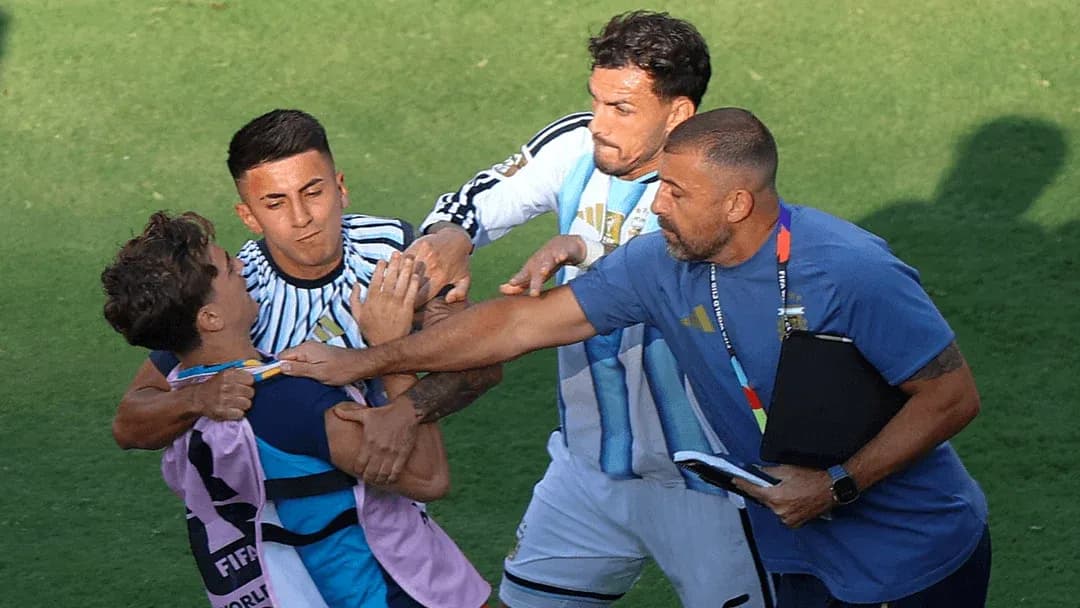
Leandro Paredes faces the prospect of becoming the Argentina player hit hardest by FIFA after world football’s governing body formally opened disciplinary proceedings into the chaotic aftermath of the 2026 World Cup final between Argentina and Spain.
The midfielder, already a combative presence on the pitch, now finds himself at the heart of an investigation that could reshape the early stages of Argentina’s next competitive cycle.
Paredes at the centre of FIFA storm
According to the disciplinary case, Paredes has been charged with three separate counts of aggression. That places him in the most precarious position of any player currently under scrutiny.
Under FIFA’s Disciplinary Code, any act of aggression against an opponent or any other person who is not a match official carries a minimum suspension of three matches per offense. Do the maths: three charges, and the theoretical ceiling reaches a nine‑match ban.
FIFA has not yet delivered its verdict, but the range of punishment is clear. Based on previous cases, a suspension of five or six games looks more realistic than the full nine, yet even that would rank among the toughest individual sanctions to emerge from this World Cup.
For a player who remains an important figure for the national team, that kind of absence would bite deep into Argentina’s planning for upcoming qualifiers and tournaments.
Molina, Ayala and Almada also under scrutiny
Paredes is not alone in the dock.
Nahuel Molina has been charged with two acts of aggression — one completed and one attempted. Each carries the same minimum three‑match threshold, leaving the full-back also facing a significant spell on the sidelines if the charges are upheld.
On the bench, assistant coach Roberto Fabián Ayala has been hit with a separate aggression charge. Should FIFA confirm the offense, he too could be suspended, stripping Argentina’s technical staff of one of its most experienced voices during future internationals.
The net stretches wider still. Thiago Almada has reportedly been charged with unsporting conduct, an offense that brings at least a one‑match suspension under FIFA regulations. Spain midfielder Gavi faces the same allegation from the other side of that bad‑tempered final.
The picture that emerges is of a showpiece match whose closing chapters spilled far beyond the accepted limits of on‑field tension.
AFA facing serious institutional consequences
The fallout is not limited to individuals. The Argentine Football Association (AFA) is also under investigation on multiple fronts.
FIFA has opened proceedings over alleged discriminatory chants and gestures, failures to comply with match and security protocols, delays to kickoff, inappropriate messages displayed by players and supporters, and the throwing of objects.
If those violations are confirmed, the consequences could be heavy. A substantial financial penalty is on the table. So is something far more damaging in sporting terms: partial or even full stadium closures for future Argentina home matches.
For a country that lives its football through the noise and colour of packed stands, the prospect of playing key games in front of reduced crowds — or behind closed doors — would be a stark punishment.
What happens next
For now, these are charges, not verdicts. FIFA has only opened disciplinary proceedings and has not imposed any sporting or financial sanctions.
Both the AFA and the Royal Spanish Football Federation (RFEF) will be able to submit evidence and present their responses before any decision is made. Only once that process is complete will FIFA rule on whether each charge is upheld and confirm the sanctions.
The 2026 final will be remembered for its drama on the pitch. The next chapter may be written in hearing rooms and legal submissions — and its impact could shape how Argentina, and to a lesser extent Spain, walk into the next phase of the international game.