.svg&w=384&q=75 "Naijagoal logo")

Lazio vs AC Milan: A Tactical Showdown Ends in 2–2 Draw
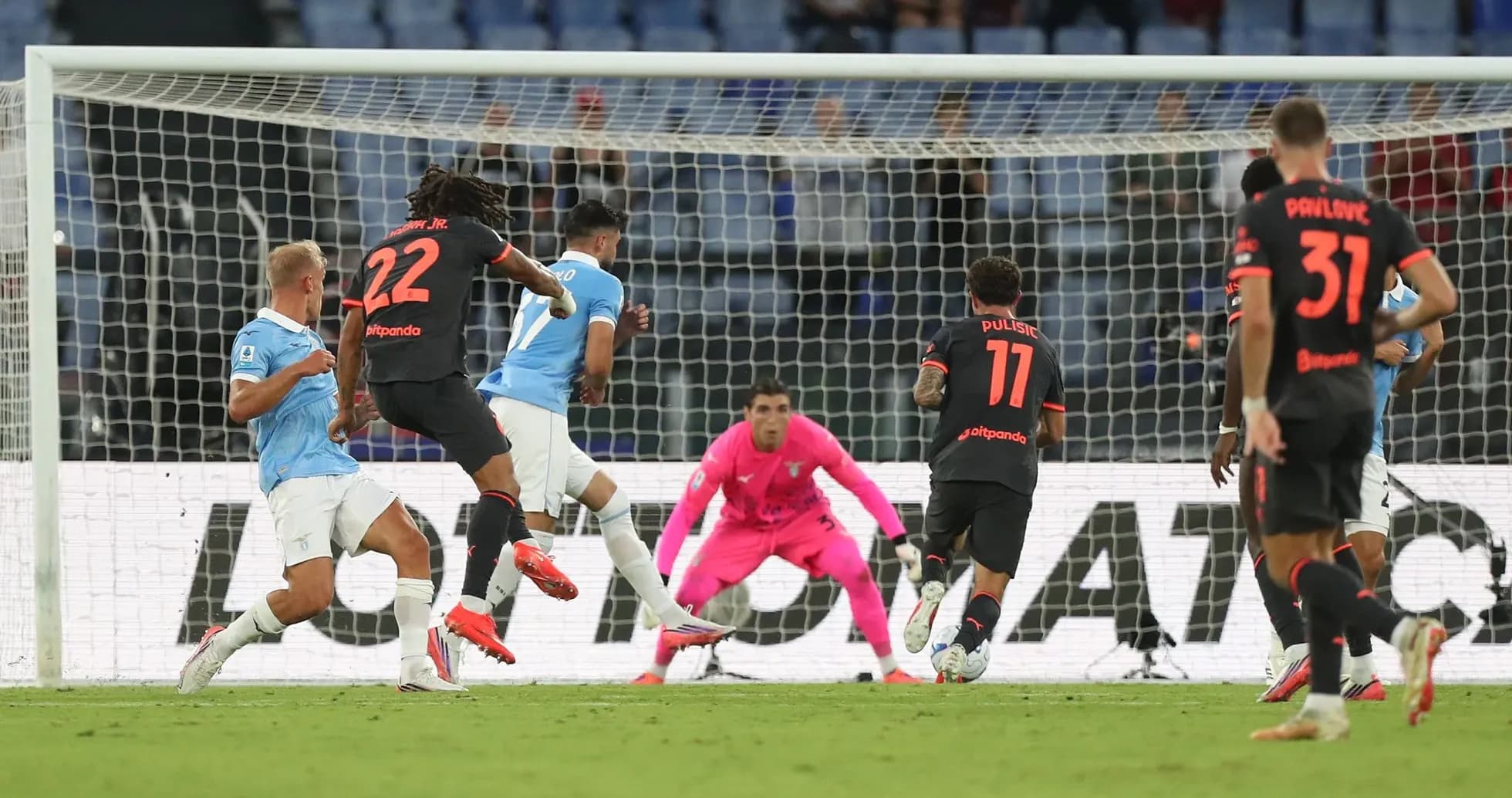
The Stadio Olimpico had the feel of an early‑season benchmark rather than a routine September date. Lazio and AC Milan arrived in Rome both unbeaten, both already hinting at their seasonal identities, and both about to test the limits of those identities over 90 tense minutes that ended 2–2 after Lazio’s two‑goal half‑time lead dissolved under Milan’s second‑half surge.
I. The Big Picture – Two projects colliding
Heading into this game, Lazio sat 4th in Serie A with 10 points from 4 matches, their overall record a clean 3 wins, 1 draw, 0 defeats. The numbers tell of a side quietly efficient rather than explosive: 6 goals scored and 3 conceded overall, a goal difference of +3, with an overall scoring rate of 1.5 goals per match and 0.8 goals conceded. At home, they had been solid rather than dominant – 1 win, 1 draw from 2, scoring 3 and conceding 2 – but the unbeaten start and Champions League ambitions framed this as a statement fixture.
Milan arrived in Rome in a similar mood. They were 6th with 8 points from 4, also unbeaten (2 wins, 2 draws), and with their own goal difference of +3 (7 scored, 4 conceded overall). On their travels, Ruben Amorim’s side had already shown resilience: 1 win and 2 draws away, with 5 goals scored and 4 conceded. An average of 1.7 goals scored away and 1.3 conceded suggested a team prepared to open the game up, trusting their attacking structure to outscore problems.
The formations underlined the contrast. Gennaro Gattuso stayed loyal to Lazio’s 4‑3‑3, a shape they had used in all 4 league matches so far, while Amorim’s Milan again rolled out the 3‑4‑2‑1 that has become their tactical signature this season. It set the stage for a classic Serie A duel: Lazio’s wide, aggressive front line against Milan’s back three and wing‑driven transitions.
II. Tactical Voids – Who was missing, and what it meant
Lazio’s squad sheet carried a heavy list of absentees. F. Dele‑Bashiru, D. Doekhi, A. Furlanetto, A. Marusic, Patric, L. Pellegrini and N. Rovella were all ruled out, several with muscle or joint injuries. For Gattuso, the most tangible voids were in the defensive and midfield rotations. Without Marusic and Patric, there was less experience and aerial presence in the back line, pushing him towards a younger, more mobile defensive unit of R. Floriani, J. Sutalo, O. Provstgaard and N. Tavares. In midfield, Rovella’s absence reduced the options for a deeper controller, making D. Frattesi and R. Belahyane’s roles even more central to Lazio’s capacity to both press and retain the ball.
Milan, by contrast, arrived with a full competitive core available. There were no listed absences in the data, and Amorim could field his preferred spine: M. Maignan in goal, S. Pavlovic anchoring the back three, A. Rabiot and Luka Modric forming an experienced central axis, with S. Chukwueze and R. Loftus‑Cheek supporting G. Ramos and the emerging A. Cisse.
Disciplinary profiles added another layer. Lazio’s yellow‑card distribution this season has been scattered but telling: 25.00% of their bookings between 16–30 minutes, another 25.00% between 31–45, then a late‑game cluster with 12.50% from 61–75, 12.50% from 76–90, and a further 25.00% deep into added time (91–105). They often start aggressively, then get dragged into fouls as matches become stretched. Milan’s yellows, by contrast, have been concentrated in the second half: 25.00% in each of the 46–60, 61–75, 76–90 and 91–105 ranges. They grow more combative as they chase or protect results, something that would prove relevant as they mounted their comeback in Rome.
III. Key Matchups – Hunter vs Shield, Engine Room battles
The “hunter vs shield” narrative belonged to Lazio’s D. Frattesi and Milan’s defensive structure. Frattesi arrived as one of Serie A’s early headline midfielders: 3 goals in 4 appearances, with 5 shots and 3 on target, a 7.55 average rating, and a willingness to crash the box from deep. He is not a classic regista; he is a vertical runner, supported by 6 tackles, 3 blocked shots and 4 interceptions that show he also contributes defensively.
His runs had to be picked up by a Milan back line marshalled by S. Pavlovic. The Serbian centre‑back has been quietly immense: 12 tackles, 1 blocked shot, 1 interception, and a huge 29 duels won out of 40. With 268 passes at 92% accuracy, he is also Milan’s first playmaker from the back. The duel was less about direct one‑on‑ones and more about timing: could Pavlovic step out to meet Frattesi’s surges without leaving space for T. Noslin and M. Zaccagni to attack?
On the flanks, another decisive storyline unfolded. Zaccagni, already with 2 assists and 8 key passes this season, is Lazio’s creative lodestar from the left. His 10 shots (6 on target) and 10 dribble attempts (4 successful) show a winger who constantly tests full‑backs, but his 2 yellow cards also underline how often he works both ways, tracking and tackling. Up against Milan’s right‑sided combination of Chukwueze and K. De Winter, the balance of risk was delicate: push Zaccagni high to pin Chukwueze back, or respect the Nigerian’s pace and 10 key passes, 6 successful dribbles and 2 assists, which make him one of the league’s most dangerous transition weapons.
In the “engine room”, the duel between Rabiot and Lazio’s midfield trio framed the game’s rhythm. Rabiot, with 133 passes at 84% accuracy, 2 assists and 3 key passes, offers Milan vertical progression from deep. His ability to break Lazio’s first line and find Loftus‑Cheek or Cisse between the lines was crucial in turning territorial pressure into real chances, especially after the break when Milan had to chase the game.
IV. Statistical Prognosis – How the numbers shaped the 2–2
From a seasonal perspective, this 2–2 felt almost pre‑written by the numbers. Lazio’s overall scoring rate of 1.5 and Milan’s overall 1.8 suggested both would find the net. Lazio’s home average of 1.5 goals for and 1.0 against, combined with Milan’s away averages of 1.7 scored and 1.3 conceded, pointed to a match where two or more goals for the visitors and at least one for the hosts were well within the statistical lane.
Defensively, neither side had been watertight. Milan’s single clean sheet had come at home; away they had already conceded 4 in 3. Lazio, for their part, had 2 clean sheets overall, but the absence of senior defenders like Marusic and Patric inevitably reduced their margin for error against a front line featuring Ramos and the in‑form Cisse (2 goals from 6 shots).
Without explicit xG values in the data, the structural indicators stand in: both teams create enough volume through runners from midfield and wide overloads to justify multi‑goal outputs. Lazio’s failure to lose in their opening 4 and Milan’s unbeaten away record made a draw a logical statistical compromise, and the way it unfolded – Lazio’s 4‑3‑3 slicing through Milan’s shape early, Milan’s 3‑4‑2‑1 grinding them down late – was a tactical expression of their seasonal DNA.
Following this result, the table will tighten near the top, but the deeper story is about validation. Lazio proved their aggressive 4‑3‑3 can hurt top‑six opposition even with a patched‑up squad. Milan showed that Amorim’s structure, anchored by Pavlovic and animated by Chukwueze, Rabiot and Cisse, has the resilience to survive hostile environments. In Rome, both projects left with a point – and with confirmation that their emerging identities can stand up to the sharpest of early‑season examinations.