.svg&w=384&q=75 "Naijagoal logo")
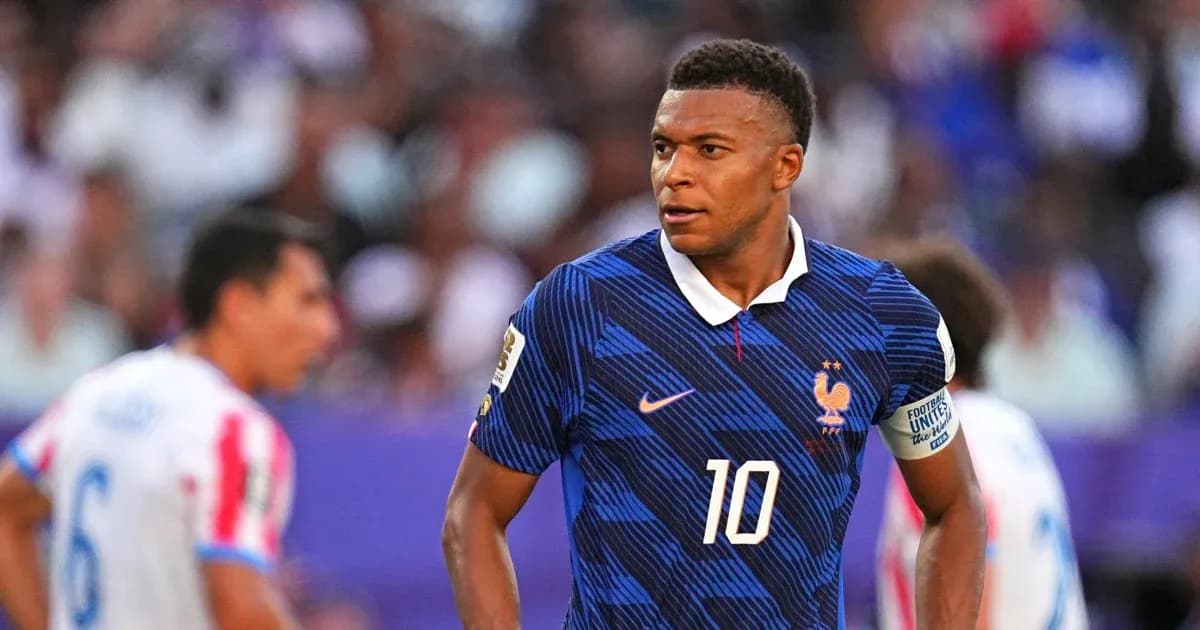

Kylian Mbappé's Bold Response to Racism in World Cup
Kylian Mbappé has spent this World Cup deciding tight games with the ball at his feet. On Monday, he decided to confront something far bigger.
Two days after his penalty knocked Paraguay out in a stormy last‑16 tie in Philadelphia, the France captain hit back at a Paraguayan senator who had launched a racist tirade against him, branding her “a despicable woman and unworthy of your position.”
The target of his fury was Celeste Amarilla, a legislator who reacted to Paraguay’s narrow 1-0 defeat by attacking Mbappé’s origins, identity and intelligence in a lengthy post on X. She described him as a “colonized Cameroonian, desperately trying to pass himself off as French,” called him a “brute” who “had not learned to write,” and went so far as to say Paraguay’s players should have slapped him after the match.
Mbappé, who has grown used to scrutiny and provocation, did not let this one slide.
“You do not represent Paraguay, that country which has sweated passion and honor throughout the competition,” he wrote in a statement that cut sharply through the noise of a World Cup off day. He accused her of “recklessness” and “brazen racism,” and said her words had overshadowed “the journey and the historic effort” of Paraguay’s players.
“I will never allow people like her the freedom to spread their hatred and racism across the world,” he added.
This was not just a star footballer defending his reputation. It was a captain stepping into a political and moral storm, and choosing his side without hesitation.
From the penalty spot to the political arena
Saturday’s last‑16 clash in Philadelphia had already been a bruising affair. France advanced thanks to Mbappé’s cool penalty in a match that simmered with tension and ill-tempered exchanges. When the final whistle went, the story should have been about a resilient Paraguay side pushing one of the tournament favorites to the limit.
Amarilla’s intervention dragged it somewhere else entirely.
Her comments ricocheted around social media and quickly spilled into official channels. What might once have been dismissed as an outburst from a fringe voice suddenly demanded a response from the institutions that govern both sport and state.
The French Football Federation did not hesitate. It described her remarks as “utterly abhorrent and unacceptable” and announced it would file a criminal complaint.
“These remarks are criminal and reprehensible. They must be prosecuted here as elsewhere,” the FFF said, confirming it was reporting the matter to the public prosecutor with a view to legal proceedings. “The players of the French national team represent France; it is our country that is being insulted.”
Inside the France camp, there was anger, but also a sense of grim familiarity. Assistant coach Guy Stephan summed up the mood in three blunt words: “It’s disgraceful, vile, outrageous.”
Paraguay distances itself
Back in Asunción, the fallout was immediate. The Paraguayan government moved to distance the country from Amarilla’s attack, issuing a statement that “deplores and rejects” her words and stresses they are “contrary to the values and principles that inspire peaceful coexistence and respect for human dignity that our country promotes.”
Officials were at pains to underline that Amarilla spoke only for herself.
“The statements of the aforementioned legislator correspond exclusively to the exercise of her individual responsibility as a member of the Legislative Branch and in no way represent the position of the Government of the Republic of Paraguay or the Paraguayan people,” the government said.
Basilio Nunez, president of the National Congress, went further, publicly rejecting “racist, xenophobic messages and those that incite violence against any person.”
He made a point of praising the national team, saying Paraguay had played “with honor and grit” at the World Cup, before delivering a line that has become a recurring plea in global sport: “Politics and sports should be kept separate.”
That separation, though, is increasingly hard to maintain when the targets are the faces of the modern game and the insults cross borders in seconds.
A president weighs in
The row soon reached presidential level.
Emmanuel Macron’s office confirmed that Paraguay’s president had written to him to express support and condemn Amarilla’s remarks. Macron then publicly backed his captain, using the same platform where the abuse first appeared.
“Another goal for Kylian Mbappé. Against racism this time. All my support,” the French president wrote on X. “When words smear, our values respond: dignity, respect, fraternity.”
In a World Cup already charged with political undercurrents, the image of a head of state applauding his striker not for a volley or a dribble, but for a written statement, felt emblematic of the era. Mbappé is no longer just a forward; he is a symbol, willingly or not, in a broader fight over identity, race and representation in French sport.
A captain’s stance
Mbappé has long spoken about social issues, but his response to Amarilla was unusually direct and personal. He did not seek to soften his language or hide behind generic condemnations.
“Madame Celeste Amarilla, you are a despicable woman and unworthy of your position,” he wrote. Line by line, he dismantled not only the insult but the platform from which it was delivered, accusing her of giving “the worst possible image of her country.”
He also turned the spotlight away from himself and back onto the Paraguayan players, insisting the world had “already forgotten” their “historic effort” because of her racism. In doing so, he framed the episode not as France versus Paraguay, but as a decent team and a proud football nation being undercut by one of its own representatives.
For a squad still chasing a World Cup, this is an unwelcome distraction. Yet it is one Mbappé chose to confront head‑on, aware that silence would be read as acceptance.
The tournament moves on. France prepare for a quarter-final, Paraguay head home after a campaign that earned them respect on the pitch. But the words fired from a phone in Asunción, and the response typed by a captain who refuses to look away, will linger long after the final whistle of this World Cup.