.svg&w=384&q=75 "Naijagoal logo")

England’s World Cup: A Historic Journey Amidst Flaws
Here’s the uncomfortable truth for England. It still probably isn’t coming home.
Look at the odds, not the songs. It is more plausible that England finish fourth – undone by Argentina and then France – than that they march through Lionel Messi and Spain and lift the trophy. That’s the cold calculation.
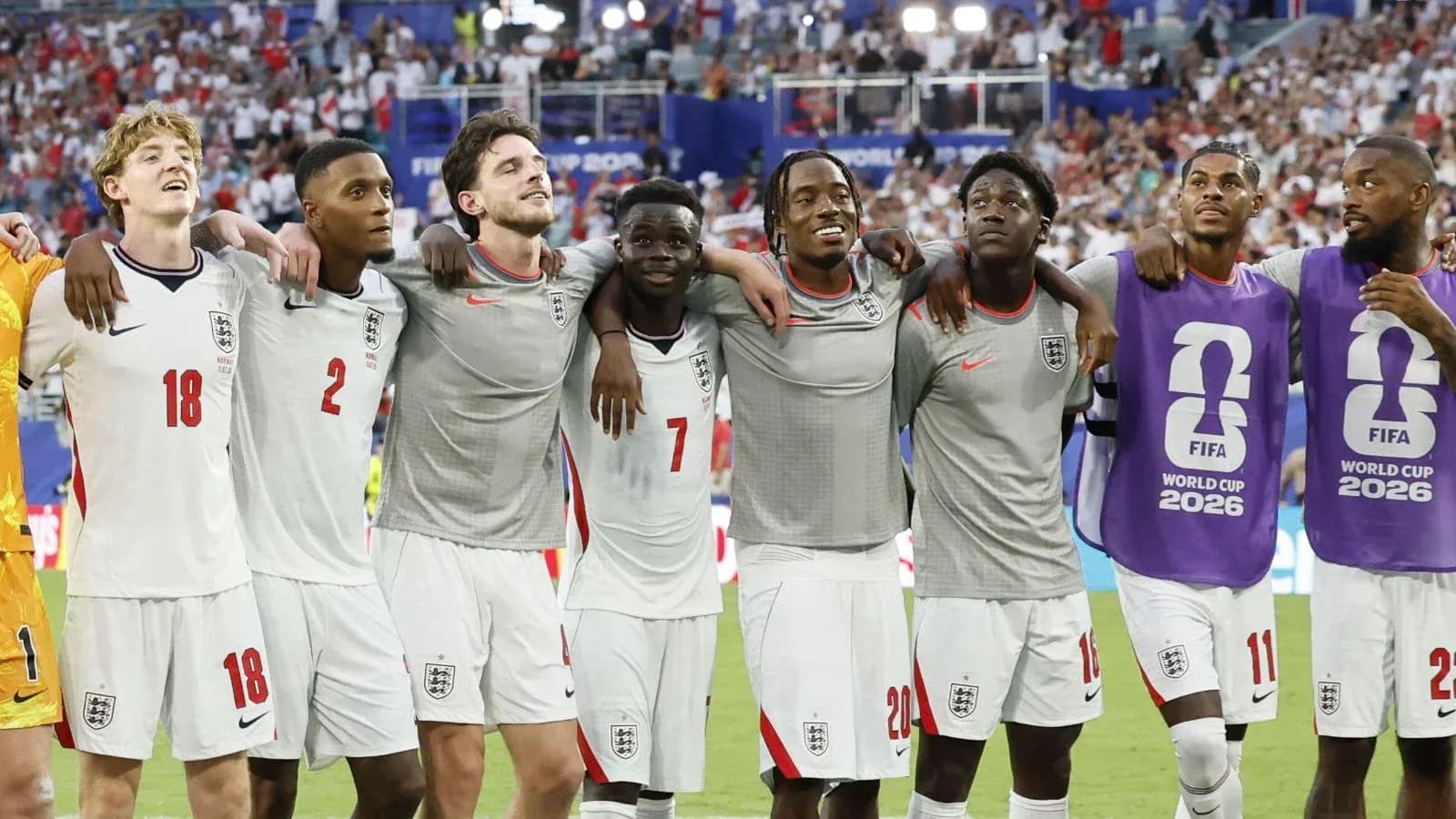
But here’s the part that has somehow slipped through the cracks of the national debate: whatever happens in Atlanta against Argentina, this is already England’s second-best men’s World Cup. Ever.
Not by vibes. By facts.
A Tournament That Outgrew the Script
This team carried the familiar smell of a standard England campaign: quarter-final exit, a few laboured performances, and the inevitable search for a scapegoat who would be ritually blamed for the next decade. That script has been torn up.
They have gone further than most expected. They have done it without ever truly catching fire, and that has coloured the mood. The football has been patchy, the performances uneven. But that’s true across this tournament.
Spain were dreadful against Cape Verde. France were a shambles for an hour against Senegal and for the entirety of their semi-final. You just remember England’s struggles more vividly because you live inside the noise – in England, as an England fan, or as a Scot watching from over the border, or worse, as a Scot living in England. The scrutiny is relentless.
What England have not been is catastrophically bad. They have never sunk to Spain’s Cape Verde level. Only occasionally have they plumbed France’s depths.
And they have not had a cushy route. Argentina’s path has been smoother, their knockout run gentler. England have had to work harder to get to the same stage.
England Don’t Do Total Collapse
Only a full-scale dismantling by Messi and company can alter the basic truth of this campaign. And history suggests that kind of humiliation is not really England’s way.
They do embarrassment. They do shock defeats to teams they should beat. They do penalties, heartbreak and post-mortems. What they almost never do is get absolutely destroyed.
Strip out the third-place play-off – that strange, hollow game that lives in a parallel universe – and since 1988 England have lost only one major tournament match by more than a single goal. One.
Even that defeat, the 4-1 mauling by Germany in the last 16 at the 2010 World Cup, came with an asterisk the size of Bloemfontein. Frank Lampard’s shot crashed off the bar, bounced over the line, and was somehow not given. It should have been 2-2 at half-time. Instead, the goal that never was helped push football down the tech-driven road it still marches along today.
Think about that record. Seventeen tournaments since the start of the 1990s. Two missed entirely. None of them won. And yet just once have England been properly, conclusively dumped out before the final whistle arrived as a mercy.
For a nation so addicted to its own footballing misery, that is a remarkable level of competitive stubbornness.
The Best of the Rest
And still, this doesn’t quite feel like England’s second-best World Cup. There’s no euphoria of 1966, no golden glow of 1990 nostalgia, no home-soil surge like 1966 or Euro 2020.
But in cold, objective terms, it is.
Reaching a semi-final outside your own confederation is harder than doing it in your own backyard or your own continent. This is already the furthest England have ever travelled in a World Cup staged outside Europe. On that basis alone, this run sits behind only 1966.
It just hasn’t been packaged that way. The performances haven’t dazzled. The narrative hasn’t soared. The noise around it has been half-shrug, half-argument.
Scotland, Seedings and Selective Outrage
Into that noise has crept a familiar Scottish soundtrack. Not bitterness, exactly, but a kind of coping mechanism. Call it what you like.
Scotland have been knocked out of the same tournament four times. That hurts. Their frustration has latched onto the draw: England’s supposedly soft route, their supposedly gentle group.
Yes, Scotland were unlucky. Brazil and Morocco in the same group is a brutal pull. No argument there. But that’s what happens when you’re in the lower pots. You are more likely to be thrown in with the heavyweights.
The seeded sides are the ones who feel the sting when another top-10 team lands in their group, as Brazil did. The more common outcome is what England got: no other top-10 team in the group. That isn’t a conspiracy. It’s how seeding works.
And here’s the twist. At the time of the draw, Croatia were ranked 10th. They were the team nobody wanted from pot two. From pot three, Panama were the highest-ranked side England could have drawn, behind only Norway – who couldn’t have been grouped with both England and Croatia anyway.
So the idea that England have breezed through some artificially softened path doesn’t really stand up. They’ve had almost exactly the route a seeded team would expect. No trapdoor opening up in the bracket. No freakish collapse of giants clearing their way.
They won their group and earned a third-placed team in the last 32. They got Mexico in the last 16, as the bracket suggested. Norway’s win over Brazil – built not on a miracle but on being better organised and more coherent on the day – stands as one of the few genuine jolts of the knockout rounds.
Croatia are always there or thereabouts. Mexico at the Azteca is a top-10 level test in all but name. And nobody, hand on heart, can seriously claim there are 10 clearly better international sides than Norway right now.
The FIFA rankings, so often mocked, have been dragged out selectively to belittle England’s route. The reality is more mundane. This is what a normal, tough, seeded run looks like.
Glorious Failure, Upgraded
Maybe this all does end in defeat. Maybe Argentina’s tournament-hardened edge proves too sharp, and Spain’s club-level cohesion too slick. Beating both back to back would be an extraordinary achievement.
The odds say it won’t happen.
But even if it doesn’t, this failure – if that’s what it becomes – will be different. Bigger. More substantial. The most glorious of England’s many glorious failures across 60 years of hurt.
Not because of a song, or a slogan, or a summer of sunshine. Because, away from the noise, this is the furthest an England men’s team has ever gone on foreign World Cup soil.
And if that still isn’t enough, what exactly does “coming home” need to look like next time?