.svg&w=384&q=75 "Naijagoal logo")
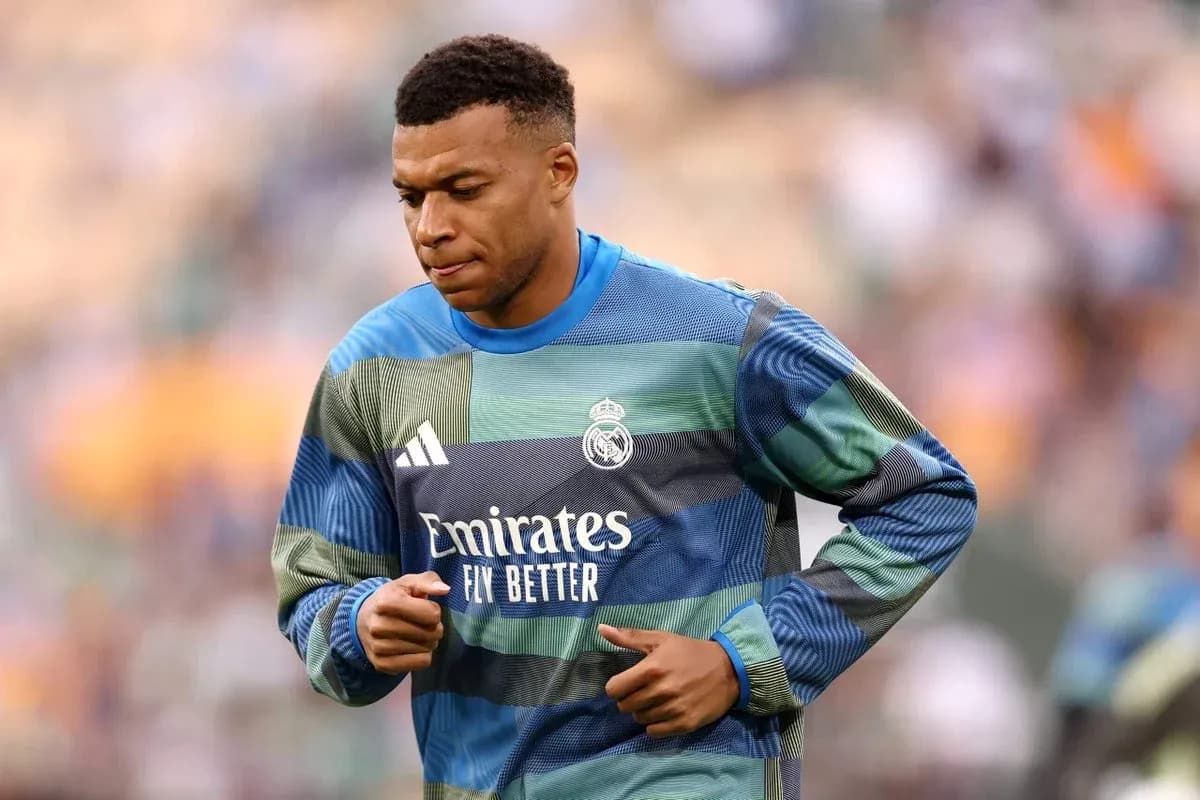
Kylian Mbappe's Impact at Real Madrid: A Complex Legacy
As Real Madrid’s players file through the concrete throat of the Bernabeu tunnel, they walk past Alfredo Di Stefano’s words, painted high on the wall.
“No player is as good as all of you together.”
It was once a motto of dominance. Today, it feels like a challenge.
The club Di Stefano dragged to five straight European Cups is staggering towards a second season without a major trophy. The stands that once roared for galacticos now whistle them. Vinicius Junior. Jude Bellingham. Kylian Mbappe. Even Florentino Perez, architect of the modern superstar era, has not escaped the jeers.
Behind the scenes, the mood is no better. Aurelien Tchouameni and Federico Valverde trading blows on the training pitch last week was not an isolated flashpoint, but a symptom. The tension has a face now, and it is Mbappe’s.
For years, Madrid chased him. For years, he said no. In June 2024, he finally arrived on a free transfer and a huge signing fee, walking into a dressing room that had just conquered La Liga and the Champions League, with Bellingham and Vinicius Jr at full tilt. It looked like the final piece.
Now, the picture is far more complicated.
The numbers say one thing…
On paper, Mbappe has delivered. Ruthlessly.
Since landing in Madrid, he has scored 77 goals across La Liga and the Champions League, more than double any team-mate in that span. He took the Golden Boot in 2024–25. He has overperformed his expected goals by seven, a striker squeezing every last drop from the chances he gets.
When Bayern Munich knocked Madrid out in the Champions League quarter-finals last month, Mbappe was one of the few who hit his level, scoring twice over the two legs. With 15 goals in the competition this season, he is almost certain to finish as its top scorer, breathing down the neck of Cristiano Ronaldo’s record of 17 from 2013–14.
He hoovers up Madrid’s attacking opportunities, demands the ball, carries the weight. This is what he was signed to do.
And yet, in the first home game after that European exit, his name was booed.
The Bernabeu did not care about shot maps or xG. It saw a superstar and a team falling short, and it chose its target.
The mood darkened further. Reports emerged of a row at Valdebebas between Mbappe and a member of the coaching staff before the trip to Real Betis on April 24, an episode that, according to sources, fed into the growing toxicity at the club. Internal frustration also flared when Mbappe travelled to Italy with his partner while recovering from injury.
His camp pushed back, issuing a statement insisting that “a portion of the criticism is based on an over-interpretation of elements related to a recovery period strictly supervised by the club, and does not reflect the reality of Kylian’s commitment and daily work for the team.”
The defence was firm. The doubts did not vanish.
For those who have followed Madrid closely over these two seasons, one question keeps circling: after all the years of pursuit, all the money, all the noise — has this actually been worth it?
…the pitch says another
When Mbappe’s signing from Paris Saint-Germain edged towards completion two years ago, a member of Carlo Ancelotti’s staff pointed to one particular column of data: his off-the-ball work.
The numbers were stark. The conclusion was blunt. He barely defended.
Even then, with Madrid fresh from a 15th Champions League crown and a squad brimming with talent, the staff worried about balance. How do you fit a forward who offers so little without the ball into a team that already carries multiple attacking stars?
Their fears have not faded.
Across La Liga and the Champions League, Mbappe records the fewest tackles, interceptions and ball recoveries per 90 minutes of any Madrid player. The more telling figure is his lack of “true” tackle attempts — the sum of tackles won, lost and fouls committed, a measure of how often a player even tries to engage.
In La Liga, among 461 outfield players, he ranks 461st. Around 0.6 attempts per game.
Most weeks, with rare exceptions like certain Clasicos or big Champions League ties, he is Madrid’s least active defender. For a superstar forward, that is not unprecedented. But it becomes a structural problem when you surround him with other attack-first players — Vinicius Jr, Bellingham, Rodrygo — who also demand freedom and the ball.
Then there is the positional riddle on the left.
Mbappe and Vinicius Jr have not clicked consistently. Both gravitate to the same territory, drifting to the left flank in the build-up, both needing space to burst into. Touchmaps show the overlap clearly. The eye test does, too.
There have been flashes — quick combinations, sharp interchanges — but nothing like the natural, almost telepathic understanding Vinicius once shared with Rodrygo. The fit feels forced, not fluid.
That raises an uncomfortable question for those who built this squad: who decided that stacking two dominant, left-sided forwards on top of each other was a sustainable plan?
The knock-on effect is visible on the scoreboard. Madrid scored 87 league goals in 2023–24, a season without a fixed No 9, when Bellingham often operated as a false nine and Joselu came from the bench as a classic target man. The attack looked improvised, yet it flowed.
Last season, with Mbappe in the side, they scored 78 in La Liga. This campaign, they sit on 70 with three games to play. The numbers are not disastrous, but they are not the leap many expected when a generational scorer walked through the door.
And the longer Mbappe’s positional needs dominate the left side, the more it shapes the future. How will other high-potential attackers fit around him? How many will have to bend or be moved to accommodate one man’s lane?
All of that would be easier to swallow if the dressing room was united behind him. It is not.
Mbappe arrived as a leader by status and salary. The highest-paid player in the squad. The man Perez hailed for making “a great effort” to finally join in 2024, even though his refusal in 2022 left scars among supporters who felt snubbed.
He has yet to win the Champions League with Madrid. The emotional credit line is short.
When the team has wobbled, he has not always been the visible, vocal figure Madrid expected. In a club that judges stars as much on aura as on output, that matters.
The case for patience
Strip away the noise, and Mbappe is still what he has always been: one of the best players on the planet.
He remains France’s main man heading into this summer’s World Cup. He thrives when he is the clear protagonist, as he is with the national team. He won that tournament as a teenager in 2018. In 2022, he became only the second man after Geoff Hurst to score a hat-trick in a World Cup final, dragging France to the brink before Lionel Messi’s Argentina finally prevailed.
Give him the keys, and he usually drives.
When former Madrid coach Xabi Alonso shifted the hierarchy earlier this season, pushing Mbappe ahead of Vinicius Jr in terms of prominence, the Frenchman responded. He looked more relaxed, more decisive, more like the player Madrid thought they were getting.
There is still room for growth — especially without the ball — but at 27, with three years left on his contract, he sits in his prime. This is not a fading star clinging to reputation. This is a forward who, if trusted and properly framed, could still redefine the attack.
He also fills a void that numbers cannot fully capture. Madrid have lost some of the dressing room’s heavyweights in recent years: Karim Benzema, Toni Kroos, Luka Modric. Voices that carried authority in the hardest moments have gone. In that vacuum, ability becomes leadership by default. Mbappe, whether he wants it or not, is one of the figures others look to.
Off the pitch, he has not been the caricature of a distant superstar. There have been clumsy media episodes, but he has often spoken with clarity in mixed zones and interviews. When Vinicius Jr alleged racist abuse from Benfica’s Gianluca Prestianni in a Champions League play-off first leg in February, Mbappe stepped up publicly with a strong defence of his team-mate. UEFA later banned Prestianni for six games for homophobic, not racist, conduct, but Mbappe’s stance underlined his willingness to stand in front of the cameras when the subject is uncomfortable.
There is also a precedent in this very stadium for what patience with a demanding, occasionally difficult superstar can bring.
Cristiano Ronaldo arrived at Madrid in 2009 as Mbappe’s childhood idol and left nine years later as their all-time top scorer, with four Champions League titles in his luggage. Yet his first two seasons yielded only a Copa del Rey. It took five years for him to finally lift the European Cup in white, in Lisbon in 2014.
The journey was not smooth. In September 2012, after scoring twice against Granada, Ronaldo refused to celebrate and later said: “I’m sad and the people at the club know it.” The drama was constant. The output was historic.
Perez and chief executive Jose Angel Sanchez chose to ride out the storms. The reward was an era.
No two careers are identical, and Mbappe is not Ronaldo. But the lesson is there: sometimes, the wait, the friction, the uncomfortable years before everything clicks, are the price of having a forward who can tilt the sport.
Where Di Stefano’s words now point
So where does that leave Madrid?
They have a striker who scores relentlessly, defends rarely, unsettles the team’s balance and yet remains one of the few players alive who can decide a Champions League tie by himself. They have a fanbase that has not forgiven his earlier rejections and a dressing room whose harmony has frayed.
They also have a squad in transition, stripped of some of its old leaders, trying to weld together Vinicius, Bellingham, Rodrygo and Mbappe into something coherent, something worthy of the badge above that tunnel quote.
Di Stefano’s line was never about the individual. It was a warning wrapped as praise.
“No player is as good as all of you together.”
For Mbappe, and for Madrid, the question is no longer whether he can score enough goals. He has already answered that. The question is whether this club — from the president’s office to the last seat in the south stand — is willing to do what it once did with Ronaldo: absorb the contradictions, bend the system, trust that the collective will eventually rise around the star.
If they are not, the next chapter in this story writes itself. If they are, the real Mbappe era at the Bernabeu has not even started yet.