.svg&w=384&q=75 "Naijagoal logo")
Korea's World Cup Journey: Hopes and Challenges Ahead
Thirty days from a World Cup that keeps getting bigger, Korea feel strangely small.
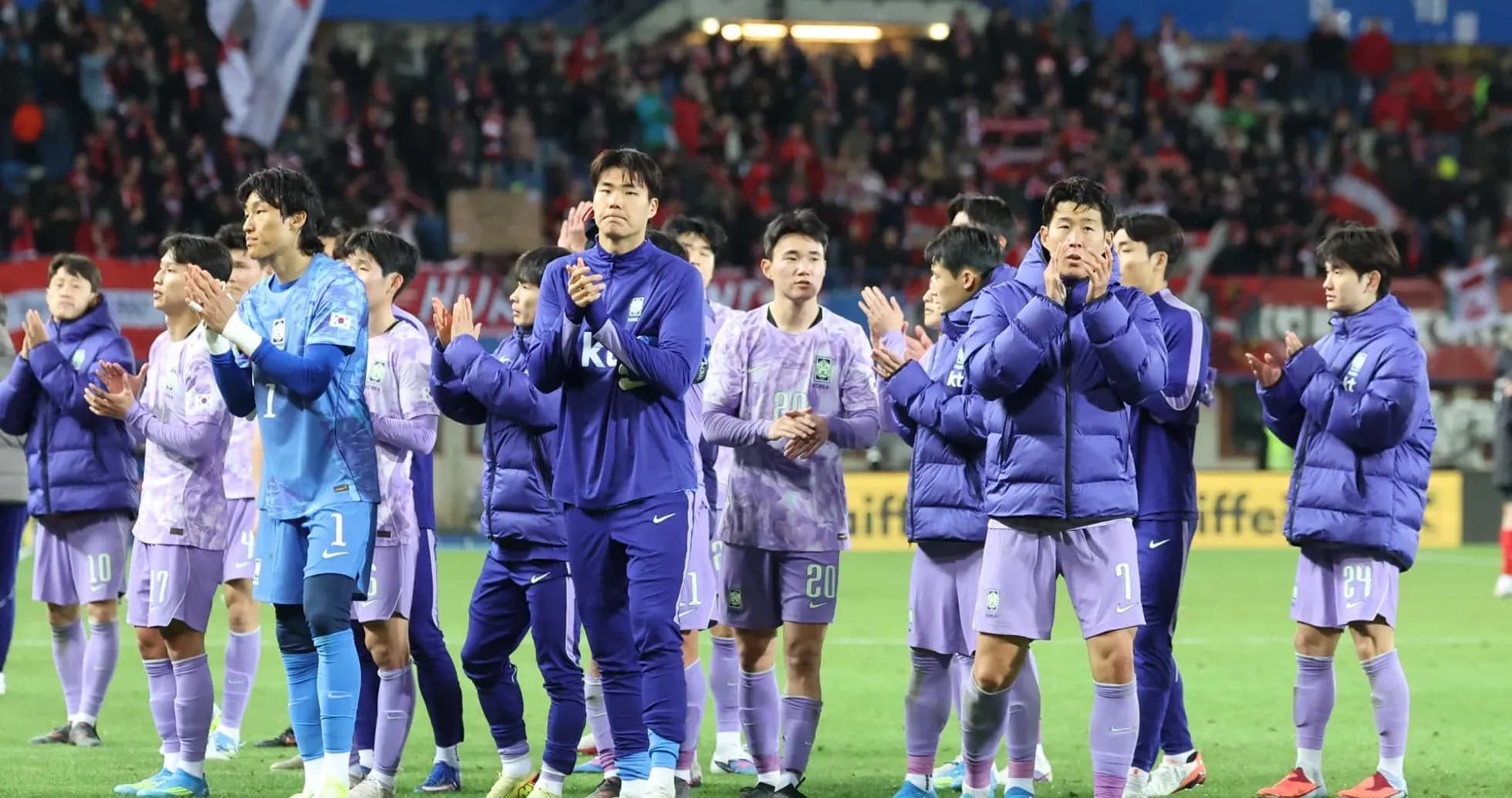
The clock is ticking in Korea, but the noise around the men's national team has been less a drumbeat of anticipation and more a sustained groan of discontent. Ever since Hong Myung-bo’s controversial appointment in the summer of 2024, the bond between the Taegeuk Warriors and their supporters has frayed badly.
At first, the anger was loud. Stadiums filled as usual for men’s internationals, only for Hong to be booed relentlessly. Banners demanding the resignation of Korea Football Association President Chung Mong-gyu cut through the air. It was hostile, but at least it was engaged.
Then came something more worrying: silence.
On Oct. 14, just 22,206 fans turned up at the 66,000-seat Seoul World Cup Stadium for a friendly against Paraguay — the lowest attendance for a men’s international there in a decade. A few weeks later, 33,256 watched Korea host Ghana in the same arena. Respectable numbers on paper, but in a country used to packed stands and electric atmospheres, the empty seats told their own story.
Korea won both games, either side of another unconvincing victory over Bolivia in Daejeon in front of about 33,000. The results were right, the performances anything but. The team looked unsure, short of rhythm, and the crowd knew it.
Then the World Cup year began, and the mood darkened.
A 4-0 dismantling by Ivory Coast on March 28, followed by a 1-0 defeat to Austria three days later, exposed the soft underbelly of Hong’s side. Two away friendlies, two losses, one heavy. Confidence — among players and public — sank even further.
Yet the draw has handed Korea a lifeline.
World No. 25 Korea landed in what many pundits immediately labeled one of the softer groups. Group A brings 15th-ranked Mexico, 41st-ranked Czechia and 60th-ranked South Africa. No giants. No France, no Brazil, no Argentina. On paper, at least, a path is there.
The schedule offers another quiet boost. Korea open against Czechia at 8 p.m. on June 11 in Guadalajara (11 a.m. on June 12 in Korea). Mexico follow a week later, same city, at 7 p.m. on June 18 (10 a.m. on June 19 in Korea). South Africa await in Monterrey on June 24, again at 7 p.m. local time (10 a.m. on June 25 in Korea).
Two of three matches in the same Mexican city. No long-haul internal flights, no punishing travel schedule. In a World Cup stretched across Mexico, Canada and the United States, that is no small advantage.
This is the biggest World Cup ever staged: 48 nations, 12 groups, and a new-look knockout phase starting with a round of 32. The top two from each group advance, joined by the eight best third-placed sides. The net is wide. Slip-ups are no longer fatal in the way they once were.
All of this has fed a growing consensus among experts that Korea should at least survive the group. How far they go beyond that is where opinion splits sharply.
This will be Korea’s 11th consecutive World Cup. Away from home soil, they have reached the knockout stage twice — in 2010 in South Africa and in 2022 in Qatar. That history offers a sliver of optimism: this is a nation that, on the right day, can punch above its weight.
Television analyst Kim Dae-gil believes the draw and format set Korea up to do just that.
“I think Korea will get to at least the round of 16,” Kim said. “Just looking at the group stage opponents, Korea won't have to expend as much energy as in some previous tournaments. We can beat Czechia and South Africa six times out of 10. And if we qualify for the knockouts as the top seed or No. 2 seed, then we will meet a beatable opponent in the round of 32.”
The optimism, in Kim’s eyes, rests on two shoulders in particular: Son Heung-min and Lee Kang-in. Son, now at Los Angeles Football Club, and Lee, the creative force at Paris Saint-Germain, give Korea the kind of attacking spark that can flip tight World Cup games.
Kim sees them as “game changers,” capable of conjuring chances from nothing. But his praise comes with a warning.
“The gap between the starters and backups is substantial,” he said. “To reach beyond the round of 16, the team will need players who can support the regulars. It is imperative for the likes of Son Heung-min to stay healthy.”
That thin layer of depth worries others even more.
Two fellow analysts, Seo Hyung-wook and Park Chan-ha, both predict Korea’s journey will end in the round of 32.
Seo has already downgraded his expectations.
He initially saw a round of 16 run as realistic. Then came the ankle injury to midfielder Hwang In-beom, and with it, a shift in his forecast. Hwang, a clever, two-way presence, may be as irreplaceable as anyone in Hong’s system. He hurt his right ankle in March playing for Feyenoord and is now rehabbing with the help of the national team medical staff.
Seo doesn’t hide his concern.
“Other mainstays have not been playing well,” he said. “Lee Kang-in and Kim Min-jae (of Bayern Munich) have not been playing much for their clubs.”
For Seo, Korea’s greatest strength is the understanding among its Europe-based core — Son, Lee, Kim and a handful of others who have grown together on this stage. The problem is the size of that group.
“The problem is there just aren't many of them,” Seo added. “At this moment, I don't think you could say anyone can play at a world-class level at the World Cup.”
Park Chan-ha shares the skepticism, but his focus is on structure and style.
“Hong Myung-bo's team has some talented players,” Park said. “And yet, they often have trouble creating scoring chances. The team relies on players' individual skills to try to capitalize on those few opportunities, but you can only do so much of that at the World Cup. I think we already saw problems with this approach in the two losses in March.”
If Hwang cannot play, or is limited, Park expects those problems to deepen. Without his control in midfield, Korea risk becoming even more reliant on isolated flashes from their stars.
For Park, everything funnels toward one night in Guadalajara.
“I think the first match against Czechia will be the most important one,” he said. “This is the one Korea must win, and they will be in trouble if they don't get it done. Czechia are not an offensive-minded team, and Korea may have difficulty breaking through their defense.”
Seo echoes that sense of jeopardy around the opener.
“In our World Cup history, the outcome of the first match often determined the fate for the rest of the tournament,” he said. “Mexico will be a tough test in the second match, and if we don't win the first match, we will be in big trouble.”
Kim Dae-gil looks at the same fixture list and circles a different date. For him, the real hinge point comes a week later.
“I think Korea and Mexico will battle for the top spot in the group,” he said, casting the June 18 clash as a probable shootout for first place.
So the picture is set.
A coach under pressure. A fan base torn between habit and apathy. A gifted but shallow core, leaning heavily on Son Heung-min and Lee Kang-in, while waiting anxiously on Hwang In-beom’s ankle. A kind draw, a forgiving format, and a World Cup that offers as much opportunity as it does risk.
Korea have a month to turn unease into momentum. When they walk out against Czechia in Guadalajara, we will find out whether this cycle bends toward another knockout run — or whether the boos from home were an early verdict on a campaign destined to fall short.