.svg&w=384&q=75 "Naijagoal logo")
Kinsky's Redemption: From Madrid Trauma to Premier League Heroics
Antonin Kinsky walked off in Madrid like a man being ushered out of his own career.
Hooked after 17 chaotic minutes, two errors, two Atletico Madrid goals, and a Champions League last-16 tie already tilting away from Tottenham, the 23-year-old trudged towards the touchline with the kind of spotlight no goalkeeper wants. Peter Schmeichel, watching on from the CBS Sports studio, called it a moment that would follow Kinsky around every time his name was mentioned. Loris Karius’ haunted night in Kyiv hung over the conversation as the obvious comparison.
Plenty decided there and then that this was it. Elite football had chewed up another young goalkeeper.
Roberto De Zerbi refused to accept that version of the story. He insisted Kinsky would play again, maybe even before the season was out. It sounded generous, almost protective, more like a manager shielding a player than predicting a revival. Tottenham supporters weren’t exactly counting the days to his return.
They are now.
From Madrid trauma to Leeds defiance
Since stepping back in for the injured Guglielmo Vicario against Sunderland last month, Kinsky has been quietly stitching his reputation back together. The basics returned first: clean handling, calm passing, a few sharp stops. The free-kick save deep into stoppage time in the 1-0 win over Wolverhampton Wanderers hinted at something more, a flash of the spectacular.
But Madrid doesn’t vanish from the mind with a couple of solid afternoons. Goalkeepers don’t erase trauma with routine saves. To really change the narrative, Kinsky needed a night that made people talk about something else when they heard his name.
Leeds United at home, Monday night, 1-1. That was the night.
He produced two saves of the highest class. One will live on the highlights reels; the other, arguably just as important, may slip into the background. It shouldn’t.
The save nobody should forget
Questions about Kinsky’s command of his box had been fair. The Carabao Cup defeat to Newcastle United in October, when he twice failed to deal with wide deliveries, left a mark. Crosses, corners, traffic around him – all filed under “concern”.
Over the last five games, he has started to push that file to the back of the cabinet. Against Leeds, he tore it up.
In the 21st minute, Brenden Aaronson swung a cross towards the far post. Joe Rodon, once of Spurs, attacked it and powered a header low towards Kinsky’s bottom-left corner. It was the kind of chance defenders hate: close range, downward, awkward to reach.
Kinsky snapped down to his left, got a strong hand to the ball, then clawed it back and held it. No spill, no second chance, no scramble. Just a clean, decisive, world-class save.
And it still wasn’t the best thing he did.
A season on the line, a hand to the bar
Tottenham are not fighting for Europe. They are fighting West Ham United for air. Every point in this relegation scrap carries weight, every mistake threatens to drag them under.
So when the clock ticked into the eighth minute of stoppage time and Sean Longstaff, pushed forward from midfield, found himself eight yards out with the ball sitting up, the stadium braced for the worst. Longstaff drilled his shot high, vicious, destined to rip into the roof of the net.
Kinsky exploded.
He didn’t charge blindly. He didn’t throw himself into no man’s land. He moved with calculation, with control, and then with raw, violent power in his right arm to reach a ball that most goalkeepers would only watch.
The shot cannoned off his glove, smacked the underside of the crossbar and bounced out. The roar from the stands was part relief, part disbelief. Tottenham stayed level. Tottenham stayed two points ahead of West Ham.
Matt Pyzdrowski, a former professional goalkeeper and specialist analyst, broke the moment down with a coach’s eye.
“What stood out most about Kinsky’s save was the composure and discipline he showed in such a high-pressure moment,” he said. As the ball was slipped in behind, Kinsky didn’t panic and rush out. He stayed on the ground, taking short, controlled steps, edging towards his near post, always staying in line with the ball. With Micky van de Ven recovering across, Kinsky understood he didn’t need to gamble. His job was to stay balanced and ready.
Technically, Pyzdrowski argued, it was close to perfect. Kinsky’s set position – feet shoulder-width apart, chest slightly over his knees, hands at waist height – left him neutral, able to move in any direction. That shape meant his hands naturally guarded the upper half of the goal, his legs the lower, echoing the way David de Gea used to set himself at his peak for Manchester United.
Had he dropped lower or widened his stance, he would have lost the explosive push required to reach the ball and blocked the path for his hands. Instead, he stayed compact and upright, trimming the distance his hands had to travel. That allowed pure reaction and coordination to take over.
“What was incredible,” Pyzdrowski added, “was how quickly he managed to line his hands up with the ball and, frankly, how ridiculous it was that he could still generate the power to drive his right hand upward to make the save — which is not something every goalkeeper would have been capable of producing in that moment.”
Not every goalkeeper. Not this goalkeeper in Madrid. But this goalkeeper now.
A mentality built for the elite
The physical tools have never really been in doubt. Kinsky is a modern goalkeeper, comfortable with the ball at his feet, tailored for De Zerbi’s possession-heavy approach. He can clip passes into full-backs, fizz the ball between the lines, and start attacks rather than simply restart play.
What Monday underlined was that he has the mentality to live at this level as well.
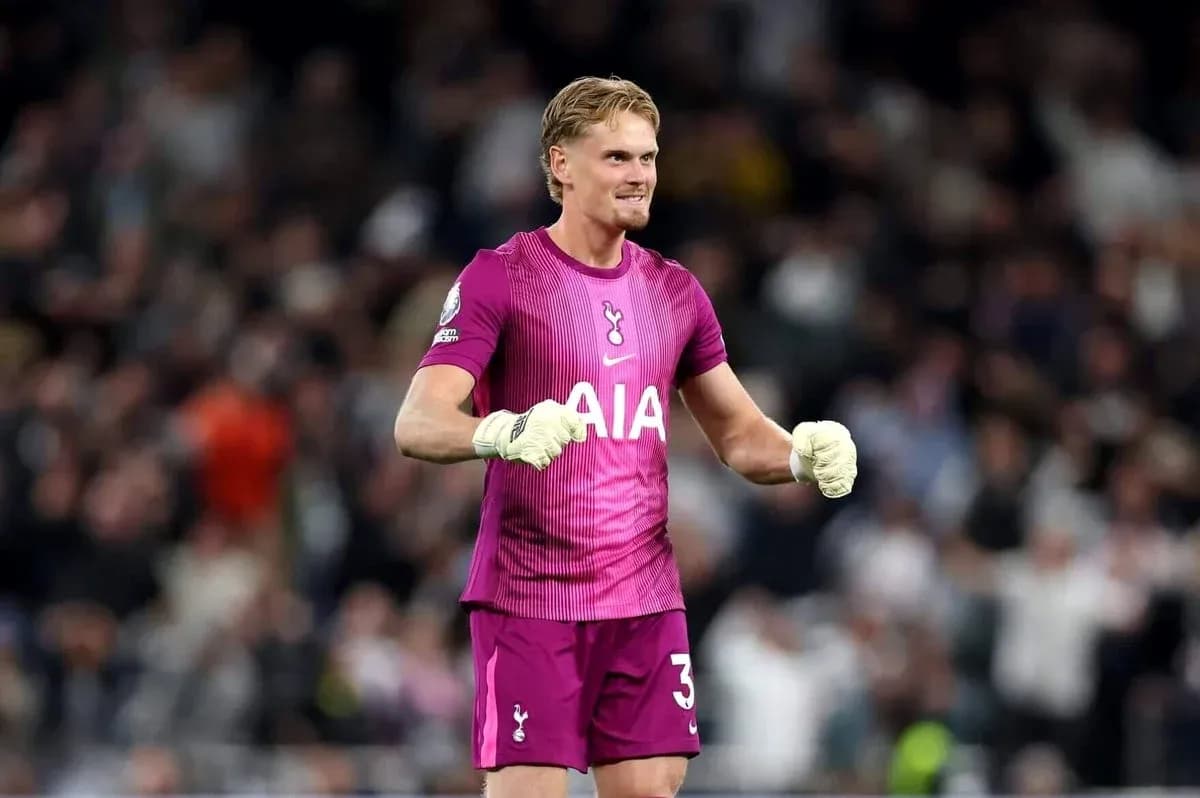
To go from the Metropolitano walk of shame to standing at full-time against Leeds, soaking up applause as one of Tottenham’s most reliable performers, takes more than coaching drills and video sessions. It takes stubbornness. It takes the refusal to let one night, however brutal, define an entire career.
Nobody could have realistically expected him to rebound this quickly. Yet here he is, not just surviving, but deciding games.
Tel’s lesson in a single night
The match itself carried its own twist. Mathys Tel experienced both sides of the emotional spectrum that Kinsky knows too well.
First, the high. A superbly curled finish gave Tottenham the lead, a strike of real quality that should have been the headline moment of his evening. Then, the low. Deep in his own box, Tel attempted an overhead-kick clearance that belonged on a training pitch, not in a relegation fight. He missed, chaos followed, and Dominic Calvert-Lewin levelled from the penalty spot.
De Zerbi, asked how he would handle Tel after such a wild swing of fortunes, said he would give the young forward “a big hug and a big kiss”. The message was clear: mistakes don’t have to be life sentences.
Kinsky is living proof.
The next chapter
Tottenham’s reality remains stark. They sit just two points ahead of West Ham, who head to Newcastle United on Sunday with the same desperate need for points. Chelsea and Everton still lie ahead for Spurs, two fixtures that will go a long way to deciding who stays and who drops.
Kinsky’s redemption arc feels complete in one sense. He has faced the worst night of his professional life and come back with one of the saves of the Premier League season, maybe the save that keeps his team above the waterline.
But if this is what he produces with his back to the wall in March, what might he deliver with survival on the line in April and May?