.svg&w=384&q=75 "Naijagoal logo")

Kendry Paez's Journey at Chelsea: From Wonderkid to Reset
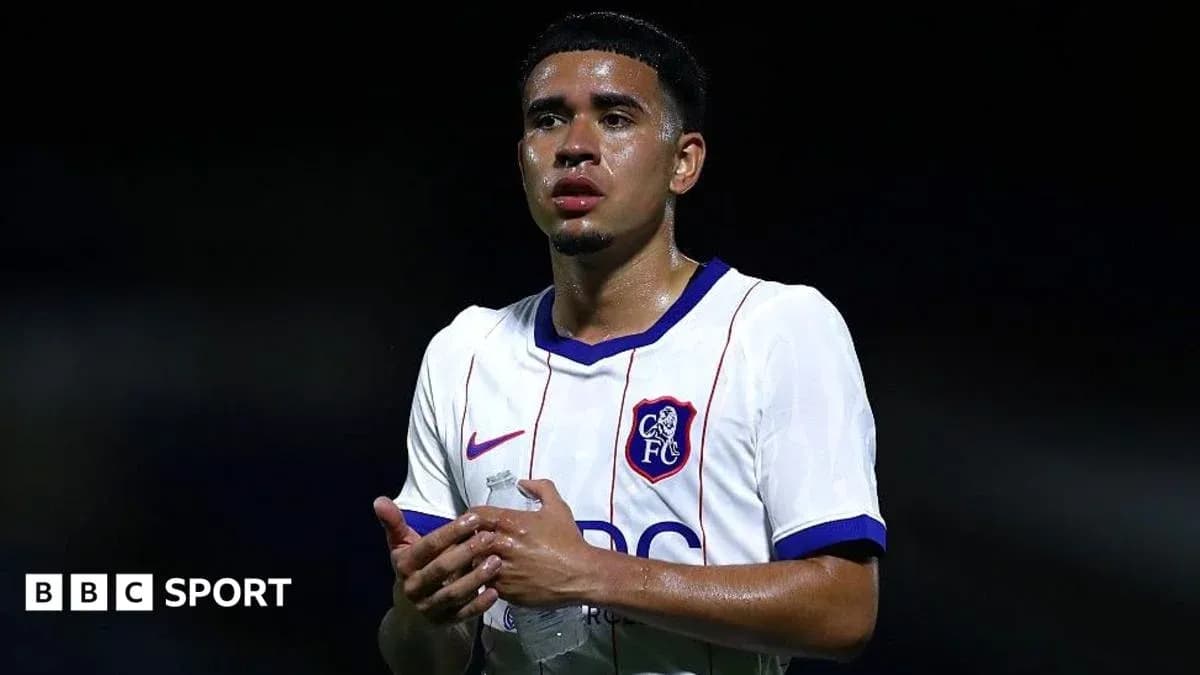
Kendry Paez finally wore Chelsea blue at the weekend. Not under the Stamford Bridge lights, not in the Premier League, but on a grey afternoon for Cobham Next Gen away at Arsenal.
Three years after Chelsea struck a £17.27m deal with Independiente del Valle for a 16-year-old prodigy, the Ecuadorian attacking midfielder’s first appearance for the club came as a 12th‑minute substitute in a 4-1 win for the newly rebranded Under-21 side on Saturday.
It was a long way from the hype that surrounded his arrival. It was also exactly where he has to start again.
From record-breaker to reset
Paez’s story was supposed to be straightforward: wonderkid in Ecuador, fast-tracked into Chelsea’s first team, another jewel in a South American-heavy project.
He didn’t just emerge at Independiente del Valle, he tore through their records. Youngest debutant and youngest goalscorer in Ecuador’s top flight at 15. A Copa Libertadores debut in the same season. A teenager treated like a senior pro long before he could drive.
His rise with the national team came just as quickly. At 16 years and 131 days, he made his second appearance for Ecuador and became the second-youngest South American to feature in a World Cup qualifier, behind only Diego Maradona. A month later he became the youngest South American ever to score in a World Cup qualifier, away to Bolivia in a 2-1 win.
By the time Chelsea agreed the deal, he had already collected 18 caps and two international goals. The club believed they were buying a future star, not a project.
Chelsea brought him into the fold early, allowing him to train regularly with the first team before he could officially join after his 18th birthday. When violence broke out in Ecuador in early 2024, the club arranged security for Paez, his family and the family of international team-mate Moises Caicedo.
They invested in him on and off the pitch. The path looked clear.
Then it started to bend.
Loans, criticism and a stalled rise
The first major test came in Europe. Paez joined Strasbourg, part of Chelsea’s multi-club network, on loan and started brightly, winning Ligue 1’s Young Player of the Month for September.
The glow faded quickly.
His form dipped and then-manager Liam Rosenior made his expectations very public. “We expect more, clearly,” Rosenior said later in the season. “I’m tired of using the excuse of the player’s youth.”
One goal in 21 appearances followed. The loan, despite the ownership links, was cut short.
Chelsea sent him to River Plate next, a two-year loan to one of South America’s giants. It was meant to be a reset in a familiar football culture, a platform to dominate.
Instead, the same questions followed him across the Atlantic.
Sources in Argentina highlighted concerns about his attitude and pointed to a flat display in the Superclasico – a 1-0 defeat to Boca Juniors at the Monumental in April – as emblematic of his struggles. Shortly afterwards, club president Stefano Di Carlo named Paez among 15 players training away from the first team.
Others around River argued he deserved more chances, but the outcome was decisive. His loan ended by mutual consent after just one goal in 14 appearances and 461 minutes.
Around the same time, another off-field moment dragged him into the spotlight for the wrong reasons, when he was filmed in a New York strip club while on international duty.
For a country that had built him up as the next great attacking talent, Ecuador began to worry.
Michel Deller, owner of Independiente del Valle, spoke openly to Hincha Amarillo. “He’s like a son to us. We care about him deeply. He’s a good kid who’s had a tough time and has made decisions that have complicated his life. We are always hopeful he’ll show his exceptional talent once again but right now, it’s up to him to decide what to do with his life.”
Not in Alonso’s plans – but back in the building
Back at Chelsea, reality bit. New manager Xabi Alonso was blunt: Paez was “not in my plans.” On the club’s website, he appeared not as a first-team option but as an academy player.
Chelsea tried to find him a loan in English football. Fifa rules blocked an overseas move; the club had already used all six of their available international loan slots. That left one option: bring him back to Cobham and start again from the academy.
For all the noise around him, those close to Paez and within Chelsea feel some of the criticism has gone too far. They accept he has made mistakes and struggled with the weight of expectation, but insist he deserves time to grow both as a footballer and as a person.
What he has now is structure. Regular training in an elite, stable environment. Family in the stands – they were at Wycombe for his recent EFL Trophy appearance. Coaches watching him closely every day instead of from afar.
And, crucially, games.
A quiet night, a late reminder
At Wycombe Wanderers in the EFL Trophy on Tuesday, Paez cut a slightly isolated figure before kick-off. Spanish-speaking, new again to this environment, he stood apart from the other academy players at times. He joined the warm-up, but mostly kept to himself.
When he came on in the 62nd minute, he was used as a right-sided No 10 in a shape mirroring Alonso’s back three, a role similar to Cole Palmer’s. For most of his cameo, he hovered on the fringes of the game as Chelsea chased it.
Then, late on, the talent flickered.
From a short corner routine in stoppage time, Paez whipped in an outswinging cross that Harrison Bettoni tapped home. Moments later, another cross from his right boot caused chaos in the Wycombe box as Chelsea hunted an equaliser in front of just 778 fans.
They lost the match. He didn’t transform the night. But those final minutes were a small, timely reminder of why so many clubs once fought to sign him.
Three days later came that long-awaited first outing in Chelsea colours at Arsenal for Cobham Next Gen. Another small step, but a step all the same.
A career still salvageable
For all the turbulence, Paez is not some raw kid without experience. He has already played 70 times for Independiente del Valle and has passed 100 senior matches in total. He has 27 caps for Ecuador and a World Cup appearance behind him.
That body of work matters. It gives him something solid to lean on while he tries to repair his trajectory.
Inside Chelsea, there is encouragement about his attitude since returning to Cobham. Coaches see a player engaged, working, benefitting from the daily standards around him. Scouts from across the English Football League and beyond regularly attend academy games; every outing is an audition.
The plan, or at least the hope, is clear. Impress enough over the coming months and a first loan move in England could be on the table in January. If one of Chelsea’s six international loan slots opens up, another overseas spell might be possible.
What happens next depends on him.
The talent that once made him one of South America’s most coveted young prospects has not disappeared. It has been buried under scrutiny, missteps and the brutal speed of elite football.
Now, in front of a few hundred spectators at academy grounds rather than tens of thousands in World Cup qualifiers, Kendry Paez has to dig it back out – and prove that this Chelsea chapter is a beginning, not the end of the story that started at 15.