.svg&w=384&q=75 "Naijagoal logo")
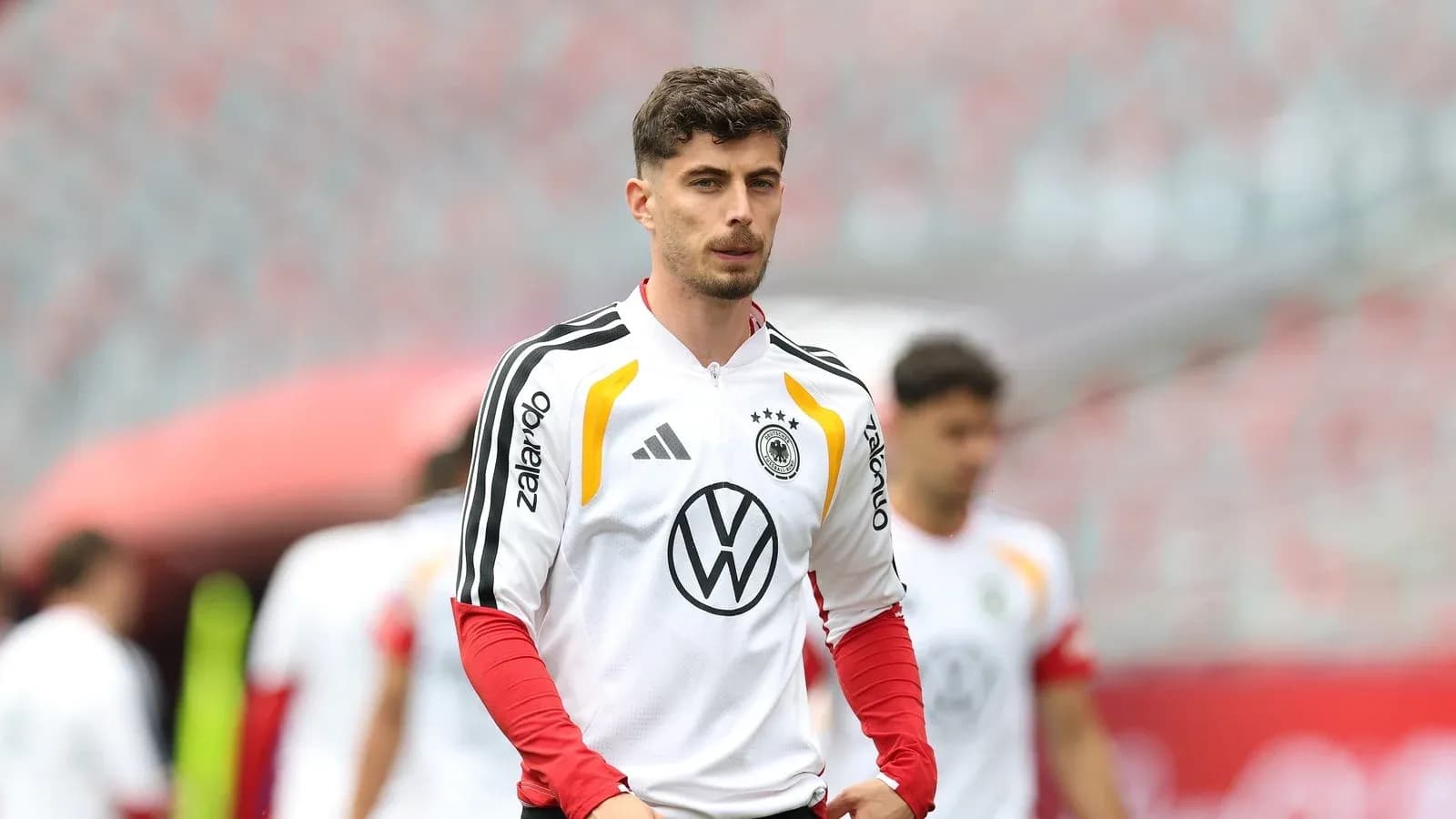

Kai Havertz Prepares for World Cup Knockout Match Against Paraguay
Kai Havertz steps into the glare of another defining night, and he looks like he’s been waiting for this one his whole life.
Germany’s number nine leads the line in Boston as his country walks into its first World Cup knockout match since lifting the trophy in 2014. A long, bruising wait. A new generation carrying the weight of an old standard. At the heart of it, Havertz – calm, clipped in his words, but very clear about what this stage means.
“This will be my first knockout match in a World Cup,” he told the media on the eve of the clash with Paraguay. “I like these big occasions and I feel comfortable in this context.”
It didn’t sound like a player daunted by history. It sounded like a player itching for the whistle.
A striker made for the spotlight
Havertz has always carried the tag of a man for big moments, and this tournament has already offered a reminder why. He struck twice in the 7-1 demolition of Curacao in Germany’s opener, a night when the front line looked slick, ruthless, untouchable. The ball fizzed, the runs dovetailed, the finishing was cold.
Then came the jolt.
A 2-1 defeat to Ecuador in the final group game dragged old doubts back into the conversation. Germany laboured against a deep, disciplined defence, struggled to prise open space, and left the pitch to a familiar soundtrack of criticism. For a team still trying to escape the shadow of early exits in 2018 and 2022, it was an unwelcome echo.
Havertz didn’t dodge it. He turned into it.
“We talk a lot about what can work better and what we need to improve,” he said. “The three of us (himself, Florian Wirtz and Jamal Musiala) know ourselves that we haven't fully shown what we're capable of up front yet. We have to take responsibility for that.”
No excuses. No deflection. The front three know they are supposed to be the edge of this Germany, not the question mark.
Building chemistry under tournament fire
This is a side still knitting together its attacking patterns on the fly. Players arrive from different clubs, different systems, and are asked to click at World Cup speed. That takes time, and time is the one thing a major tournament rarely grants.
“It takes a bit of time because everyone comes from their clubs to the national team and you have to get used to your teammates,” Havertz explained. The outside noise, he insists, stays outside. “When you are in a major tournament, people talk (but) I don't care what people say, we are focused on ourselves.”
That single-mindedness is central to how he carries himself. He doesn’t posture, he doesn’t rant. He narrows the lens: the next game, the next movement, the next finish.
Tonight, the next obstacle is Paraguay.
Paraguay’s rise and the challenge ahead
On paper, some will see a familiar storyline: European heavyweight against South American underdog. The tournament itself tells a different tale.
Paraguay opened their World Cup with a 4-1 defeat to hosts USA, a scoreline that suggested a short stay. Instead of folding, they tightened. Two games, two clean sheets, and a very different tone. A 1-0 win over Turkey steadied them. A goalless draw with Australia, gritty and controlled, was enough to push them through as one of the eight best third-place teams.
This is not a side that will open up and trade punches. They will close spaces, contest every ball, lean into their strengths: aggression, intensity, discipline without the ball. Exactly the sort of opponent that troubled Germany against Ecuador.
Havertz knows what’s coming.
“They have quality; aggression and intensity are what define them,” he said. “We need a good performance, and we'll be better tomorrow.”
The message is clear: expect a fight, but expect a different Germany too.
A fifth star in the distance
For all the talk of tactics and chemistry, nights like this always seem to come down to personalities. Who embraces the stage. Who wants the ball when the match tightens and the noise swells.
“I like big matches, matches on the biggest stage,” Havertz said. “We are fully convinced we can win.”
That conviction is not just about Paraguay. It’s about the path beyond, about a country chasing a fifth world title after a decade wandering outside the latter stages. The last time Germany reached the knockout rounds, they left with the trophy. The gap since then has felt like a rupture in their identity.
Now, in Boston, with a new leader at the tip of the attack and a dangerous opponent in front of them, the question is simple: is this the night Germany starts to look like Germany again?