.svg&w=384&q=75 "Naijagoal logo")

Just Fontaine's Legendary 13 Goals in World Cup History
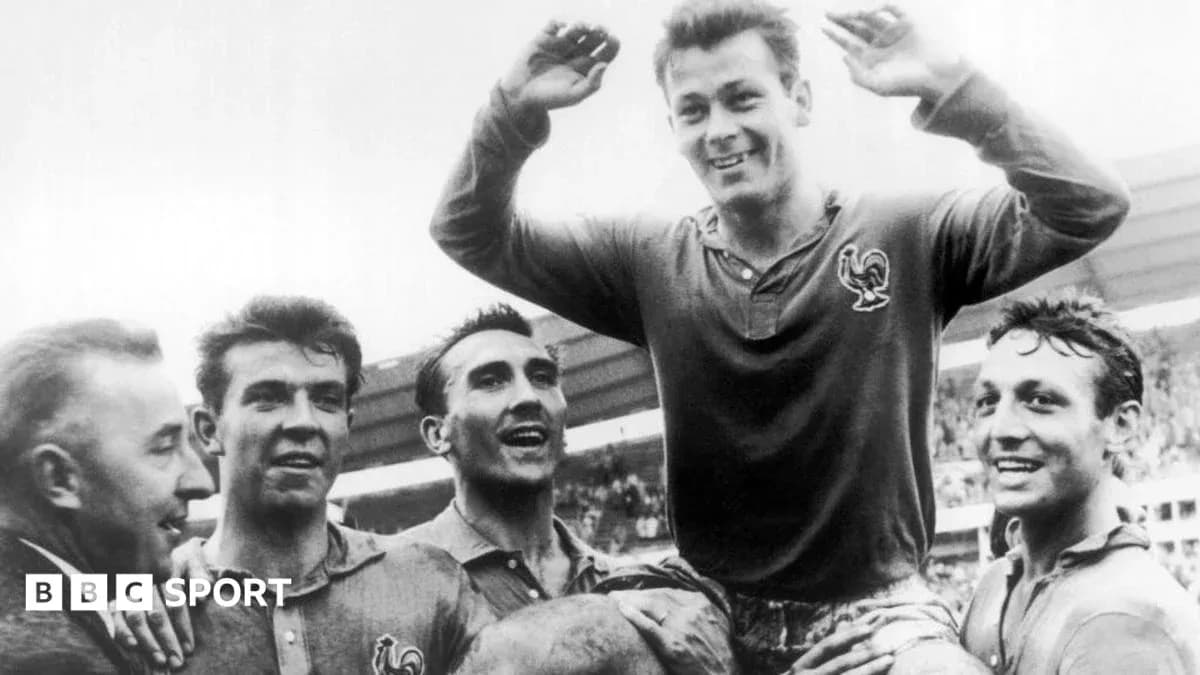
Just Fontaine scored 13 goals at a single World Cup. That number alone feels absurd in the age of data, xG and defensive blocks. Then you remember he did it in six games, in borrowed boots, as a late replacement who was not even meant to start for France.
The record has become a kind of football ghost story. It appears every four years, gets whispered about when a striker hits form, then vanishes back into the trivia rounds and the dusty corners of memory. The man behind it has long been treated as a quiz question, not a giant.
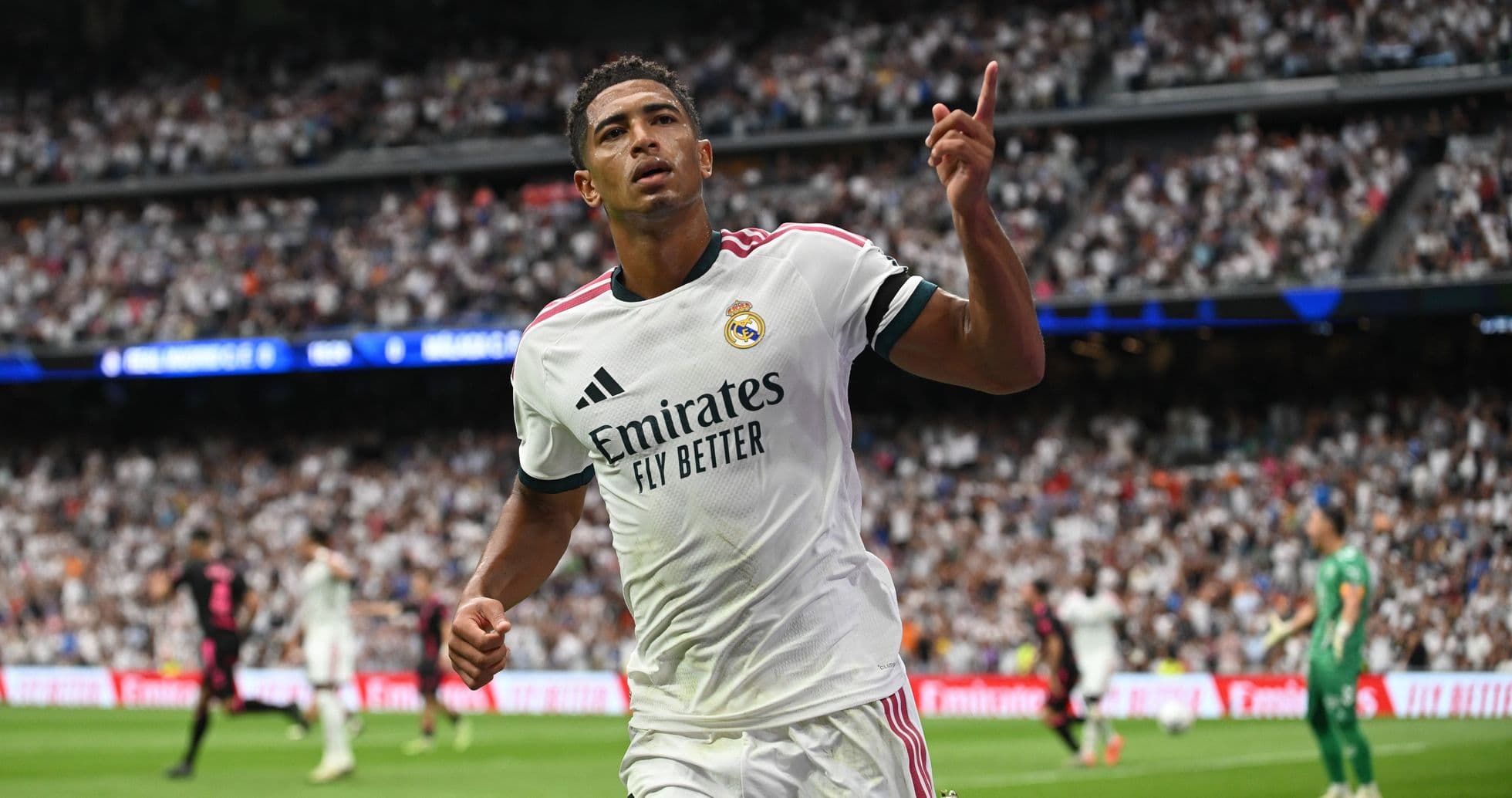
Yet here we are in 2026, with Lionel Messi, Kylian Mbappe, Erling Haaland and Harry Kane chasing the Golden Boot and, in the distance, Fontaine’s silhouette. Mbappe already has eight, Messi and Haaland seven, Kane and Jude Bellingham one behind them. The numbers are impressive. They still feel small next to 13.
This expanded World Cup, with 48 teams and an extra round, is supposed to tilt the odds. Reach the semi-finals and you play eight matches. More minutes, more chances, more goals. On paper, it should drag Fontaine back towards the pack.
On grass, he remains out of reach.
A record born by accident
Fontaine’s story does not begin like a legend. It begins with a twist of fate and a pair of boots that didn’t belong to him.
Born in Marrakesh in August 1933, when Morocco was still a French protectorate, Fontaine grew up far from the Parisian boulevards that would later celebrate him. By the time Morocco gained independence in 1956, he was already an established forward in the French leagues. His path was set: he would play for Les Bleus.
The 2026 quarter-final between France and Morocco was billed as the Just Fontaine derby for a reason. In another era, with modern eligibility rules and a different political backdrop, he might have stood on the other side of that divide.
In 1958, though, he was simply fighting for a place. As sports journalist and historian Philip Barker recalls, Fontaine was not first choice. Rene Bliard was supposed to lead the line. Then came the warm-up injury, the scramble, the promotion from the fringes.
The change was so late Fontaine did not even have suitable boots for the opening match. He borrowed a pair from team-mate Stephane Bruey and walked into history.
It sounds like a fable now. At the time, it was just chaos.
Fontaine had undergone surgery on his meniscus during the season and had been a doubt for the tournament. That, oddly, became an advantage. While others arrived worn down by a long campaign, he came in fresh, sharp, almost unburdened.
He had only five caps when manager Albert Batteux turned to him. He was not a mystery, though. At club level he was already a proven goalscorer, spearheading Reims to a league and cup double in 1957-58. By the end of his career he would collect four Ligue 1 titles – one with Nice, three with Reims.
Still, he did not land in Sweden dreaming of Golden Boots or records. Speaking to the BBC in 2002, Fontaine described a different world. Little pressure. Few journalists. A federation so sure France would go home early that players were given only three shirts each.
He even turned down a penalty in the third-place play-off. The man chasing 13 did not know he was chasing anything at all.
Lighting the fuse in Sweden
Once the tournament started, everything exploded.
France opened in Group Two against Paraguay. Fontaine scored a hat-trick in a wild 7-3 win. That was the spark. From there, he simply never stopped.
He scored in every match. Every single one. Group games, knockout rounds, even the semi-final defeat to a Brazil side powered by a 17-year-old Pelé. By the time France reached the third-place play-off against West Germany, the borrowed boots were almost mythic.
He finished with four more in a 6-3 win. Thirteen goals, stitched across six games. A number that has hung over every World Cup since.
What strikes you watching those grainy black-and-white clips is how modern he looks. This is not a battering ram centre-forward bullying fragile defenders and leather balls. Fontaine darts, times his runs, bends the line. Against Paraguay he breaks the offside trap with late surges into the box, then slides finishes into the corners.
Barker points to that pace, that edge. L’Equipe called him “a leader of the attack in the English style” – courageous, combative, stubborn. Score a hat-trick in your first match and the rest of the tournament suddenly feels like your stage.
His third goal against West Germany might be the purest expression of it all. He picks up the ball around halfway, drives, outpaces defenders and tucks it into the far corner. Decades later, it would echo in Michael Owen’s famous run for England against Argentina in 1998.
This was not just volume. It was quality.
The 1958 World Cup suited him. It was a goal rush: 126 scored across the tournament, the second-highest total in a 16-team edition after 1954. France, with Fontaine and Raymond Kopa at the heart of their attack, were the most prolific side with 23.
Barker argues that this French team deserves to sit beside the country’s more celebrated vintages. Before 1998 and 2018, there was 1958 – the first great French side. The front five alone scored 22 goals. Slow defences or not, the way they moved the ball, the fluency of their combinations, would trouble any era.
Fontaine was not just finishing moves. He was creating for Kopa, linking, leading. France’s charge was only halted by that Brazil team, one of the greatest sides the sport has seen. There was nothing lightweight about the standard.
Beyond the World Cup glare
The cruel part of the story is that Fontaine never came back to this stage. Thirteen goals, one World Cup, then the curtain. You cannot help wondering what France might have done in 1962 or 1966 with that kind of striker still in their ranks.
His club career kept its edge. In 1958-59 he dragged Reims to the European Cup final, scoring 10 times to finish as the competition’s top marksman. Real Madrid, inevitable even then, beat them in the final. Yet Fontaine had already done enough to stand among Europe’s elite. In the 1958 Ballon d’Or he finished third, behind Kopa, who was by then a star at Madrid.
On international duty, Fontaine and Kopa shared a room and ideas. They talked football, movement, understanding. You can see the product of those conversations in the way France flowed through that World Cup.
When the goals finally stopped, Fontaine did not step away from the game. He helped form the French players’ union, the UNFP, becoming its first president in 1961. He went into management, taking charge of France for two matches in 1967, then coaching PSG and Toulouse, before spending two years in the dugout with Morocco – the country of his birth.
He also ran sports shops, stayed close to the sport, and kept that record as a quiet companion. Barker recalls how he relished the moments when people still recognised his name as the World Cup’s most prolific marksman.
Fontaine used to joke that if he came back in 200 years, his record would still be standing. L’Equipe simply called it “unbeatable.”
He died on 1 March 2023, aged 89. By then he had seen France lift two World Cups and watched Mbappe emerge as the new spearhead of the national team, the man most likely to hunt him down.
A number that refuses to fall
Now Mbappe is closing in again, with Messi, Haaland and Kane in the same race. The format has changed, the boots are custom-made, the pitches manicured, every run and shot tracked by GPS and algorithms.
The number has not moved.
“How appropriate it would be if Mbappe beats him?” Barker muses. There would be a poetic symmetry in France’s new superstar finally reaching a French record set in another age, by a striker born in Marrakesh, who wore someone else’s boots and walked into football immortality almost by accident.
But 13 is a heavy number. It has stared down generations of great forwards and never blinked. As this World Cup hurtles towards its climax and the goals keep coming, the question hangs over the tournament.
Is anyone really going to catch Just Fontaine? Or will his borrowed boots keep walking just out of reach?