.svg&w=384&q=75 "Naijagoal logo")

Jurgen Klopp's Bold Start as Germany Head Coach
Jurgen Klopp has never been one for half measures. His first act as Germany head coach proves it.
Two squads. Forty-four players. A clear statement that nobody’s place is safe and nothing will be done by habit.
Klopp rips up the old template
For the upcoming Nations League fixtures against the Netherlands, Serbia and a double-header with Greece, Klopp has split his selections into two distinct groups, mixing established internationals with a wave of new faces.
Sixteen players are uncapped. Among them: Said El Mala of Koln, Freiburg trio Max Rosenfelder, Philipp Treu and Derry Scherhant, and Celtic midfielder Mika Baur. For them, this is not just a call-up. It’s an invitation into a new era.
There were bold omissions, too. Stuttgart forward Deniz Undav, one of the Bundesliga’s most productive attackers, has been left out for fitness reasons, Klopp explained. No ambiguity, no drama. Just a firm line on physical readiness.
He also drew a line under one of the most persistent debates around the national team: Joshua Kimmich will be a midfielder. Under Julian Nagelsmann, Kimmich often shifted to right-back. Under Klopp, the armband stays on and the position moves permanently inside. That decision alone reshapes Germany’s spine.
Nagelsmann’s resignation after Germany’s World Cup last-32 exit to Paraguay left a vacuum. Klopp has wasted no time filling it with clarity.
Clear hierarchy, fresh chances
In goal, Marc-Andre ter Stegen is now the undisputed No 1. Currently on loan at Ajax from Barcelona, he has been confirmed as first choice. No rotation talk, no open competition rhetoric. The shirt is his.
There are recalls for Karim Adeyemi, Leeds United midfielder Anton Stach and Brentford forward Kevin Schade, each given another chance to stake a claim as Klopp tests the depth of his attacking and midfield options.
The scheduling underlines why he wanted two groups.
The first squad will tackle the opening two games: the Netherlands in Amsterdam on Thursday, September 24, then Greece in Augsburg on September 27. The second group steps in for Serbia in Munich on October 1 and the return meeting with Greece in Thessaloniki on October 4. Four games in 11 days, two squads, one overarching audition.
This is rotation with a purpose, not a friendly-season experiment. Klopp wants intensity in every fixture, not a side running on fumes by October.
A cap, a country and a message
If the football decisions were decisive, the symbolism was even sharper.
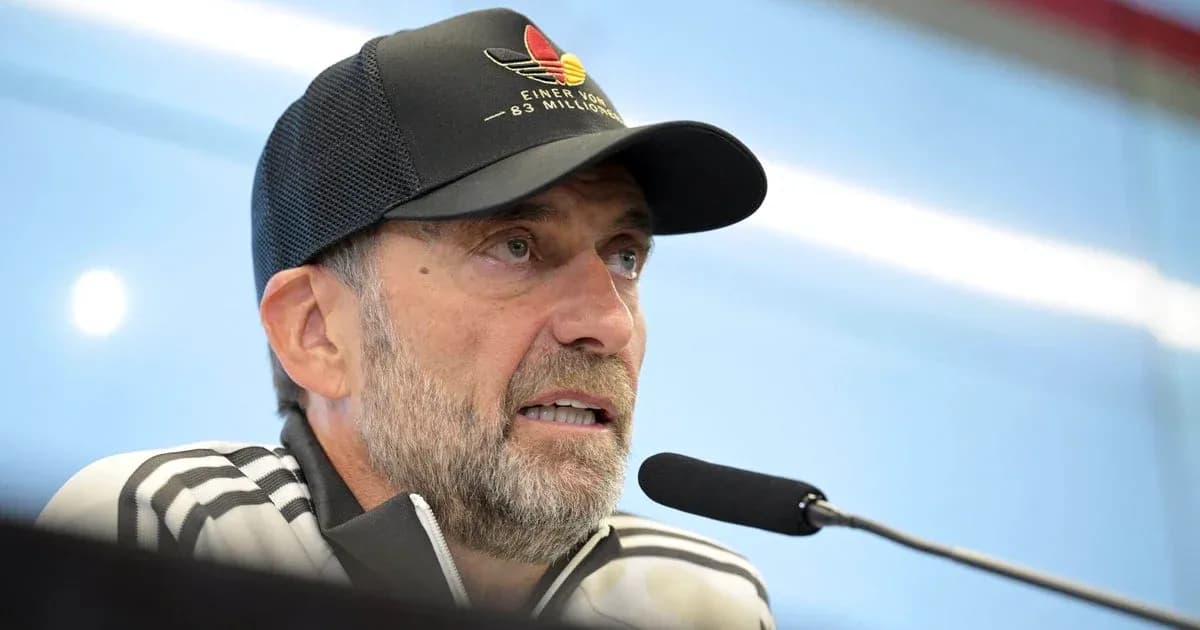
Klopp walked into his press conference wearing a baseball cap in black, red and gold, emblazoned with the words: “one of 83 million”. It was impossible to miss. It was not accidental.
Germany is living through a fractious political spell. The far-right Alternative für Deutschland (AfD) party has surged in several regions, most recently in Saxony-Anhalt, where it claimed more than 43 per cent of the popular vote and a majority. That result did not come out of nowhere. AfD support has been climbing for years at both state and federal level, feeding off anger, division and economic frustration.
Klopp’s cap dropped straight into that conversation.
Asked about its meaning, he spoke of unity, joy and reclaiming national symbols. He said he wanted people to feel “happy and fortunate” to live in Germany, to take pride in the flag without ceding it to those who preach exclusion. He stressed that national pride should not belong to “the wrong people”, and that football’s role is to create a sense of community, to make people feel better – but only if the public is willing to embrace that atmosphere.
The message cut deeper than a simple slogan. In Germany, patriotism is never a light topic. The legacy of national socialism hangs over every discussion of flags, anthems and national identity. As the country becomes more diverse and grapples with multiculturalism, the meaning of those symbols shifts. For some, they represent inclusion and shared values. For others, they are tools to be twisted into aggressive nationalism.
That tension reflects a broader divide. Germany is a federal state built on strong regional identities, each with its own reading of the country’s political and social changes. The result is a patchwork of competing visions of what Germany is – and what it should be.
Into that landscape steps Klopp, cap on head, squads on paper, trying to bind 83 million people to a team again.
He cannot heal a nation with a Nations League campaign. But if his selections and his symbolism are any guide, he intends to make every minute Germany spends with this team feel like it belongs to everyone, not just those shouting loudest.