.svg&w=384&q=75 "Naijagoal logo")
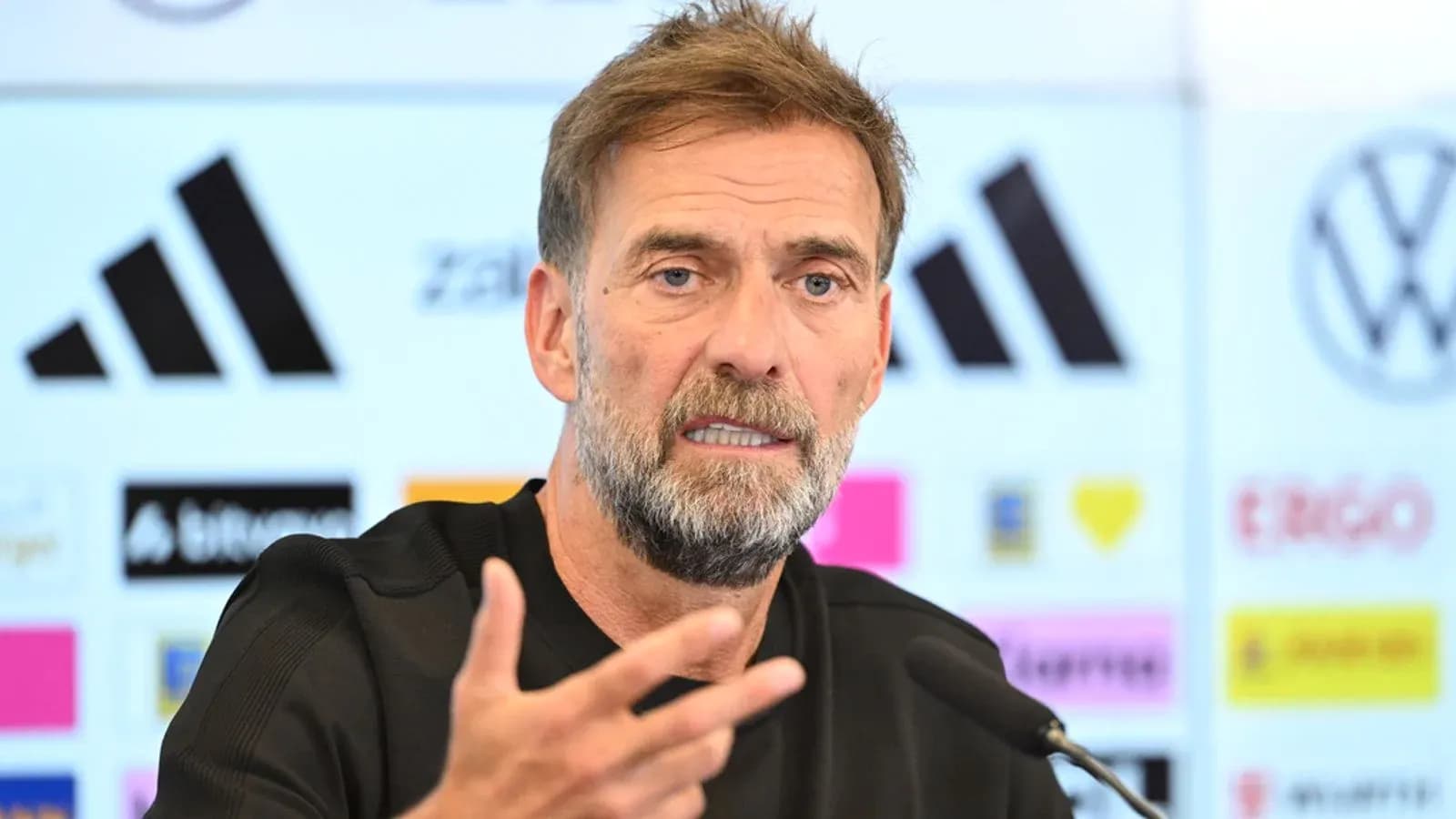

Jurgen Klopp Appointed Head Coach of Germany
Jurgen Klopp has been handed the job German football has circled around for years. Now it’s his.
The former Liverpool manager has been appointed head coach of Germany on a deal running through to the end of the 2030 World Cup, a seismic move that drags one of the game’s most charismatic figures back from the boardroom and into the technical area.
Klopp walked away from Anfield in 2024, worn down, as he put it, by “running out of energy” after nine relentless years that brought six major trophies, including the Premier League and Champions League. After a six‑month pause, he resurfaced not on a touchline but in a suit, becoming Red Bull’s head of global soccer and insisting he had no appetite to jump back into club management.
The national team has changed that calculation.
A warning with the handshake
Unveiled on Friday, Klopp did not arrive with soft words or romantic promises. He arrived with a warning.
He made it clear that the job comes on his terms, and that those terms include a line of protection around his family and an unforgiving view of failure.
“It is my mission to make the national team squad a better team and hope the pool for me to choose from will be bigger, but it is not something I am doing against you, I am doing it for you. It is an honour,” he said, before the tone hardened.
“I will be remunerated very graciously and if tomorrow Jurgen Klopp is s***, I will be gone. But if the DFB says let us discontinue the job, then that's it. And if you behave badly and don't let my family in peace, I'll be gone. I'll just turn away. I know there are other countries where national team head coaches are treated even worse. I love this job but I am also ready to call it quits if needs be.
“Jurgen Klopp is not going to have any ‘career’ after the national team. This is the pinnacle, the high point of my footballing career as a coach. I will give everything I've got, and I have the best possible assistant coaching team.”
No safety net. No talk of legacy beyond this role. For Klopp, Germany is the summit.
Resetting what “success” means
The euphoria around his appointment was instant. In German football, Klopp has long been seen as the dream ticket: a serial winner with a bond to the country’s football culture and a style built on intensity and emotion.
He moved quickly to puncture the idea that his mere presence guarantees trophies.
“Jurgen Klopp being in the job doesn't automatically mean we're going to be world champions,” he said.
For him, the battle starts with expectations.
“Success is performance vs expectations. We need a new set of expectations. Many people have asked themselves, are we as good as France? If the answer is no, then that is not necessarily true. If the question is, do we have players like Dembele, Barcola, Mbappe? Then the answer is no, we don't, but we can still beat them.
“We don't want to play like Argentina, Spain, England or France. We want to play like Germany, do it the German way but very intense. Are we the number one team at the moment? No, we aren't; I accept that. Would we be happy to be the number two team? Then people would say we aren't number one.
“At the moment, we have 11 teams ahead of us. Yes, we can beat them, but for this to happen, you need to play very good, intense football.”
That is the core of the Klopp project: reclaiming a German identity, not copying the current champions of the world or Europe, and doing it with the kind of ferocious, high‑octane football that made his Dortmund and Liverpool sides so feared.
First call, first choice
When Julian Nagelsmann stepped down after a World Cup campaign that fizzled out in the last 32 with a penalty shoot‑out defeat to Paraguay, the DFB did not cast a wide net. They went straight for Klopp.
He said yes.
His first assignment is not a gentle introduction. Germany open the new era against the Netherlands in the Nations League on September 24, a fixture heavy with history and scrutiny. The noise around that night will be huge. So will the expectation that something will look different.
On the bench beside him will be familiar faces. Former Liverpool assistants Pep Lijnders and Peter Krawietz join the staff, reunited with the man they helped drive to the top of European football. Sven Bender, who played under Klopp at Borussia Dortmund and understands the demands of his system, is also on board.
Off the pitch, the structure is shifting too. Per Mertesacker, who left his role as Arsenal’s academy manager at the end of last season after eight years in north London, will become Germany’s sporting director in January, replacing Andreas Rettig. A World Cup winner stepping into a key strategic role, just as Klopp takes charge on the grass.
It is a clear attempt to align coaching, identity and long‑term planning around one vision.
The last great job
Klopp’s Liverpool CV is already etched into modern football history: Champions League, Premier League, Club World Cup, FA Cup, and the League Cup twice. He turned a restless giant into a machine and went toe‑to‑toe with one of the greatest club sides of the era.
Now he calls this role “the pinnacle”.
There will be no club comeback, no late‑career tour. The national team is his final act.
Germany have turned to the coach who thrives in chaos, who embraces pressure, who demands that players run and believe until their lungs burn. He has laid down his own conditions, stripped away illusions and pointed directly at the work ahead.
The question now is simple: can Jurgen Klopp drag a fallen heavyweight back to the top of the world one last time?