.svg&w=384&q=75 "Naijagoal logo")

José Mourinho Returns to Real Madrid: A New Era Begins
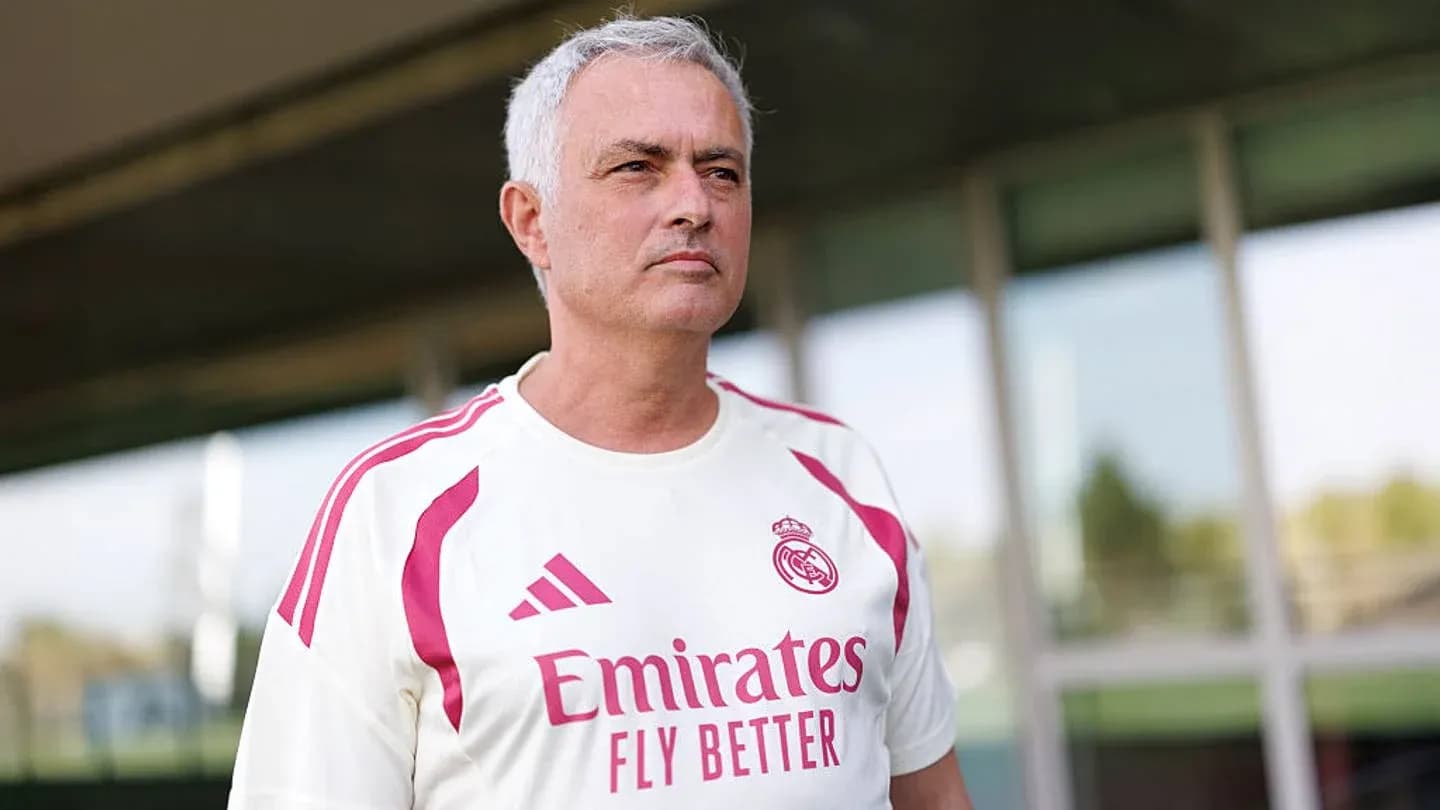
The gates at Valdebebas swung open this week to a familiar figure and a very different Real Madrid.
José Mourinho is back in white, back in charge, and back in his natural habitat: a training pitch where reputations mean less than running stats and defensive shape. Preseason has barely started, but the tone is already clear. This is an audition.
World Cup commitments and injuries mean the squad is thin for now. Several of Madrid’s biggest names are still on the beach, others are in treatment rooms, and some are only pencilled in to return over the coming weeks. The players who did report on July 13, though, have been handed a priceless head start.
They are the first to feel the new regime. The first to impress him. Or the first to fall behind.
Mourinho has arrived with a revamped staff, including former Madrid midfielder Sami Khedira, and a brief that could hardly be harsher: restore a winning mentality at a club that has gone two full seasons without a major trophy. Standards will spike. Patience will not.
For a handful of players, this summer is not just about fitness. It is about survival.
Trent Alexander-Arnold: Talent versus tolerance
Trent Alexander-Arnold was one of the early birds.
Left out of Thomas Tuchel’s England squad for the World Cup in a decision that dominated headlines, he had no tournament to extend his summer. So he was back at Valdebebas on day one, lacing up while many of his teammates were still posting holiday photos.
His first year in Madrid was solid rather than spectacular. There were flashes of the passing range that made him a star at Liverpool, some sharp deliveries, some clever combinations. But the familiar doubts followed him to Spain. Concentration without the ball. Positioning in transition. The defensive lapses that managers notice even when fans prefer not to.
Now comes a manager who notices them more than most.
Mourinho has never hidden his dislike for defenders who freelance tactically or drift from their assignments. With Denzel Dumfries signed to compete directly for that right-back berth, Alexander-Arnold’s margin for error has shrunk. Preseason offers him a clean slate, yet it also exposes him to a coach who will not indulge old habits.
He has the ball at his feet. He has a rival in his mirror. How he defends over the next few weeks may decide how much he attacks once the season starts.
Dean Huijsen: A window of opportunity
Dean Huijsen should, by rights, be exhausted right now. He could easily have been in the final days of a World Cup run with Spain.
Instead, he is back in Madrid early, the victim of a tight call from Luis de la Fuente. The national team coach left him out of the final squad in favour of Atlético Madrid’s Marc Pubill, a decision that underlined how narrow the margins are at the top level.
Huijsen’s season for Madrid was a mixed bag. There were raw, nervy moments in a back line that creaked in the biggest matches of 2025–26, but also clear glimpses of why so many see him as a future pillar at centre-back: composure on the ball, height, the right instincts.
The problem? Mourinho’s defensive rebuild is already under way.
Ibrahima Konaté, Marc Cucurella and Dumfries have arrived, and at least one more reinforcement is expected. History says Mourinho leans on experience at the back, especially when trying to fix a fragile team. Young defenders often have to wait, or leave.
Yet the World Cup has unexpectedly opened a door. Konaté is away with France. Éder Militão is still sidelined. For the first friendlies of the summer, Huijsen will have space to breathe and minutes to burn.
If he looks jittery, the club’s transfer plans will gather pace around him. If he looks ready, he might just force Mourinho to rethink the hierarchy before it is fully written.
Eduardo Camavinga: Between exit rumours and a reset
Eduardo Camavinga is another early returner, and another player whose status at Madrid feels strangely blurred.
Omitted from France’s World Cup squad despite his pedigree, the midfielder has endured a stop-start spell in Spain. Once seen as a cornerstone of the club’s future, he has regressed in recent seasons, slipping from automatic starter to rotation piece, from untouchable prospect to potential sale.
Clubs in England have been linked. None have truly moved.
So he runs. He presses. He trains under a coach whose view of him is not yet fixed.
Camavinga wants to stay. That much is clear from those around him. What is not clear is where Mourinho sees him. A disciplined partner in a double pivot? An energetic option off the bench? Or a valuable asset in a market that could help finance the rebuild?
With so many midfield rivals still away on international duty, this is his window. Every drill, every tactical session, every friendly is a chance to show Mourinho the version of Camavinga that once thrilled Europe, not the one who drifted in and out of games last year.
If he cannot convince the new boss now, when the squad is thin and the slate is relatively clean, when will he?
Brahim Díaz: From national hero to club question mark
Brahim Díaz will arrive later than most, and with a different glow.
For Morocco, he has become a leading man. His performances in their run to the World Cup quarterfinals were electric at times, full of risk and responsibility. The ball kept finding him in the tightest moments. His teammates kept trusting him.
At Madrid, the picture is far less clear.
At 26, he has delivered bright cameos and the odd decisive contribution, but he remains filed under “useful squad player” rather than “undroppable starter.” That status is under review now, and not just because of Mourinho.
Rodrygo Goes is still recovering from an ACL injury, leaving a vacancy on the right side of the attack in Mourinho’s preferred 4-2-3-1. There is a role there for someone who can both threaten goal and work relentlessly without the ball.
Díaz has just lived the intensity of a World Cup knockout run, only knocked out on July 9. He will have a short spell to rest, reset, and then report. Once he does, he walks into a preseason where that right-wing slot is one of the few genuinely open battles.
For once, his international status might give him the confidence to demand more at club level. The question is whether he can sustain that level of influence when the shirt is white, not red and green.
Arda Güler: Trust on the phone, doubts on the board
Arda Güler’s World Cup was brief. Türkiye fell at the group stage, and his tournament ended early. His summer break will be shorter than most, and he is expected back at Valdebebas as soon as next week.
On the international stage, there is no debate. Güler is central to his country’s plans, the creative hub, the player who makes things happen.
At Madrid, his place is anything but secure.
Mourinho’s tactical preferences complicate the picture. Does Güler have the physical power and defensive discipline to function in a two-man midfield? If not, can he survive as a wide player in a system that demands constant running and tracking? The No.10 role, the natural home for his gifts, appears locked down by Jude Bellingham.
Then there is the looming presence of Bernardo Silva, whose signing fits every Mourinho template: experienced, tactically mature, industrious, and reliable. If the Portuguese playmaker slots into the attacking band, Güler risks being squeezed from multiple directions.
One detail offers a different tone. According to SPORT, Mourinho picked up the phone after Türkiye’s elimination and called Güler personally, offering words of confidence.
That call matters. It signals intent. But words in July are one thing; team sheets in August and September are another. Güler now has to turn that private reassurance into public trust, and he has only a few weeks of preseason to make the case that his talent is too rich to ration.
Endrick: Between hype and hard reality
No player in this squad splits opinion quite like Endrick.
To some, he is a once-in-a-generation forward, a teenager destined to bend games to his will. To others, he is a meme, a weekly barometer for overreaction on social media. His half-season at Lyon did little to calm the noise: 16 goal involvements in 24 matches, flashes of brilliance, and enough inconsistency to feed both camps.
Brazil still believed. They took him to the World Cup. Madrid, under Carlo Ancelotti, were more cautious. Opportunities were limited, much to the frustration of those who saw him as a symbol of the club’s future.
He is still only 19. That matters. So does the fact that, according to reports, another loan is not planned for this season. He will be in the building. He will be in the squad. The question is how high up the pecking order he can climb.
This is where Mourinho comes in.
The Portuguese coach has been sceptical of hype before, but he has also nurtured young attackers when they proved they could handle his demands. Preseason will be Endrick’s laboratory and his courtroom. Every run in behind, every press, every decision in the box will be logged.
He needs to turn curiosity into conviction. He needs Mourinho to see more than a prospect, more than a marketing asset. He needs him to see a striker he can trust when the season turns cold and brutal.
The sun is out at Valdebebas, but the mood is anything but leisurely. A new manager, a new staff, a squad in flux, and six players staring at a crossroads.
By the time the last of the World Cup stars walk back through the door, Mourinho will already have formed his first impressions. For Alexander-Arnold, Huijsen, Camavinga, Díaz, Güler and Endrick, these quiet July sessions might end up defining their entire season.
At a club that measures success in trophies, not promises, who will still be standing when the real games begin?