.svg&w=384&q=75 "Naijagoal logo")

Jose Mourinho's Departure from Chelsea: A Heartbreaking Goodbye
The day Jose Mourinho walked into the Chelsea dressing room to say goodbye did not feel like football. It felt like a bereavement.
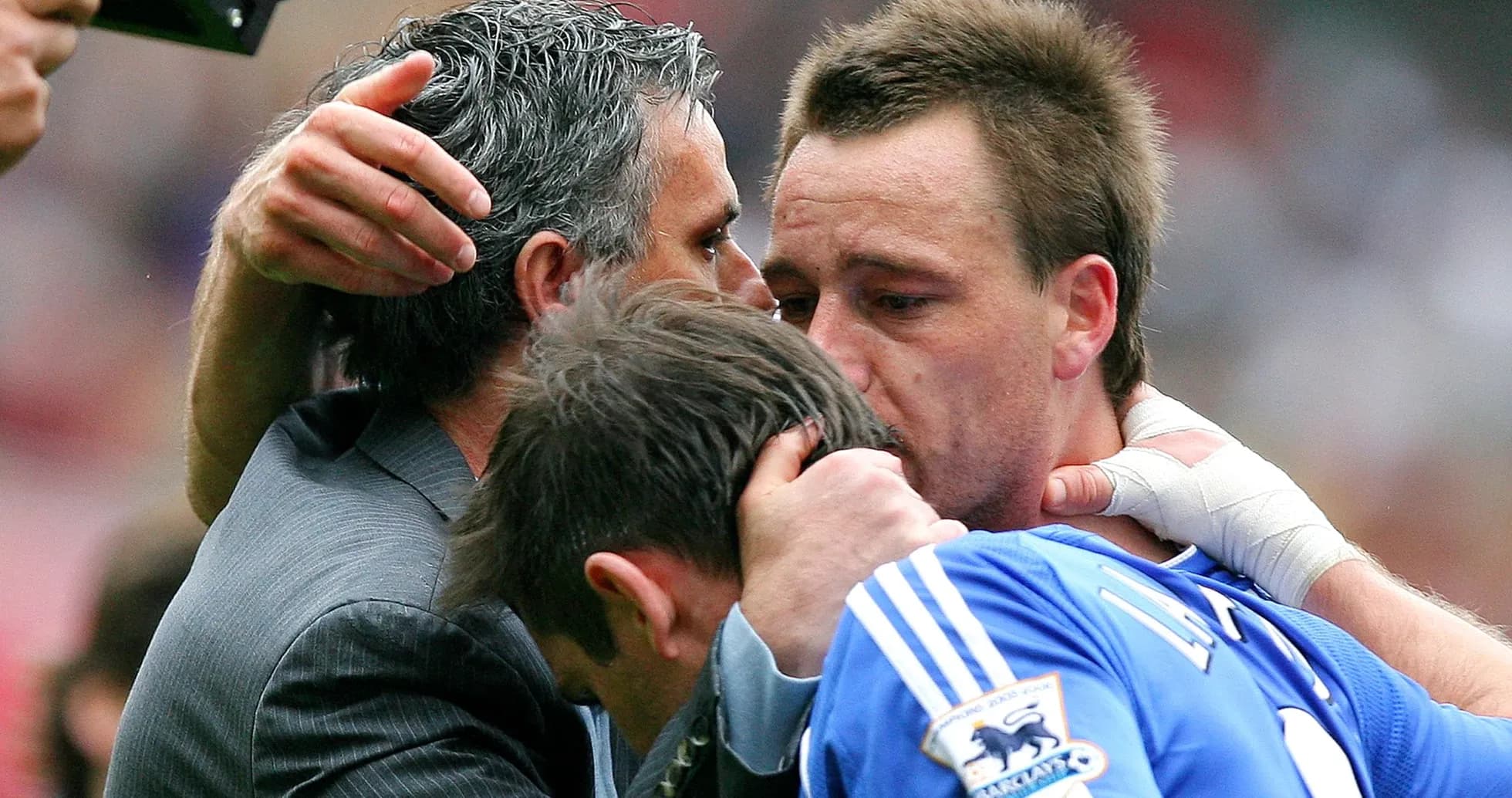
Frank Lampard still sees it clearly. The door opened, Mourinho stepped in, and the room – a place usually filled with noise, banter, and adrenaline – fell into a stunned silence.
"I remember him coming into the dressing room and he said to me that he’d been sacked," Lampard recalled. In that instant, the medals, the trophies, the tactical meetings all blurred into one simple truth: the man who had defined their careers was gone.
"I couldn’t think about how much this man had helped my career, how much I loved working with him," Lampard said. "There were tears, which is not normal in the dressing room when a manager leaves."
These were not academy kids or fringe players breaking down. These were hardened professionals at the peak of their powers, men who had won titles and stared down the biggest nights in Europe. Yet Mourinho’s departure cut through all that bravado.
John Terry felt it just as deeply – and still carries the weight of it.
"I would leave that pitch in a coffin for him," the former captain said, his admiration undimmed by time. The image is stark, but it captures the hold Mourinho had on that Chelsea squad: absolute loyalty, bordering on devotion.
"You’ve got grown men, tears running down their face, not really understanding why," Terry added. "And even still today I’m like, that’s my fault."
The moment that haunts him is not a final, not a title decider, but a 1-1 Champions League draw against Rosenborg – a result that helped trigger Mourinho’s dismissal.
"When we drew the Champions League game, my man scored," Terry said. "If I didn’t let that person score, would he have lasted another couple of years? Who knows? I still feel kind of responsible for that, if that makes sense."
It does make sense, in the uniquely brutal logic of elite dressing rooms. One mistake, one lapse, and the dominoes fall. Terry has replayed it often enough.
"It’s just disappointing how it all ended, if I’m honest," he said. "I absolutely loved him and adored him and was more upset than anyone, to be honest."
While the players wrestled with guilt and grief, Mourinho saw a different story unfolding above his head. The bond that had once existed between himself, chief executive Peter Kenyon and owner Roman Abramovich – the tight triangle that powered Chelsea’s rise – had started to fray.
"In my work, the triangle: Jose, Peter Kenyon, Roman was invaded by strangers," Mourinho revealed. That was the shift. Not on the pitch, but in the corridors and executive boxes.
"In the beginning, you play at Stamford Bridge, you look to the box, Roman, his wife, with one or two persons of his confidence," he said. "A few seasons later: former players, agents. These kinds of people, they know where the money is."
The owner’s box, once a symbol of clarity and control, became crowded. More faces. More voices. More opinions on football matters that Mourinho believed should remain his domain. The purity of that original working relationship dissolved into something murkier.
The tension did not only surface in boardrooms or transfer meetings. It seeped into moments that bordered on the surreal.
Mourinho recalled one episode that underlined just how far expectations had drifted from the professional to the personal. Abramovich, away in Sardinia, had a request.
"I think Roman changed," Mourinho said. "For example, one day Peter came to me quite embarrassed and he told me, 'Jose, I have to tell you something. The boss is in Sardinia with these boats, and the people that work in these boats they play football against guys from the hotel, and they are losing. Can you go there to win a game for him?'"
It sounds like a joke. It wasn’t. The owner wanted his manager – one of the most sought-after coaches in world football – to drop everything and fly out to rescue a kickabout on a luxury yacht.
Mourinho’s answer was as blunt as his touchline persona.
"'No, Peter, I have training today. I have to prepare for tomorrow; I cannot go'," he replied.
"And he was not happy with that."
That refusal, trivial on the surface, spoke to a growing disconnect. Mourinho saw his duty to the team, to the next match, to the work. Abramovich, increasingly, saw a different kind of relationship – one where the manager’s loyalty extended far beyond the technical area.
The tears in the dressing room told one story: players devastated by the loss of a leader they adored. The stories from the boardroom and the owner’s yacht told another: a power structure slowly twisting out of shape.
Between those two worlds, Mourinho stood alone.