.svg&w=384&q=75 "Naijagoal logo")

Jacob Bergström: From Subway Worker to Swedish Champion
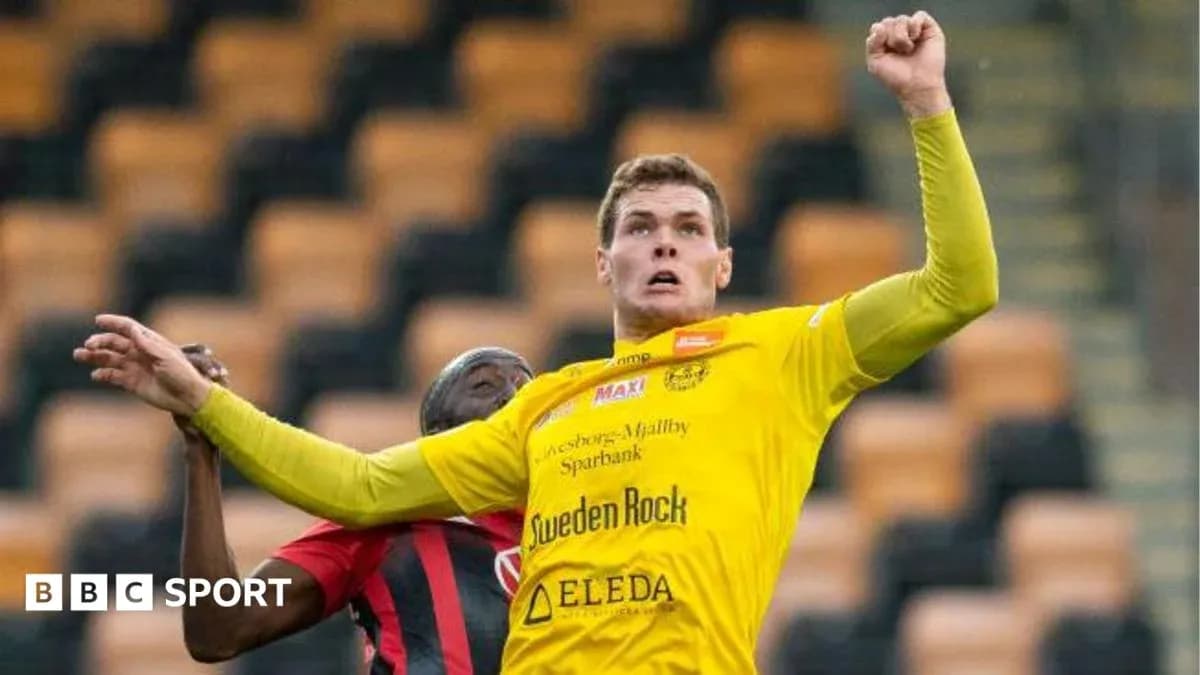
On a bike, past the boats and the holiday cabins, through a village that goes quiet in winter and roars in yellow and black in summer, Jacob Bergström rides towards the Champions League.
This is not how these stories are supposed to start. Not at 31. Not from a Subway counter. Not from Sweden’s third tier.
Yet here he is.
From sandwich shop to Swedish champion
Bergström was never a prodigy. No academy badge, no fast track, no slick highlight reels as a teenager. At 22 he was still playing amateur football, working at Subway to pay the bills. Even when Mjällby came calling in 2018, the dream did not immediately turn into a full-time job. He did not become a professional until he was 24.
Now he is the centre-forward of the most unlikely champions in Sweden.
Over the past year, the burly 6ft 3in striker has helped Mjällby to the first league title and first Swedish Cup in the club’s 87-year history. A village side, from a sliver of coast in southern Sweden, suddenly sitting on top of the domestic game.
And then came Europe. Bergström scored on his Champions League debut. The man who once wondered if football would ever be more than a side hustle is now preparing to face Slovan Bratislava, led by a coach who has lifted the Champions League trophy itself: Yaya Touré.
“When I first came here, we were in the third division,” he told BBC Sport. “I was so happy to sign. It was so big to me then. I never dreamed of anything like this… For me to be here now is crazy, and to do it with Mjällby as well is amazing.”
Crazy is one word. Fairytale is another.
A village on the edge of Europe
Mjällby’s story has travelled far, not just because of what they’ve won, but where they come from.
The club is based in Hällevik, a quiet coastal village in Blekinge with fewer than 1,000 permanent residents. In winter, it is a fishing community with long, empty stretches of beach and a stillness that doesn’t feel like the staging ground for Champions League qualifiers. In summer, holidaymakers pour in and the population can quadruple.
It is here, in this unlikely outpost, that Sweden’s champions live and train.
As the dominant club in Blekinge County, Mjällby draw fans from across the region. They averaged home crowds of around 5,000 last season – five times the population of the village itself. Yellow and black shirts spill in from every corner of the county.
Bergström grew up an hour north in Karlskrona, the naval city where handball and ice hockey usually elbow football aside. After a short spell in the capital with Djurgården, he came back in 2023, this time properly committing to the village that had already changed his life. He moved to Hällevik with his wife and their two children. Now it is home.
It suits him. The slower winters. The packed summers. The rhythm of a place that can feel almost deserted one month and then suddenly alive the next.
“You have the ocean and the people,” he says. “It’s so beautiful by the water and the beach. In the winter there’s not many people here, so it doesn’t fit for everyone, but it fits for us.”
The bike, the beer and the megaphone
Strandvallen, Mjällby’s home, sits just 100 metres from the Baltic Sea. A few trees, a campsite, an outdoor swimming pool, and then the pitch. On matchdays, Bergström cycles there. No tinted windows, no security detail. Just a bike and a short ride through a village dressing itself in yellow and black.
He still cycles on European nights. Fans still bump into him in the local supermarket. Stardom has not insulated him from the place that made him.
The supporters see themselves in him. A late bloomer. A worker. A man who looks like he could just as easily be on the terrace as leading the line. He embodies the underdog mentality of the rural communities around Blekinge.
He also plays the part with relish. He once celebrated in front of Malmö fans and stood his ground as they showered him with beer, later joking that “it tasted very good”. After a win over Mjällby’s big-city rivals last season, he grabbed a megaphone and led the away end in a chant of “whoever doesn’t jump is a Malmö pig”.
This is not a distant professional. This is one of them, just in boots and a number on his back.
A village steps onto the European stage
Mjällby’s first European night at Strandvallen, against Lincoln Red Imps of Gibraltar, felt less like a routine qualifier and more like a festival. Around 3,500 squeezed into the ground. Another 2,300 set up at Hällevik’s marina with deckchairs and cool boxes, watching on a big screen as if it were a summer film night.
A jazz band greeted fans. The air felt different. A village that usually counts its residents in hundreds was suddenly playing host to the Champions League anthem.
“[Playing in Europe] is special for the whole village and for everyone here at the club,” Bergström says. “Every time I take my bike to the game, I see all the people in their yellow and black shirts. Everyone has flags in their garden. It’s so fun to see everyone get together. They are so proud to be part of this journey we’ve made together.”
A 0-0 draw in Gibraltar was enough to send Mjällby through to the third qualifying round. The reward: Slovan Bratislava, 24-time champions of Slovakia, and the first managerial posting of Yaya Touré.
Yaya’s long road to Strandvallen
Touré, now 43, has seen the Champions League from the inside. He won it with Barcelona in 2009 at Rome’s Stadio Olimpico. He helped Manchester City build their modern era. He has played in some of the sport’s grandest arenas.
Tuesday’s first leg at Strandvallen will be something else entirely.
Away teams rarely enjoy the trip to Hällevik. It is a long drive through flat farmland, tractors rolling past with Mjällby flags fluttering in the wind. There are no grand boulevards, no towering stadium looming over a city skyline. Just fields, then forest, then suddenly a ground pressed up against the Baltic.
The stadium itself is modest, but the noise is not. On European nights, the hardcore fans are relocated to the biggest seated stand, concentrating the sound and turning the place into a small, swaying wall of yellow and black.
Touré has already admitted Mjällby have “something that other teams don’t have”. He will feel it when he steps out in front of a crowd that knows exactly what is at stake: a shot at the Champions League play-offs, the brink of the group stage.
For Mjällby, it is a meeting with a club that has dominated its domestic league. For Bergström, it is another surreal chapter – from amateur pitches and sandwich counters to a technical area occupied by one of the modern game’s great midfielders.
The fairytale keeps running
Even if Mjällby fall short against Slovan Bratislava, this is not the end of the road. Their domestic success has already guaranteed them a place in at least this season’s Conference League. More European nights await. More stars to face. More journeys from the marina and the campsites to that little ground by the sea.
Bergström will still climb on his bike. The village will still hang its flags. The Baltic will still sit just beyond the stand, quiet and cold.
The world’s biggest club competition will move on to its usual superclubs and superstars. But on this stretch of Swedish coastline, a 31-year-old latecomer to the professional game has already bent the script.
The Champions League is supposed to belong to the giants. For a while yet, it also belongs to Hällevik.