.svg&w=384&q=75 "Naijagoal logo")

Iraola's Challenge: Managing Liverpool's Fixture Congestion
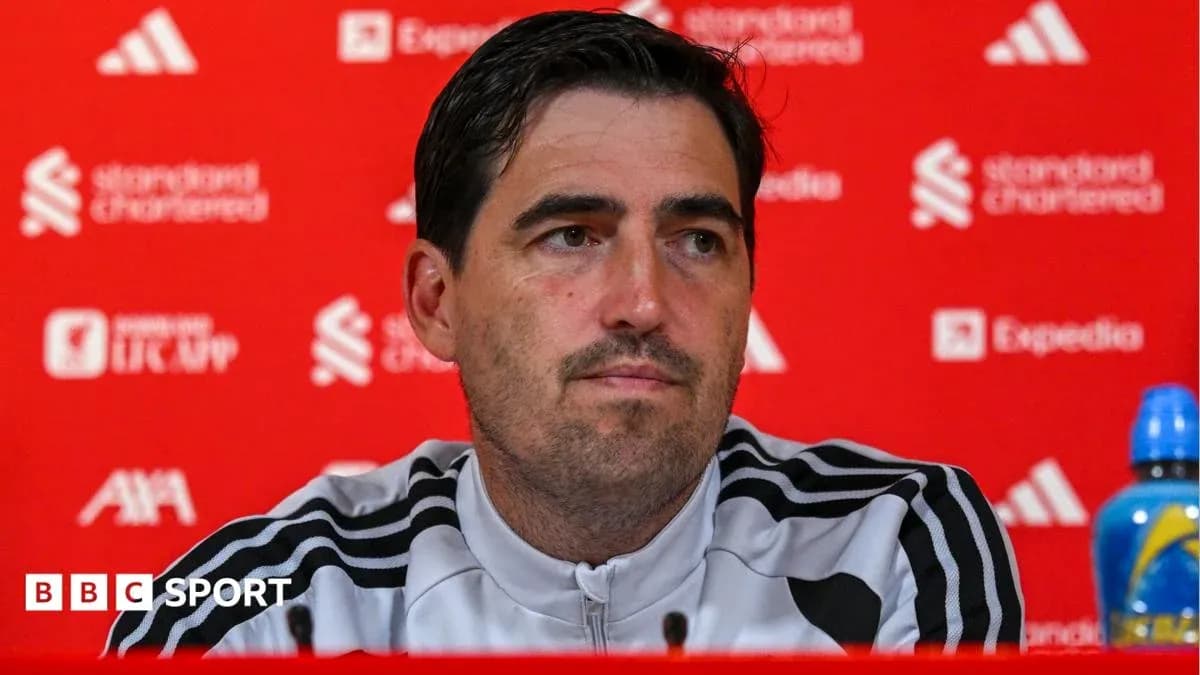
Andoni Iraola has barely had time to unpack at Liverpool, but the fixtures haven’t waited for him. Atletico Madrid on Wednesday, Fulham on Saturday, Tottenham in the Carabao Cup on Tuesday. The games are coming like waves, and the new head coach is already working out who can swim.
Asked if he can simply pick his strongest XI every time, Iraola didn’t dress it up.
“No,” he said. “You can decide and put the same players in every game. The problem is there’ll be a moment when they’re really tired. And there is more risk of injury.”
That’s the reality he’s walking into. Some players, he knows, can go every three days and barely flinch. “They are very robust, their performances don’t change too much.” Others feel the strain. Their level dips, the risk spikes, and Liverpool’s new boss is still discovering who falls into which category.
“I have to learn who is ready to play games every three days and who needs a rest so their performance level isn’t affected,” he admitted. With some, he thought he already knew. With others, this schedule is exposing them – “it’s new, even for them, because they haven’t played as many games. We are learning.”
And now comes Tottenham at Anfield in the Carabao Cup. No gentle easing into the competition, no lower-league opponent to blood youngsters and fringe players. Just another Premier League side, one with its own problems but still dangerous enough to punish any miscalculation.
So Iraola has a choice. Rotate heavily and risk another stuttering display, or lean on his stars again and gamble with fatigue in September. After back-to-back home draws in the league, plenty inside Anfield will be tempted by the idea of a statement performance and a strong side. Others will look at the Champions League schedule, the league grind and Tuesday’s tie, and argue the opposite: protect legs now or pay later.
Either way, the learning curve for Liverpool’s new man in the dugout just steepened.
A Cup Steeped in Red
If any competition feels like it belongs to Liverpool, it’s this one.
Ten League Cup trophies sit in the club’s history, more than anyone else. The first came in 1980-81, the start of a remarkable run of four in a row that finished in 1984. Back then, the Reds treated the competition like a habit they couldn’t kick.
Then came a wait. Over a decade passed before number five arrived, Steve McManaman scoring twice against Bolton at Wembley in 1995 to drag the trophy back to Merseyside.
The new millennium brought another burst. Gerard Houllier’s side lifted it in 2001, then again in 2003, that seventh success coming against Manchester United in a final that mattered far beyond the silverware itself.
Kenny Dalglish, back for a second spell in charge, added the next one in 2012. Cardiff City pushed Liverpool all the way to penalties, but the Reds survived the shootout and climbed the steps once more.
Then came another long pause. The club’s next League Cup didn’t arrive until 2022, in a final that felt like it might never end. Jurgen Klopp’s Liverpool edged Chelsea 11-10 on penalties in an extraordinary shootout, Caoimhin Kelleher and Kepa Arrizabalaga at the heart of the drama.
Two years later, Klopp signed off from the competition with a 10th triumph, again at Chelsea’s expense in 2024, the last League Cup he added to the Anfield cabinet.
Now Iraola inherits that legacy. The question is simple, and heavy: can he take Liverpool to number 11?
Tired Legs, Tired Minds: Anfield Feels the Strain
Two home games. Two draws. For only the third time in 63 years, Liverpool have failed to win either of their opening league fixtures at Anfield. It’s not a crisis, but it’s not the script anyone had in mind for the Iraola era.
The contrast with midweek was stark. Against Atletico Madrid in the Champions League, Liverpool were sharp, aggressive, relentless. Against Fulham, in a 0-0 draw, they looked like a side still stuck in the departure lounge after a long-haul flight.
The Cottagers arrived low on confidence, having conceded seven goals in their first three league games under Alvaro Arbeloa. They left with their first point of the season and the feeling they might have taken all three.
Liverpool, by comparison, looked drained. Physically and mentally tired, their play lacked the edge that had rattled Atletico. This was the first real glimpse of how Iraola’s high-intensity style copes with two matches a week. The answer, for now, is uncomfortable.
The numbers tell their own story. Six points from four Premier League games. Unbeaten, yes, but with four points dropped at Anfield against Nottingham Forest and Fulham, another draw at Newcastle and the only win coming away at Ipswich.
The new, heavyweight front line misfired. Alexander Isak, Bradley Barcola and Florian Wirtz started together in a league game for the first time, a £364m attacking trio that promised fireworks but rarely sparked. Liverpool had chances, but nowhere near enough for a side with such attacking investment.
Isak’s involvement was again worryingly low. Just 16 touches in 90 minutes – the second fewest by any outfield Liverpool player on record – after he recorded the fewest (14) against Forest a fortnight earlier. Wirtz, so bright in midweek against Atletico, faded into the background. Barcola and Isak showed flashes, but the chemistry between them will clearly take time.
Time, though, is exactly what the calendar isn’t offering.
Fulham Dig In, Liverpool Run Out of Ideas
Arbeloa, returning to Anfield as an opposing manager after 98 appearances for Liverpool between 2007 and 2009, arrived under pressure. Three league defeats from three, questions already swirling. He left with a clean sheet, a point and a performance that suggested his Fulham side might be tougher than their start implied.
Iraola made three changes from the midweek win. Kostas Tsimikas, Ryan Gravenberch and Victor Munoz came in for Milos Kerkez, Alexis Mac Allister and Rio Ngumoha. Arbeloa responded with two of his own: Austrian centre-back David Affengruber handed a debut in place of Joachim Andersen, and Sander Berge replacing Cesar Palacios.
Fulham almost punished Liverpool’s early sloppiness. A mix-up between Alisson and Gravenberch left Gonzalo Garcia with a golden chance, Jeremy Jacquet forced to hack the ball off the line to spare his teammates’ blushes. It was entirely Liverpool’s own doing and a warning they failed to heed.
The visitors grew into the half. Josh King tested Alisson from inside the box, Antonee Robinson headed wide, and Liverpool’s attacks stuttered. At the other end, Munoz forced a strong save from Bernd Leno with a header, while a Bradley Barcola volley was deflected behind by Timothy Castagne.
Iraola acted at the break. Kerkez replaced Tsimikas, who had struggled, and by the hour mark Gravenberch and Munoz made way for Mac Allister and Cody Gakpo as Liverpool’s head coach tried to wrestle control back.
Isak finally carved out a sight of goal, but Leno dealt with it comfortably. The Fulham goalkeeper then parried away a powerful strike from Dominik Szoboszlai, and with each save the tension inside Anfield grew.
On 72 minutes, Iraola rolled the dice again. Ngumoha and Jeremie Frimpong came on, more attacking thrust, more fresh legs. The pattern didn’t change. Isak headed wide from a stoppage-time corner, Fulham broke to threaten through King and Kevin, and when the whistle went Arbeloa’s side had their point.
Liverpool had their frustration.
Adapt or Fall Behind
This is the new reality for Iraola. At least seven more Champions League games to come, a Carabao Cup tie against Tottenham on Tuesday, the league campaign stretching out ahead. The schedule will not ease off.
He knows now that some of his players can’t simply be thrown out every three days and expected to reproduce the Atletico intensity. He knows his expensive front line is still a work in progress. He knows Anfield, so often a fortress, has already let four points slip.
The lesson is clear. Liverpool must adapt, and quickly, if they want this season to be about trophies rather than excuses. The next test comes under the lights, in a competition the club knows better than anyone.
Does Iraola trust his “robust” core again against Spurs, or start discovering who else is ready to carry Liverpool through a season that’s only just beginning to bite?