.svg&w=384&q=75 "Naijagoal logo")
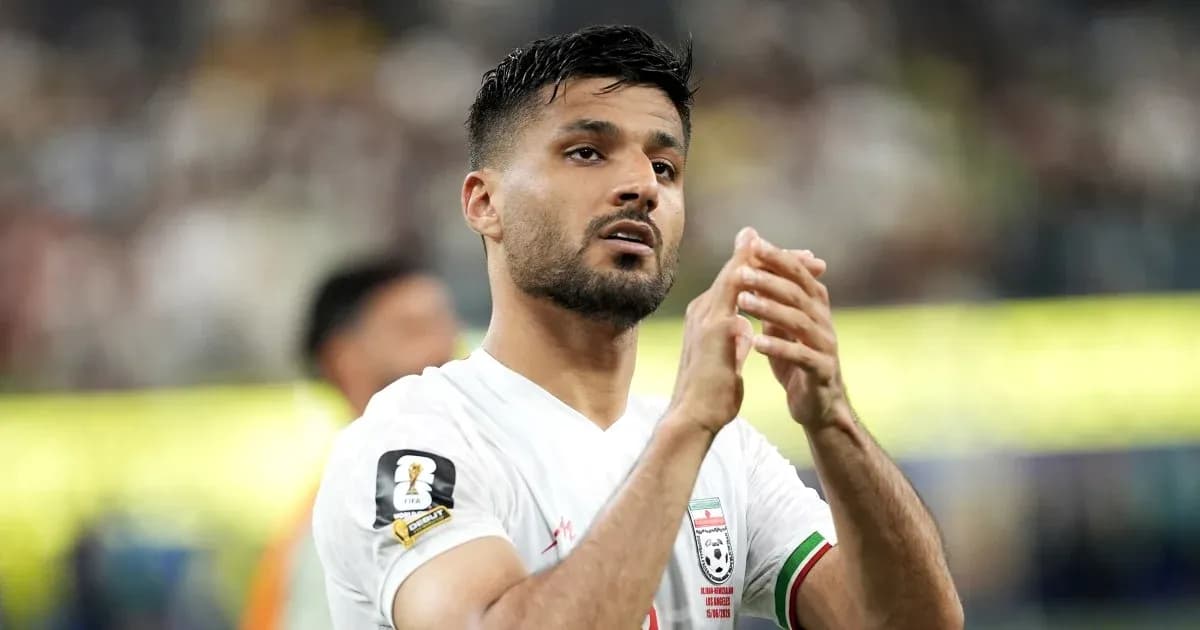

Iran's World Cup Campaign Faces Chaos After Draw
Iran’s World Cup campaign is barely one game old, and already it feels like a survival mission being run on someone else’s terms.
Just a few hours after clawing back a 2-2 draw against New Zealand in a politically charged opener at SoFi Stadium on Monday night, Iran’s players were told to get out of the United States and head straight back to their training base in Mexico.
No recovery session. No night in the hotel. No explanation.
“They didn’t even give us time to recover,” coach Amir Ghalenoei said through an interpreter. “After the game today, they said to us, ‘You have to leave immediately.’”
The plan had been simple: arrive in California two nights before the match, stay over after the game, then fly back to Tijuana at lunchtime on Tuesday. Instead, Iran’s squad was hustled onto a plane for the short but draining 140-mile trip south, their carefully laid schedule ripped up without warning.
“We are asked to get on a plane and return to our camp in Tijuana, and we are really troubled by that,” Ghalenoei said. “It seems like others are doing the planning for us. The decision-making for us is being made elsewhere.”
He never said who gave the order.
A World Cup played under a shadow
Nothing about this World Cup cycle has been normal for Iran. Since the U.S. and Israel began a war against Iran on Feb. 28, the team’s preparations have been shaken by politics, logistics and outright hostility.
Iran asked FIFA to move its three group-stage matches out of the U.S. That request was rejected. The federation decided to play on anyway.
The journey into Los Angeles for the opener underlined the strain. Captain Mehdi Taremi described a five-hour ordeal of travel and security checks on what should be a quick hop from Tijuana to the LA area.
By the time they kicked off against New Zealand, Iran looked like a team carrying more than just the weight of a World Cup.
“I think our team is perhaps the most oppressed in the World Cup,” Ghalenoei said.
Several key staff members never even made it to the tournament. The president of Iran’s football federation, coaching support staff, media officers — all denied U.S. visas, stripping away layers of support around a squad already operating in a storm.
“We have to leave Los Angeles right now, and it’s not good for us,” Taremi said about an hour after the final whistle. “I think FIFA have to help us more than this. ... Everything is like a disaster, actually, for us.”
Legs cramping, plans collapsing
On the field, the toll showed in small but telling ways.
The match unfolded in mild conditions, but several Iranian players suffered cramps. Ghalenoei pinned it on the disrupted build-up, the late arrivals, the constant back-and-forth across borders.
“Before the game, I said we haven’t had time to adjust because of the travel,” he explained. “Many of our players, they had cramps, and that’s why we had to substitute them. So it wasn’t for technical reasons that we made substitutions. It was because of the injury and because of the cramp.”
Now, with players due to be examined by the technical staff on Tuesday, the coach is watching the same pattern repeat: delayed arrivals, forced early departures, recovery windows squeezed to nothing.
“They are making the situation more difficult,” he said.
A draw that felt like both a rescue and a warning
Strip away the politics for 90 minutes, and the football itself had a wild, compelling edge.
Iran, ranked 65 places above New Zealand in FIFA’s rankings, expected to start with authority. Instead, Elijah Just struck early in each half, twice putting New Zealand in front and threatening to turn Iran’s opener into a damaging upset.
The response said plenty about the players’ resilience.
Ramin Rezaeian dragged Iran back into the game in the first half, steering in a clever finish with the side of his boot. Then, with the pressure rising and the pro-Iranian crowd roaring them on, Mohammad Mohebi met a perfect cross from Rezaeian and powered home a header in the 64th minute to make it 2-2.
Iran had salvaged a point. The relief inside SoFi was obvious.
Yet the result still stung. For a team chasing its first-ever progression from a World Cup group, dropping points to the lowest-ranked side in the group — and doing so after twice falling behind — was a reminder of how thin the margins will be.
A divided crowd, a united noise
The backdrop in Los Angeles was unlike almost any other World Cup match.
Outside the stadium, several hundred Iranian Americans protested against the government in Tehran. Inside, the tension seeped into the pre-match rituals. Some fans from the diaspora jeered and turned their backs during the national anthem, a stark, visible rejection of the regime.
Once the ball rolled, the mood flipped.
The vast majority of the crowd roared for the players, not the politics. With Los Angeles home to the largest population of Iranians outside Iran, SoFi Stadium felt like a temporary outpost of Tehran.
“It was an incredible atmosphere in the game, all 90 minutes,” Taremi said. “It was like at home for us.”
Mohebi’s equaliser ignited that energy. His celebration, though, drew its own spotlight. He appeared to mime shooting a gun, sparking criticism online, before flashing the “ice in my veins” gesture popularised nearby by Los Angeles Lakers guard D’Angelo Russell, and then forming a heart with his hands to the stands.
“The Iranians who live in Los Angeles, they make a great atmosphere,” Mohebi said. He insisted the celebration was spontaneous. “That celebration, it comes in the mind, and I did like this” — motioning to his arm — “for all the fans. Just a celebration.”
After the final whistle, the tension eased. Players from both sides embraced, shook hands, swapped shirts. Ghalenoei sat alone in the dugout, watching as his squad walked the perimeter of the pitch, applauding thousands of flag-waving supporters who stayed to salute them.
Tougher tests ahead, with no margin for error
The group table could hardly be tighter: Iran, Belgium, Egypt and New Zealand all sit on one point after the opening round. On paper, Iran’s hardest work still lies ahead.
Next comes Belgium in Inglewood on Sunday. Then a trip north to face Egypt in Seattle next week. Both opponents carry more pedigree and more firepower than New Zealand. Both will sense vulnerability in a side whose off-field battles keep stacking up.
“We’re facing more hurdles, but we’re not going to let that stop us from doing our best,” Ghalenoei said. He called the New Zealand match “one of the best games in the World Cup so far,” convinced that fans inside and outside the stadium had been gripped by the spectacle.
The question now is simple and brutal: with travel orders, missing staff, political pressure and physical strain closing in, how long can Iran keep turning chaos into resistance — and can that be enough to finally break their World Cup ceiling?